Colorado Mule Deer Draw Odds With One Point 2027
Colorado's 2026 primary draw offered nonresident mule deer hunters with one preference point realistic shot at dozens of hunt codes, including second-rifle tags in units 48, 51 and 41, where the nonresident drawn-out level sat at exactly one point. Residents with one point drew tags in codes like GMU 16 first rifle, GMU 6 muzzleloader and GMU 59 archery, among others. The 2027 draw hasn't run yet, and quotas will change, but the 2026 data shows where to start your planning.
Do I Need Points to Draw a Colorado Mule Deer Tag?
No. Colorado's 2026 deer draw issued licenses to resident applicants at zero points for 679 of 991 total hunt codes. Nonresidents drew 495 codes at zero points. If you're sitting at one preference point, you're above the minimum for most codes and competitive in several rifle seasons. A single point doesn't guarantee you'll draw your first choice, but it opens the door to hundreds of units statewide.
The Colorado preference-point system awards you one point per species per year when your first-choice primary-draw application fails. Drawing a first-choice license burns all your points for that species. Your second, third and fourth choices don't earn or use points, and neither do the secondary draw, leftover tags or over-the-counter licenses. There's no point fee for deer.
Nonresidents can apply for the primary draw but face a quota cap. Hunt codes that required fewer than six resident points in the 2026 draw allow up to 25 percent nonresident licenses; codes that required six or more resident points allow up to 20 percent. The cap applies to your first choice only (until January 1, 2028, when the split extends to second choices). Private-land-only and Ranching for Wildlife codes are exempt from the quota.
Which 2026 Mule Deer Codes Drew Out at One Point?
The 2026 Primary Deer Post Draw Report (republished by a third-party source and not yet verified against the official CPW PDF) listed nonresident draw-out levels at one point for 14 buck rifle, muzzleloader and archery codes. These included:
- DM016O1R (GMU 16, first rifle): 15 licenses, residents drew out at one point, nonresidents at one point. Ten of 26 resident first-choice applicants drew.
- DM017O1R (GMU 17, first rifle): 15 licenses, both resident and nonresident draw-out at one point. Eight of 23 residents drew.
- DM048O2R (GMU 48, second rifle): 320 licenses, both groups at one point. Residents drew 230 of 444 first-choice applicants.
- DM048O3R (GMU 48, third rifle): 220 licenses, one point for both groups. Residents drew 142 of 351 applicants.
- DM051O2R (GMU 51, second rifle): 100 licenses, one point both sides. Residents drew 66 of 164.
- DM039O4R (GMU 39, fourth rifle): 60 licenses, one point for both. Residents drew 42 of 111.
- DM027O4R (GMU 27, fourth rifle): 35 licenses, one point both. Residents drew 18 of 45.
- DM006O1M (GMU 6, muzzleloader O1): 115 licenses, one point for both. Residents drew 61 of 157.
- DM059O1A (GMU 59, archery O1): 150 licenses, one point both. Residents drew 113 of 303.
Several codes drew nonresidents at one point while residents needed zero. Examples include DM041O2R (GMU 41, second rifle, 600 licenses), DM043O2R (GMU 43, second rifle, 325 licenses), DM039O3R (GMU 39, third rifle, 100 licenses), DM033O4R (GMU 33, fourth rifle, 100 licenses) and DM016E1R (GMU 16, plains rifle E1, 50 licenses). Residents in these codes faced lower competition, but nonresidents still needed a single point to qualify.
Units 48 and 51 offer public-land access along the Arkansas River drainage and west-slope benchlands, though pressure spikes during rifle seasons. GMU 16 covers flatter terrain near the Wyoming border, with plains whitetail mixed in. Fourth-rifle hunts like GMU 39 and 27 run late (November 18 to 22 in 2026), meaning rut activity and weather can shift success unpredictably.
What About Zero-Point Nonresident Codes?
Nonresidents drew licenses at zero points in 495 hunt codes during the 2026 primary draw. These zero-point codes included large-quota second and third rifle hunts:
- DM003O2R (GMU 3, second rifle): 600 licenses. Residents drew 317 of 331 first-choice applicants. Nonresidents drew out at zero.
- DM007O2R (GMU 7, second rifle): 350 licenses. Residents drew 286 of 409. Nonresidents at zero.
- DM018O3R (GMU 18, third rifle): 800 licenses. Residents drew 495 of 579. Nonresidents at zero.
- DM019O3R (GMU 19, third rifle): 615 licenses. Residents drew 487 of 658. Nonresidents at zero.
- DM011O2R (GMU 11, second rifle): 500 licenses. Residents drew 218 of 218. Nonresidents at zero.
- DM035O2R (GMU 35, second rifle): 745 licenses. Residents drew 475 of 478. Nonresidents at zero.
Zero-point nonresident codes tend to be high-quota hunts in units with moderate public access or areas near the front range where hunter density and habitat fragmentation reduce draw competition. Your first-choice odds depend on how many people apply, but if you're willing to hunt flatter terrain or crowded zones, you can skip the points chase entirely.
How Do Nonresident Quotas Affect My Odds?
Colorado's nonresident allocation varies by hunt code. For codes that required fewer than six resident preference points in the previous year's draw, up to 25 percent of licenses go to nonresidents. For codes that required six or more resident points, the cap drops to 20 percent. The percentages are based on a rolling three-year average with a one-year lag, and they apply to your first-choice applications only (through the end of 2027; starting with the 2028 draw, the split extends to second choices).
If a code drew residents at one point in 2026, you're competing for the 25 percent slice. If the code drew residents at six or more points, you're competing for the 20 percent slice. The drawn-out level tells you the last preference-point level at which a license was issued in 2026; it's a result of that year's applicant pool, not a predictor. A code that drew out at one point can still favor residents with zero points or squeeze nonresidents above one point if demand shifts.
The quota doesn't apply to Private-Land-Only or Ranching for Wildlife licenses, which remain exempt. Secondary draw and leftover licenses also ignore the nonresident cap, though those hunts don't use your points.
Free to join
Download mobile app
- Detailed draw odds
- Point tracking
- Deadline reminders
- 19 states covered

Free to join
Download mobile app
- Detailed draw odds
- Point tracking
- Deadline reminders
- 19 states covered
Free to join
Download mobile app
- Detailed draw odds
- Point tracking
- Deadline reminders
- 19 states covered
When Is the 2027 Deer Draw Deadline?
Colorado's primary draw rule sets the deadline at 8:00 PM Mountain Time on the first Tuesday in April. By calendar, that's April 6, 2027 (not yet confirmed by CPW in the sources read). The 2026 application window opened March 1 and closed April 7, 2026.
You'll need a qualifying small game license before applying. For nonresidents, that's a habitat stamp ($12.76 for ages 18 to 64 in 2026) and an annual small game license ($104.86 in 2026). Application processing fees in 2026 were $11.49 per species for nonresidents and $8.93 for residents (nonrefundable). The 2027 fee schedule hasn't been published yet; verify both license costs and processing fees when CPW releases the 2027 Big Game brochure.
What Does a Nonresident Deer License Cost?
Nonresident deer license fees in 2026 appeared on CPW's hunting-deer page as a deer-fishing combo. The 2026 Chapter W-0 fee appendix listed the nonresident deer license at $504.17 and the resident deer license at $48.50. Expect similar pricing for 2027, but confirm the exact total before you submit payment.
What Are My Rifle Season Dates?
Colorado's 2026 mule deer rifle seasons ran:
- First rifle: October 14 to 18
- Second rifle: October 24 to November 1
- Third rifle: November 7 to 15
- Fourth rifle: November 18 to 22
- Plains rifle (E1): October 1 to 7
Muzzleloader season O1 opened September 12 to 20, and archery O1 ran September 2 to 30. The 2027 season dates haven't been confirmed yet. CPW typically publishes the new schedule in its Big Game brochure, which should appear online early in the year.
Second rifle overlaps the peak of the rut in many units. Third rifle catches post-rut movement when bucks are exhausted and weather can pin deer against terrain features. Fourth rifle is a gamble; snow and cold can concentrate deer or scatter them into lower elevations where access is easier. Plains rifle E1 runs early, before most migration and before the front-country units get hammered by OTC hunters.
If you're building a strategy around rifle dates, check whether your target unit historically sees early or late migration. Weather in November can swing success by 30 or 40 percent between years, and if you're hunting public land in a high-pressure unit, the difference between second rifle and fourth rifle isn't just timing but how many other hunters have already pushed deer around.
How Do Leftover and Secondary Draw Licenses Work?
The secondary draw runs in June and issues licenses that didn't fill during the primary draw. You can apply for leftover tags as a second chance, but you won't earn or use preference points. Nonresident allocation caps don't apply to secondary or leftover sales, so if you strike out in the primary draw with one point, you can still grab a license later without burning your points.
Leftover lists appear on CPW's website after the primary and secondary draws close. You can buy these licenses online or over the phone while supplies last. The trade-off is that the best codes and best seasons usually fill during the primary draw. By the time leftovers appear, you're looking at either low-demand codes or hunts with challenging access.
If you're serious about drawing a specific code, apply first choice in the primary draw. If you're flexible, leftover lists can land you a tag without waiting for points to build.
Free to join
Download mobile app
- Detailed draw odds
- Point tracking
- Deadline reminders
- 19 states covered
Free to join
Download mobile app
- Detailed draw odds
- Point tracking
- Deadline reminders
- 19 states covered
Free to join
Download mobile app
- Detailed draw odds
- Point tracking
- Deadline reminders
- 19 states covered
Can I Hunt Colorado Mule Deer Over the Counter?
Colorado offers over-the-counter licenses for some species and seasons, but over-the-counter mule deer licenses for nonresidents were not confirmed in the sources read. CPW's nonresident page mentions OTC white-tailed deer and archery pronghorn, but mule deer OTC availability for nonresidents remains unverified. Residents have access to some OTC deer licenses depending on the unit and season.
If you're planning to hunt mule deer in Colorado without going through the primary draw, confirm with CPW whether an OTC option exists for your residency status. Don't assume that mule deer OTC licenses are available simply because whitetail or pronghorn OTC tags are listed.
What Changes Are Coming for the 2028 Draw?
Starting with the 2028 draw (not 2027), Colorado will remove the hybrid draw and replace it with a 50-50 split between a preference-point draw and a bonus or weighted draw. The resident-nonresident allocation will also shift to a 75-25 split and will apply to both first and second choices, instead of first choice only.
The 2027 draw still uses the current system, which means one point for an unsuccessful first-choice application, preference-point draws for most codes, and a hybrid draw for codes that required 10 or more resident points in the previous year and had at least five licenses. If you're planning to apply in 2027, ignore the 2028 rule changes.
The Chapter W-2 rule amendment took effect January 1, 2028, but CPW has published detailed explanations of the change. Read the official rule text and the draw-change document on CPW's website if you want to understand how the new system will affect applicants with mid-range or high point totals.
Free to join
Download mobile app
- Detailed draw odds
- Point tracking
- Deadline reminders
- 19 states covered
Free to join
Download mobile app
- Detailed draw odds
- Point tracking
- Deadline reminders
- 19 states covered
Free to join
Download mobile app
- Detailed draw odds
- Point tracking
- Deadline reminders
- 19 states covered
How Do I Compare Mule Deer Codes Across States?
If you're sitting at one preference point in Colorado, you can also look at Wyoming mule deer draw odds with one point or Idaho controlled mule deer draw odds to see how your odds stack up across the West. Colorado's system front-loads preference points, so a single point opens more doors here than in states with harder point creep or lower nonresident quotas. Wyoming uses a different preference system with special and regular tags. Idaho's controlled hunts have smaller quotas but can offer higher success if you draw.
Comparing draw systems and quota structures between states takes time, but if you're serious about filling a mule deer tag, building a multi-state strategy with one point in each system gives you more chances to draw in a given year.
Plan Your Colorado Mule Deer 2027 Hunt With TAGZ
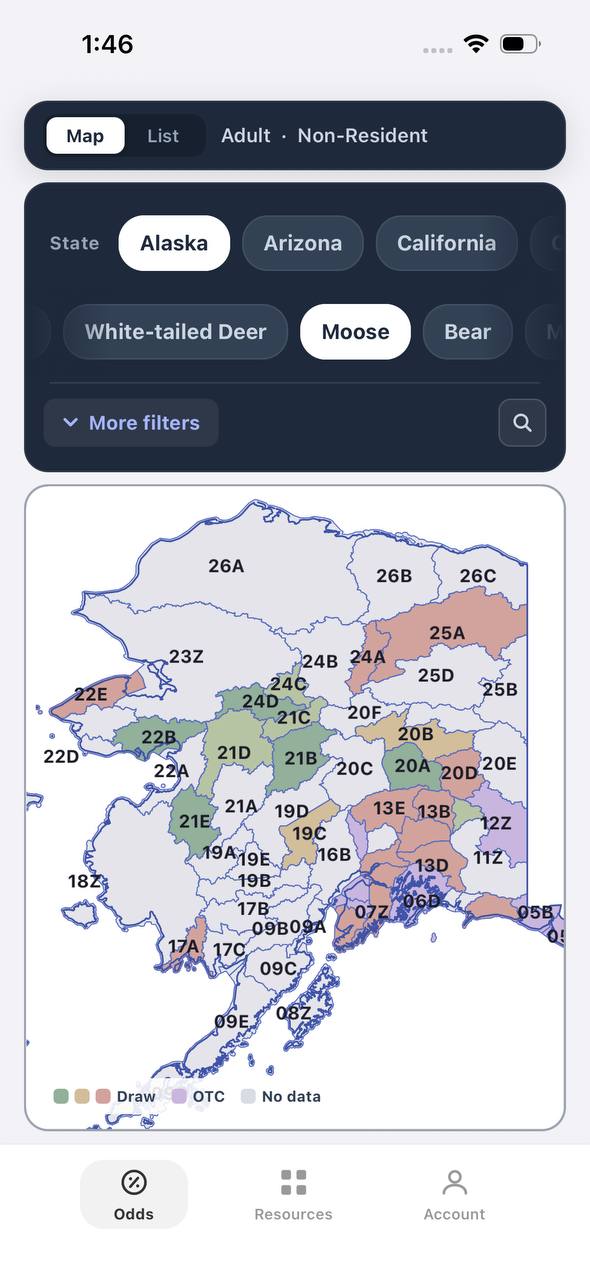
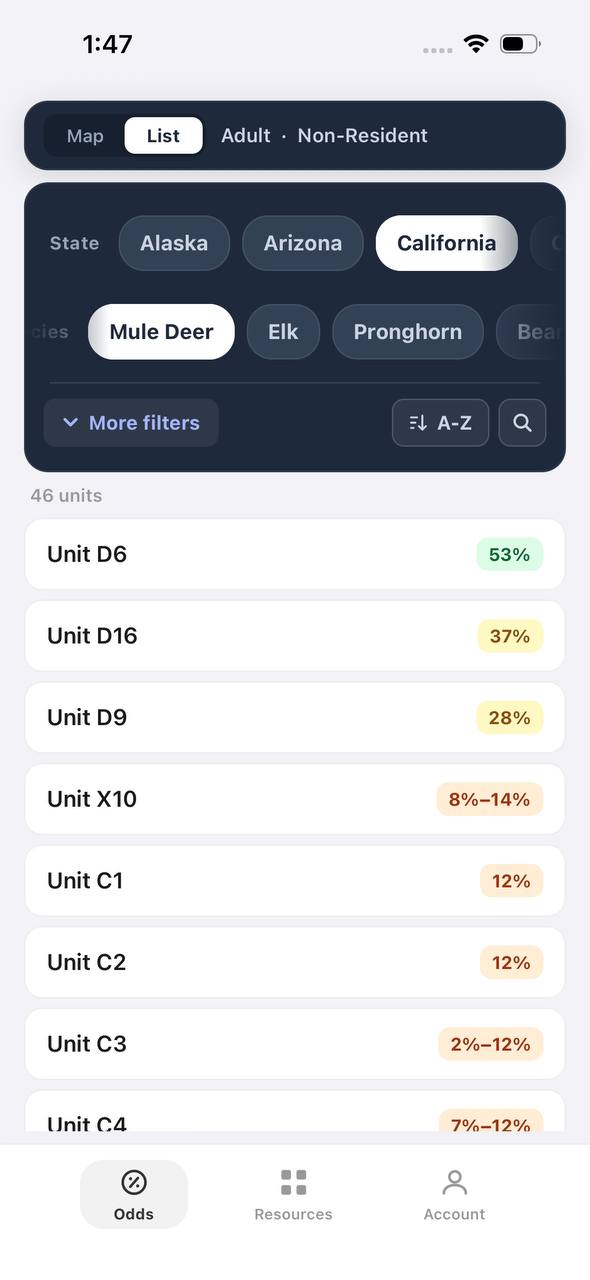
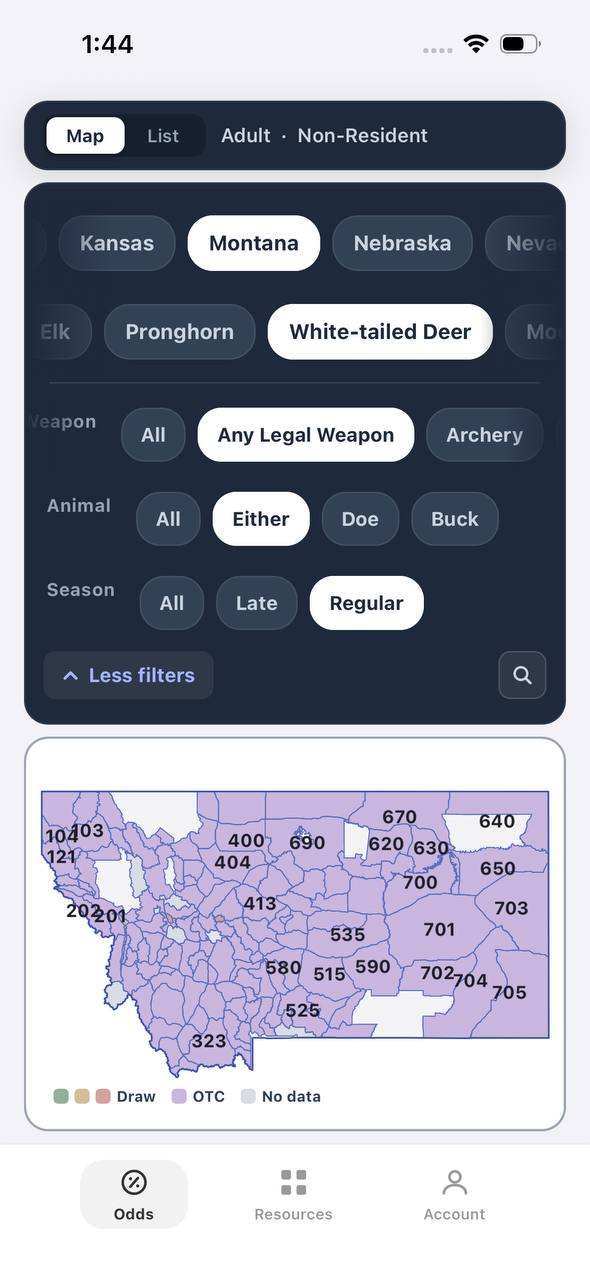
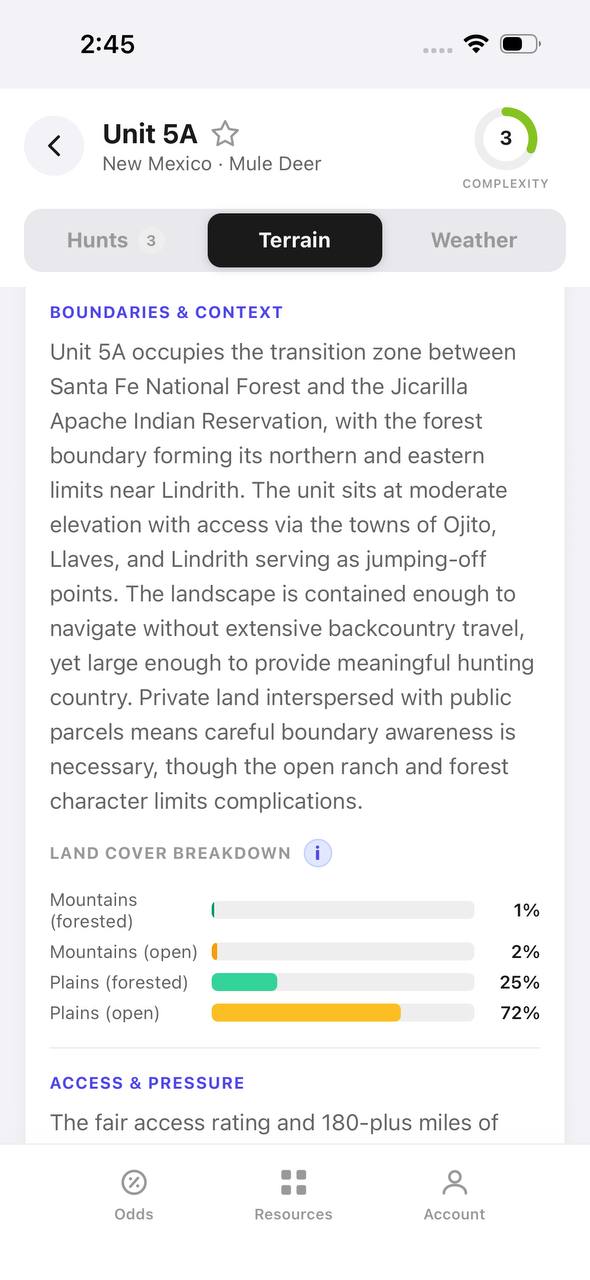
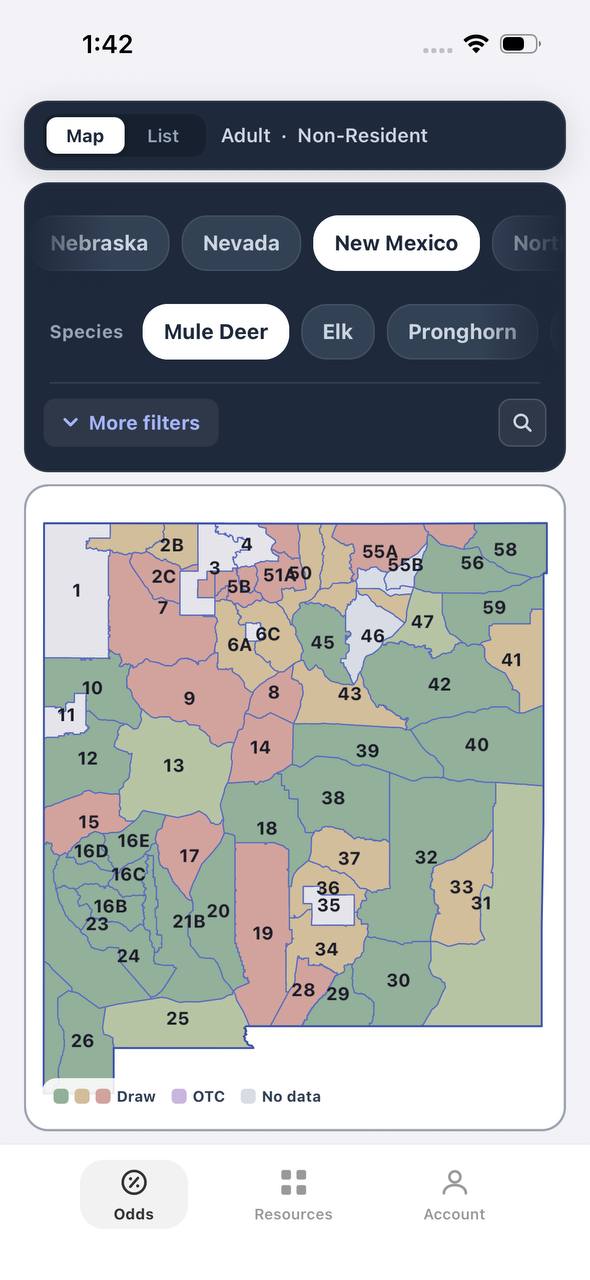
TAGZ lets you track Colorado deer draw odds by hunt code and compare resident and nonresident draw-out levels across multiple years. You can filter by season, weapon type and unit to find codes that match your point level and preferred terrain. The platform doesn't predict future draws or guarantee you'll draw a tag, but it organizes the data so you can make better decisions about where to apply.
You can also set up alerts for leftover license availability and monitor changes to quotas or hunt codes when CPW publishes the 2027 brochure. Stop guessing. Start planning with TAGZ.
Official Colorado Hunting Sources
- CPW Big Game Hunting: Mule Deer (statistics, draw recaps, season information)
- CPW Primary Draw Information (application process, deadlines, point system)
- CPW Nonresident Information (quotas, license requirements, OTC availability)
- Chapter W-2 Big Game Draw Rules (official rule text, effective 2025; hybrid draw, allocation)
- Chapter W-0 Fees Appendix F (2026 license fees, approved May 6, 2026)
- CPW Draw Changes Effective 2028 (50-50 split, 75-25 allocation, second-choice changes)
Last verified: October 22, 2026. Data from the 2026 completed primary draw. 2027 license quotas, hunt codes, season dates and fees have not been published yet. Nonresident over-the-counter mule deer availability is unverified. Confirm all requirements, deadlines and fees with CPW before applying.
FAQ — Colorado Mule Deer Draw Odds With One Point
How many Colorado mule deer codes drew out at one point for nonresidents in 2026?
Fourteen buck rifle, muzzleloader and archery codes drew nonresidents at exactly one preference point in the 2026 primary draw. These included GMU 48 second and third rifle, GMU 51 second rifle, GMU 16 first rifle and plains rifle E1, GMU 6 muzzleloader and GMU 59 archery.
Can I draw a Colorado mule deer tag with zero points as a nonresident?
Yes. Nonresidents drew 495 hunt codes at zero preference points in the 2026 primary draw. Large-quota second and third rifle hunts in units like 3, 7, 18, 19, 11 and 35 all had nonresident draw-out levels at zero.
What is the nonresident allocation for Colorado deer licenses?
Up to 25 percent of licenses go to nonresidents for codes that required fewer than six resident points; up to 20 percent for codes that required six or more resident points. The allocation applies to first-choice applications only (through 2027) and is based on a rolling three-year average with a one-year lag.
When does the 2027 Colorado primary deer draw close?
The rule sets the deadline at 8:00 PM Mountain Time on the first Tuesday in April, which by calendar is April 6, 2027 (not yet confirmed by CPW in sources read). The 2026 window closed April 7, 2026.
Do leftover deer licenses use preference points?
No. The secondary draw in June and leftover sales after both draws do not earn or use preference points. Nonresident allocation caps do not apply to secondary or leftover licenses.
What changes are coming for the 2028 Colorado deer draw?
Starting with the 2028 draw (not 2027), Colorado will remove the hybrid draw, replace it with a 50-50 split between preference and weighted draws, and apply the 75-25 resident-nonresident allocation to both first and second choices instead of first choice only. The 2027 draw remains on the current system.
Was this article helpful?
Previous
Utah General Deer Draw Odds 2027
Utah general-season buck deer operates on a first-choice preference point system with 86,625 permits in 2026, where nonresidents drew many units at zero points but popular zones needed 4-8 points.
Related
Wyoming Elk Draw Odds With Two Points 2027
Wyoming's 2026 elk draw data shows two nonresident preference points drew four any-elk areas in the Regular draw (Areas 008, 084, 096, 122) and Region E general licenses in the Special draw, while most elk tags required three or more points.
Next
Arizona Elk Draw Odds and Tag Guide 2027
Arizona elk draw uses a bonus-point system with three passes and a 10% nonresident cap. February 2027 deadline applies for fall hunts, with early-season bull tags highly competitive and late-season hunts drawing faster with 7-13 points.