Youth Hunting Applications: Best States for Building Preference Points

Starting your child in state preference point systems early gives them a massive advantage for future premium hunts. While most Western states allow youth to accumulate points, the rules, costs, and strategic value vary dramatically. Some states let kids build points starting at birth, while others require them to wait until they're old enough to hunt. The best states combine low point costs, generous age requirements, and access to species that require many years to draw.
The math is simple but powerful. A child who starts accumulating points at age 5 enters the adult draw pool at 18 with 13 years of points already banked. In species like Nevada desert bighorn sheep or Wyoming moose, that head start can mean the difference between drawing at 35 versus 50. For parents willing to invest a few hundred dollars annually across multiple states, the return on investment comes in the form of once-in-a-lifetime hunting opportunities their children wouldn't otherwise draw until middle age.
Wyoming: The Gold Standard for Youth Point Banking
Wyoming leads the nation in youth-friendly preference point rules. Children can begin accumulating points at any age, including infancy, for all big game species. The state's preference point system is straightforward and applies to both residents and nonresidents. For nonresidents, annual point fees run $15 for deer, elk, and pronghorn, and $20 for moose and bighorn sheep. These are among the lowest point costs in the West.
The strategic value lies in Wyoming's tough-to-draw species. Nonresident moose tags in units like 38 or 44 require 15-20+ preference points. Desert bighorn sheep in areas like 1 or 2 can exceed 20 points. Rocky Mountain bighorn sheep tags regularly demand 10-15+ points. Starting a child at age 5 means they enter the adult pool with enough points to compete for tags that would otherwise require waiting into their 30s or 40s.
Wyoming also offers youth hunting opportunities separate from the adult draw. Resident youth under 18 can hunt deer and elk in many areas without competing in the preference point system, allowing them to gain field experience while simultaneously banking points for future premium hunts. Parents should check the Wyoming Game and Fish Department website annually for current regulations and point costs.
Colorado: Early Entry With Species Diversity
Colorado allows children to begin accumulating preference points once they obtain a hunter education certificate, typically around age 10-12. The state uses preference points for deer, elk, pronghorn, bear, and moose. Point costs are reasonable at $5 per species for residents and $10 for nonresidents. Colorado's system gives one point per year per species when you apply, making it a pure preference system without random elements at the max-point tier.
The advantage of starting early in Colorado centers on moose and high-demand elk units. Resident moose tags require 15-25+ preference points depending on the unit. Premium nonresident elk units like 2, 10, or 201 demand 20+ points. For deer, units like 61 or 76 in the San Juan Mountains require significant point accumulation. Building a foundation during the teen years positions youth applicants to draw these tags in their late 20s or early 30s rather than their 50s.
Colorado also provides excellent youth hunting opportunities separate from the preference point draws. Youth-only elk and deer hunts in select units give children hunting experience while their points accumulate. The Colorado Parks and Wildlife website maintains updated information on youth hunts and application requirements.
Utah: Bonus Points and Early Hunting Opportunities
Utah operates a bonus point system rather than a pure preference system, meaning applicants with more points have more chances in the draw but are never guaranteed a tag. Youth can begin accumulating points at age 12, the same age they become eligible for a hunter education certificate. Bonus point fees run $5-$10 per species depending on residency status.
The Utah system rewards early participation because bonus points compound in value. Each point equals one additional entry in the draw. An applicant with 15 bonus points has 16 chances (their base application plus 15 bonus entries) compared to a first-time applicant with just one chance. For species like desert bighorn sheep, Rocky Mountain bighorn sheep, moose, and mountain goat, top-tier units see applicants with 20+ bonus points. Starting at age 12 gives a youth applicant 20+ points by age 32.
Utah also offers dedicated youth hunting opportunities, including youth-only deer and elk hunts in select units. These hunts allow young hunters to gain experience while building points for future premium draws. The Utah Division of Wildlife Resources provides detailed information on youth hunts and bonus point rules.
Nevada: Maximum Points for Desert Species
Nevada uses a bonus point squared system, where each bonus point is squared to determine the number of entries in the draw. This system heavily favors applicants with many points. Youth can start accumulating points at age 12. Point costs are $7-$10 per species depending on the animal.
Nevada's strategic value lies in its desert species. Desert bighorn sheep tags are among the most coveted in North America, with some units requiring 20-25+ bonus points. Elk in units like 231-234 (Ruby Mountains) or 141-143 (Schell Creek) also demand substantial point investment. Mule deer in premium units like 231 or 114 require 10-15+ points for nonresidents.
The squared bonus point system makes early accumulation especially powerful. An applicant with 20 bonus points has 400 entries (20 x 20), while an applicant with 10 points has only 100 entries (10 x 10). Starting at age 12 means a Nevada resident youth reaches 20+ points by their early 30s, putting them in position to draw tags that would otherwise require decades of applications. Check the Nevada Department of Wildlife website for current regulations and application deadlines.
Free to join
Download mobile app
- Detailed draw odds
- Point tracking
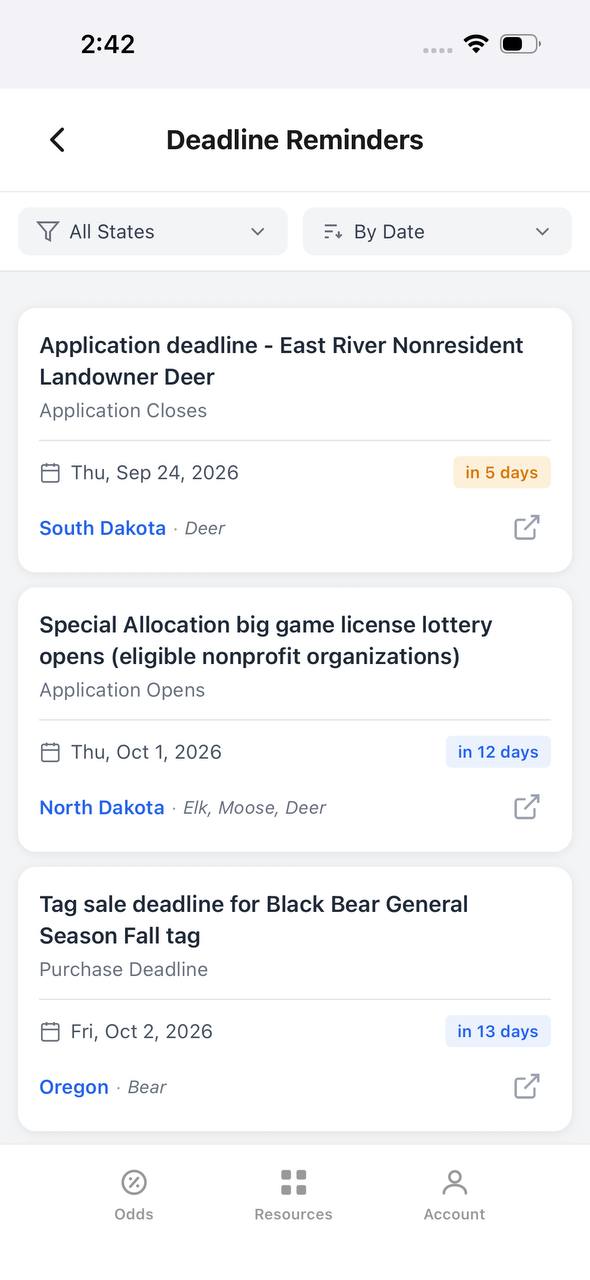
- Deadline reminders
- 19 states covered

Free to join
Download mobile app
- Detailed draw odds
- Point tracking
- Deadline reminders
- 19 states covered
Free to join
Download mobile app
- Detailed draw odds
- Point tracking
- Deadline reminders
- 19 states covered
Arizona: Bonus Points for Premium Mule Deer and Elk
Arizona operates a bonus point system for all big game species except bear and mountain lion. Youth can begin accumulating points at age 10. Point costs are $5 per species for residents and $15 for nonresidents. Arizona's bonus points carry forward each year and dramatically improve draw odds in the bonus pass, which allocates up to 20% of tags to applicants with the most points.
Arizona's strength lies in trophy mule deer and elk units. The Kaibab (units 12A East, 12A West, 12B) for mule deer requires 15-20+ bonus points. Premium elk units like 10 (Kaibab North) or 9 (Kaibab South) demand similar or higher point totals. Coues deer in units like 36A, 36B, or 36C also require substantial points for quality hunts. Desert bighorn sheep tags routinely exceed 20 bonus points.
Arizona offers youth-only hunts in select units for deer, elk, and pronghorn. These provide hunting opportunities while allowing point accumulation for future premium draws. The Arizona Game and Fish Department maintains comprehensive information on youth hunts and bonus point rules.
Montana: Preference Without Early Accumulation
Montana uses preference points for some species but does not allow youth to bank points before they're eligible to apply. Children must be at least 12 years old and possess a hunter education certificate to begin accumulating points. This limits the head start compared to Wyoming or Colorado, but Montana still deserves consideration for families planning long-term point strategies.
Montana's preference points apply primarily to moose, sheep, and mountain goat permits. These are limited-entry species with extremely low draw odds. Elk and deer are largely general-season or draw-without-points species, reducing the strategic value of early point accumulation for those animals.
For families already committed to other states, Montana can serve as a secondary option. The Montana Fish, Wildlife & Parks website provides details on youth hunting opportunities and limited-entry permit applications.
Free to join
Download mobile app
- Detailed draw odds
- Point tracking
- Deadline reminders
- 19 states covered
Free to join
Download mobile app
- Detailed draw odds
- Point tracking
- Deadline reminders
- 19 states covered
Free to join
Download mobile app
- Detailed draw odds
- Point tracking
- Deadline reminders
- 19 states covered
Idaho: Minimal Point Advantage but Strong Youth Hunting
Idaho does not use preference or bonus points for most big game species. The state operates on a draw-only system for controlled hunts, with equal odds for first-time and repeat applicants. This eliminates the strategic value of banking points early, but Idaho offers excellent youth hunting opportunities separate from the controlled hunt draw.
Idaho provides youth-only elk, deer, and pronghorn hunts in select units. These hunts give young hunters high-quality experiences without competing against adults. For families prioritizing immediate hunting opportunities over long-term point accumulation, Idaho remains a valuable state. Visit the Idaho Department of Fish and Game website for youth hunt information.
Strategic Considerations for Parents
Building preference points across multiple states requires annual commitment and financial investment. Parents should prioritize states where the family plans to hunt long-term and where the species of interest require many years of points. For most families, Wyoming, Colorado, and Nevada represent the highest-value investments. Arizona and Utah add diversity for families focused on mule deer, elk, or desert species.
Consider starting your child in 2-3 states rather than spreading investments across all Western states. Focus on states with low point costs, generous age requirements, and species that align with your family's hunting goals. For example, a family interested in elk and moose might prioritize Wyoming and Colorado, while a family targeting desert bighorn sheep would focus on Nevada and Arizona.
Track point totals annually and monitor draw odds as your child accumulates points. As they approach adulthood, adjust application strategies to maximize the value of their accumulated points. Some states allow point transfers or family application options that can further enhance youth point strategies.
Cost Analysis and Return on Investment
The total cost of banking points varies by state and species but remains manageable for most families. For example, starting a child at age 10 in Wyoming, Colorado, and Nevada for elk, deer, and moose costs approximately $100-$150 per year. Over 10 years, that's $1,000-$1,500 in point fees. By age 20, that child enters the adult draw pool with 10 points in each state and species.
The return comes in the form of access to premium hunts decades earlier than would otherwise be possible. A Wyoming moose tag that normally requires 20 years to draw becomes accessible in 10 years with the early start. That same moose tag might cost $20,000-$40,000 on the landowner tag market. The financial value alone justifies the point investment, not to mention the hunting experience gained during prime physical years.
For families committed to Western big game hunting, starting children in preference point systems early ranks among the highest-value investments you can make. The modest annual costs compound into enormous strategic advantages over time.
Free to join
Download mobile app
- Detailed draw odds
- Point tracking
- Deadline reminders
- 19 states covered
Free to join
Download mobile app
- Detailed draw odds
- Point tracking
- Deadline reminders
- 19 states covered
Free to join
Download mobile app
- Detailed draw odds
- Point tracking
- Deadline reminders
- 19 states covered
Application Deadlines and Annual Maintenance
Each state has specific application deadlines, typically falling between January and June. Parents must submit applications annually to continue accruing points. Missing a year means losing a point opportunity and potentially falling behind peers who maintain consistent applications.
Create a calendar reminder system to track deadlines across all states where your child accumulates points. Many states offer grace periods or late application options, but these often come with additional fees or reduced point values. Treat the annual application as a non-negotiable commitment, similar to renewing insurance or paying property taxes.
Some states allow purchasing points without entering the draw, which can be more cost-effective for youth applicants not yet ready to hunt. This option preserves points while avoiding the full application fee. Review each state's rules to determine whether buying points or applying for tags makes more financial sense for your family's timeline.
Teaching Financial Responsibility and Long-Term Planning
Involving children in the point-building process teaches valuable lessons about delayed gratification, financial planning, and goal setting. Explain how the system works, show them draw odds statistics, and let them participate in application decisions as they mature. This transforms point accumulation from a parental task into a shared family project that builds hunting knowledge and life skills simultaneously.
As children reach their mid-teens, gradually transfer responsibility for tracking deadlines, researching units, and submitting applications. By the time they're 18, they should understand the systems well enough to manage their own applications independently. This knowledge becomes a lifelong asset as they continue hunting into adulthood.
FAQ — Youth Preference Points
Can a child accumulate preference points before they're old enough to hunt?
Yes, in some states. Wyoming allows point accumulation at any age, even infancy. Colorado and Arizona require a hunter education certificate (typically age 10-12). Nevada and Utah require applicants to be at least 12 years old. Each state sets its own age requirements, so check specific regulations before starting.
What happens to preference points if my child doesn't draw a tag?
Points carry forward to the next year in all states that use preference or bonus point systems. Points accumulate indefinitely until used to draw a tag or until the applicant voluntarily surrenders them. Missing an application year means losing that year's point opportunity, but existing points remain intact.
Are youth preference points worth the annual cost?
Absolutely, especially for species requiring 10-20+ years to draw. Starting at age 10 means entering the adult pool with a decade-plus head start. For premium tags like Wyoming moose or Nevada desert bighorn, that advantage can mean drawing in your 30s instead of your 50s. The modest annual investment ($50-$150 across multiple states) compounds into enormous value over time.
Can my child apply in multiple states simultaneously?
Yes. Each state operates independently, allowing applicants to build points and apply for tags in as many states as they choose. Most serious Western hunters maintain point portfolios across 3-5 states. Focus on states with the best opportunities for species your family wants to hunt.
What if my child draws a tag while still building points?
Drawing a tag typically resets points to zero for that species in that state. This is why some families apply for youth-only hunts or less competitive tags early, then focus point accumulation on once-in-a-lifetime species like moose, sheep, and mountain goat. Balance immediate hunting experiences with long-term point strategies based on your family's priorities.
Should I start my child in resident or nonresident status?
Use your current residency status. If you're a Wyoming resident, start your child as a resident. If you live out of state, they'll start as nonresidents. Point costs and draw odds differ significantly between resident and nonresident status. If your family plans to relocate, some states allow converting nonresident points to resident points, though rules vary. Check with each state's wildlife agency before making assumptions about point portability.
Was this article helpful?
Previous
Nonresident Hunting License Requirements in Every Western State (2025 Guide)
A complete breakdown of nonresident hunting license requirements across all eleven Western states, including application deadlines, point systems, and costs for elk, deer, and other big game species.

Related
Best States for First-Time Nonresident Elk Hunters in 2025
Colorado, Idaho, and Montana offer the most accessible elk hunting for first-time nonresident hunters through OTC tags, affordable combination licenses, and huntable public land that doesn't require years of preference points.
Next
Best Western States for Trophy Pronghorn Hunting Applications
Wyoming, Arizona, and New Mexico offer the best trophy pronghorn opportunities, with Montana and Nevada providing strong value for hunters willing to research units strategically.