Public Land Elk Hunting in Arizona: 2027 Guide to Units, Tags & Strategy
ElkArizonaPublic LandDraw OddsRifle
9 min read·Nov 17, 2026·TAGZ
Public Land Elk Hunting in Arizona: 2027 Guide to Units, Tags & Strategy

Arizona manages elk through a draw-only system with no preference points, making every applicant equal in the random draw regardless of past applications. The state offers roughly 20,000 elk tags annually across general and limited-entry units, with the vast majority of huntable land being public — primarily managed by the U.S. Forest Service and Arizona State Trust Land. For 2027, nonresidents face a 10% tag allocation cap and significantly lower draw odds than residents, but Arizona's bonus point system and high-quality bulls make it a premier Western elk destination worth the investment.

Understanding Arizona's Elk Draw System

Arizona Game and Fish uses a bonus point system, not preference points. Each bonus point gives you one additional entry in the random draw. A hunter with five bonus points gets six total entries (initial application plus five bonus points). This means accumulated points improve your odds but never guarantee a tag. The system rewards patience while keeping trophy units accessible to first-time applicants through pure luck.

Residents and nonresidents apply through the same portal during the spring draw period, typically opening in early January and closing in mid-February. The 2027 draw application period will follow this pattern. Hunters may apply for up to five hunt choices in order of preference, and the draw processes each choice sequentially. If you draw your first choice, your bonus points are consumed. If you are unsuccessful across all choices, you gain one bonus point for the following year.

Resident Versus Nonresident Tag Allocation

Arizona caps nonresident elk tags at 10% of the total quota for each hunt code. This creates a substantial gap in draw odds. For example, a premium archery hunt in Unit 9 might show 5-10% resident odds with zero points but less than 1% nonresident odds. Even general rifle hunts in lower-demand units often require nonresidents to accumulate 3-5 bonus points for reasonable draw probability, while residents draw with zero to two points.

Nonresidents must also purchase a hunting license and apply for the draw, which adds upfront costs before knowing whether you drew. Arizona does not refund application fees if you are unsuccessful, though the license fee can be applied toward future years. This financial structure favors residents and makes Arizona a points-building proposition for most nonresident hunters rather than a first-year opportunity.

Top Public Land Units for Rifle Hunters

Units 9, 10, and 23 anchor Arizona's premium elk zones, offering 350-plus class bulls and high elk densities on predominantly public land. Unit 9 sits in the Kaibab National Forest north of Flagstaff and is legendary for heavy-antlered bulls. Draw odds are brutal — typically requiring 15-plus bonus points for nonresidents and 8-12 for residents on rifle hunts. The payoff is a legitimate chance at a 370-inch bull in open ponderosa pine and aspen country.

Unit 10, just south of Unit 9, provides similar terrain and quality but slightly better draw odds. Expect to burn 10-15 nonresident points for rifle tags here. The Coconino National Forest dominates the landscape, and glassing ridges at dawn often reveals multiple bulls in a single drainage. Unit 23, located in the White Mountains near the New Mexico border, also produces mature bulls and holds dense herds, though point creep has pushed rifle tags into the 12-plus point range for nonresidents.

For hunters with fewer points, Units 4A, 4B, 5A, and 6A offer solid public-land opportunities with 2-7 bonus points required for nonresidents. These units stretch across the Prescott and Tonto National Forests and produce consistent 300-320 class bulls. Terrain varies from pinyon-juniper foothills to ponderosa pine highlands, and success rates hover around 25-40% depending on weapon and season.

Archery and Muzzleloader Opportunities

Arizona's early archery season runs in September, coinciding with the rut. Archery tags in top units like 9 and 10 are nearly as difficult to draw as rifle tags, often requiring 10-plus nonresident bonus points. However, mid-tier units such as 1, 2A, 2B, and 3C offer archery draws in the 3-6 point range with legitimate bull opportunities. The rut provides calling advantages, and archery seasons allow hunters to access wilderness areas and roadless zones where pressure drops dramatically after opening weekend.

Muzzleloader seasons occur in October, post-rut, and generally see lower draw odds than rifle hunts. Units 7 East and 7 West, for example, often draw with 2-4 nonresident points for muzzleloader tags. These hunts trade rut activity for cooler weather and reduced hunter numbers. Elk concentrate near water and transition to winter feeding patterns, making glassing and spot-and-stalk the dominant tactic.
Draw odds
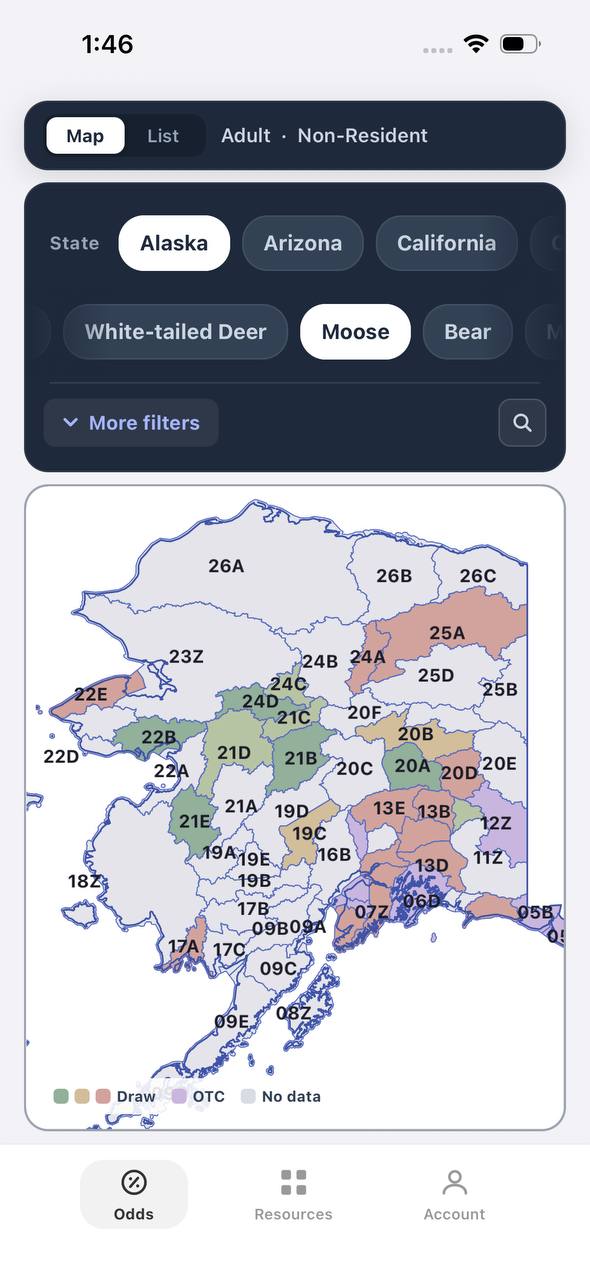
Alaska moose draw odds by unit, colored by draw, OTC, or no data
AdultNonresident

Alaska · Moose

Draw, OTC, and no-data units across the whole state.

Adult, Nonresident, Moose, no additional filters. Every unit is colored by its best matching draw odds; if nothing draws, it shows OTC; if neither, no data.

  • Alaska mixes draw and OTC moose hunts within the same region.
  • Green units are worth an application; purple units are OTC.
  • Filters stay applied when a unit is opened for hunt detail.
Draw odds
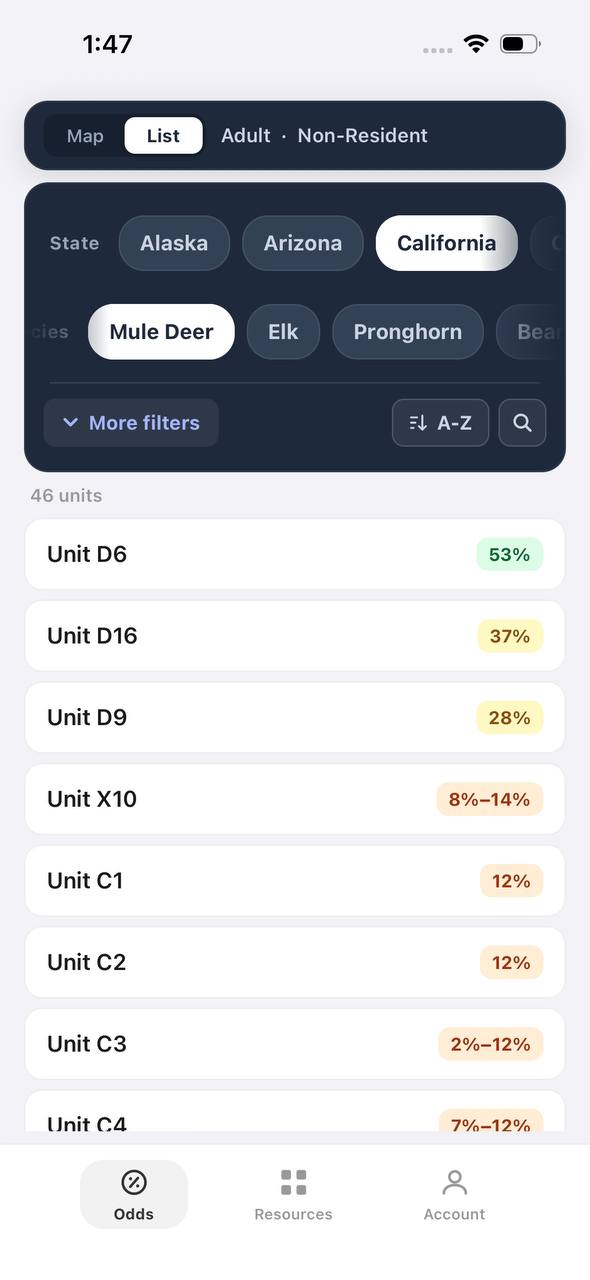
California mule deer draw odds ranked by unit in a list
AdultNonresident

California · Mule deer

Nonresident odds ranked unit by unit.

Adult, Nonresident, Mule deer, no weapon or season chip, so every matching hunt in a zone is combined into one badge and sorted by best projected odds.

  • D6 leads the list; a range like 8%–14% means more than one hunt code exists in that zone.
  • The list and the map read the same filtered hunt set.
  • 46 units are shown for this species and state alone.

Free to join

Download mobile app

  • Detailed draw odds
  • Point tracking
  • Deadline reminders
  • 19 states covered
Download on the App StoreGet it on Google Play
Unit detail
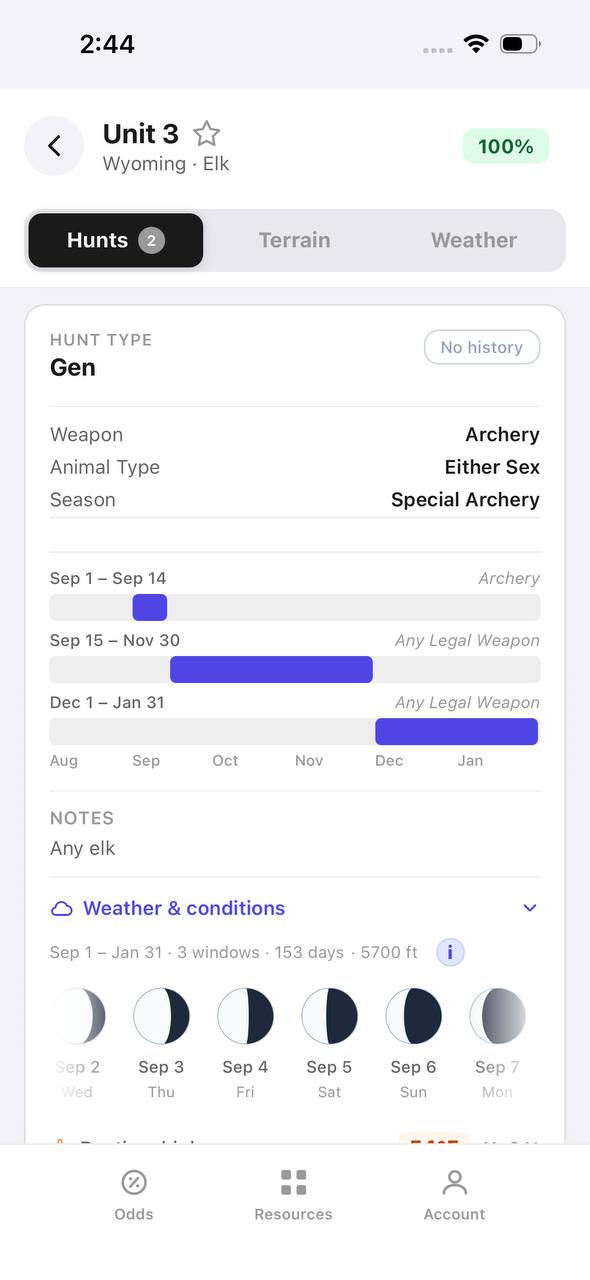
Wyoming elk unit detail, hunts tab, showing hunt windows on a timeline

Wyoming · Elk, Unit 3

Every hunt window inside one unit, laid out on a timeline.

Unit 3 has two hunt codes for elk. Each one shows its weapon, animal type, and season as a bar on a shared Aug–Jan timeline, plus a day-by-day moon phase strip.

  • Archery, then a long Any Legal Weapon window, then a late season — three opportunities in one unit.
  • The 100% badge at top means no real draw competition for the selected filters right now.
  • Weather & conditions expands below the hunt list without leaving the unit.
Terrain data
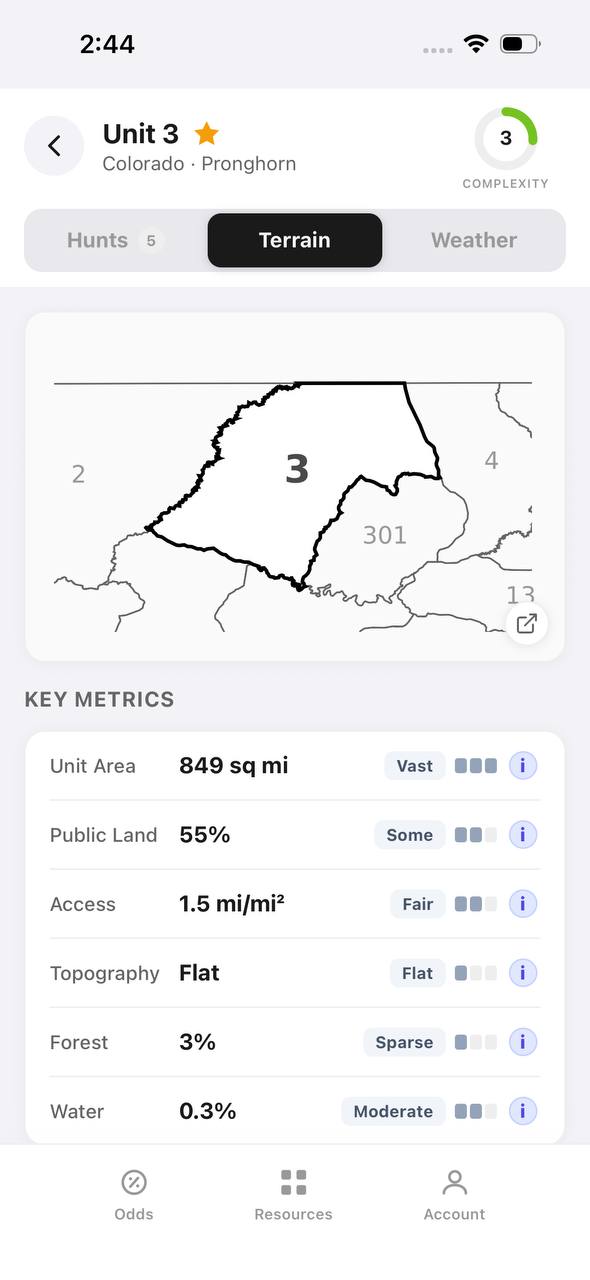
Colorado pronghorn unit detail, terrain tab, showing unit outline and key metrics

Colorado · Pronghorn, Unit 3

Unit boundaries and a complexity score at a glance.

The Terrain tab draws the unit outline against its neighbors and scores it for complexity, then breaks out area, public land, access, topography, forest, and water.

  • 849 sq mi, 55% public land, and flat topography make this a fairly approachable unit.
  • Each metric carries a short rating word — Vast, Some, Fair, Flat, Sparse, Moderate — with a tooltip.
  • The outline map shows adjacent units 2, 4, 13, and 301 for context.
State profiles
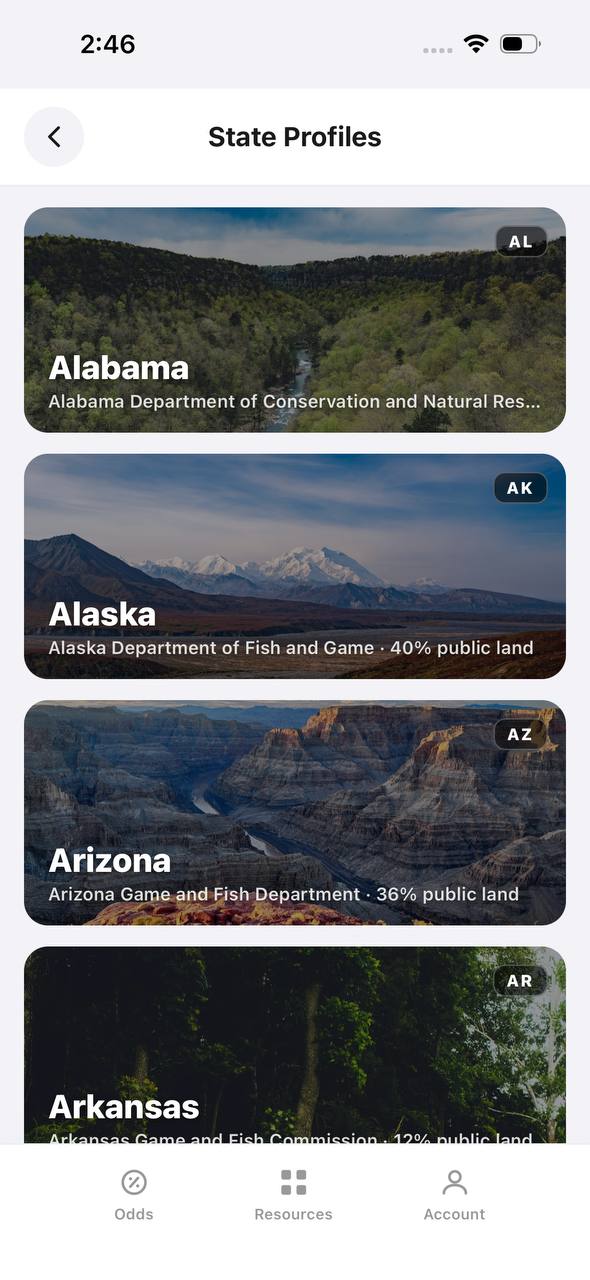
State Profiles screen listing states with wildlife agency and public land percentage

State Profiles

Each state's wildlife agency and public land share, at a glance.

State Profiles lists every covered state as a photo card naming its wildlife agency and, where available, its public land percentage.

  • Public land percentage shows right in the list, before opening the state.
  • Each card names the exact agency the regulations come from.
  • States without a public land figure yet, like Alabama here, are still listed.
Points wallet
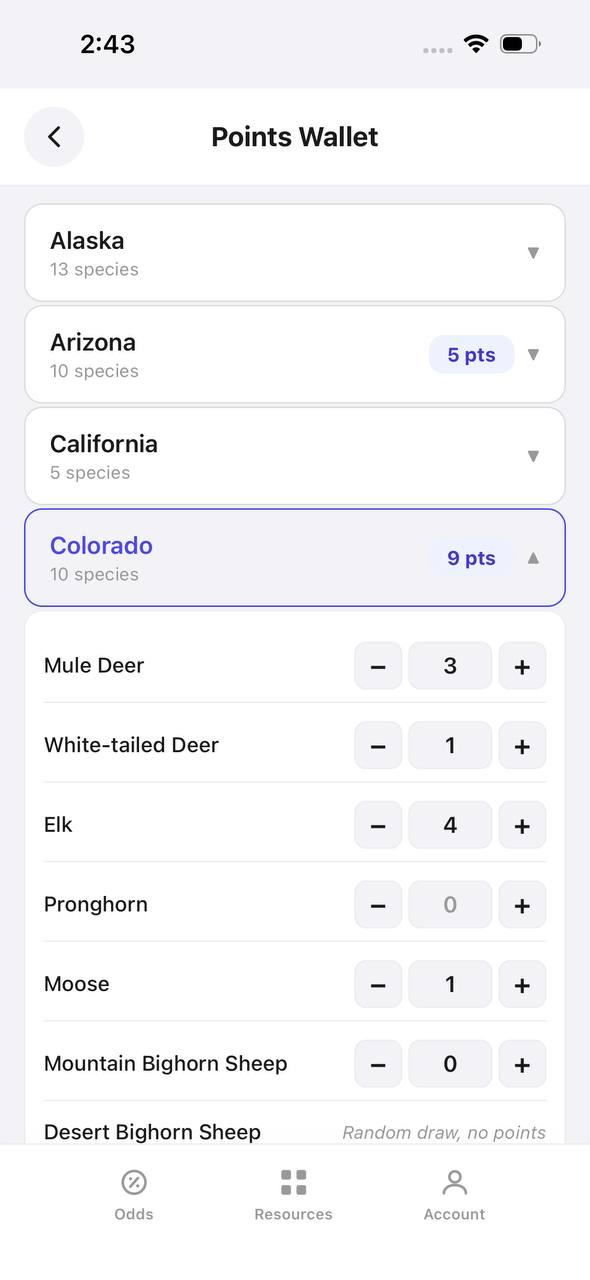
Points Wallet screen with Colorado expanded, showing a point stepper per species

Points Wallet · Colorado

Every state and species point balance in one wallet.

Points Wallet lists each state with a species count; expanding a state, like Colorado here, shows a stepper for every species so a balance can be entered or adjusted directly.

  • Colorado alone tracks points across 10 species independently.
  • Species with no points, like Pronghorn here, still show a zero to stay visible.
  • Desert Bighorn Sheep is flagged as a random draw with no points system.

Free to join

Download mobile app

  • Detailed draw odds
  • Point tracking
  • Deadline reminders
  • 19 states covered
Download on the App StoreGet it on Google Play
Draw odds
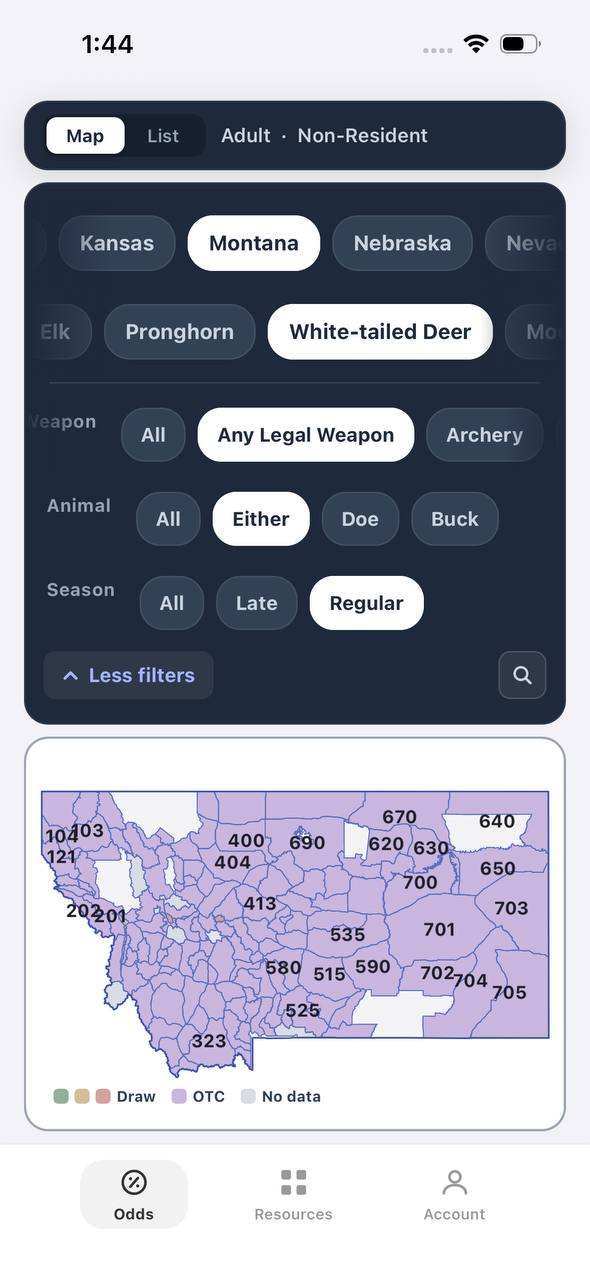
Montana white-tailed deer draw odds filtered to any legal weapon, either sex, regular season
AdultNonresidentAny Legal WeaponEitherRegular

Montana · White-tailed deer

Nearly the whole state is OTC for this filter combination.

Adult, Nonresident, White-tailed deer, filtered to Any Legal Weapon, Either, Regular. Under this combination almost every unit turns purple — over the counter.

  • Switching weapon, sex, or season changes the picture completely.
  • Purple means the tag can be bought directly, no draw.
  • This is the tag-and-go read of Montana whitetail, not the point-based one.
Terrain data
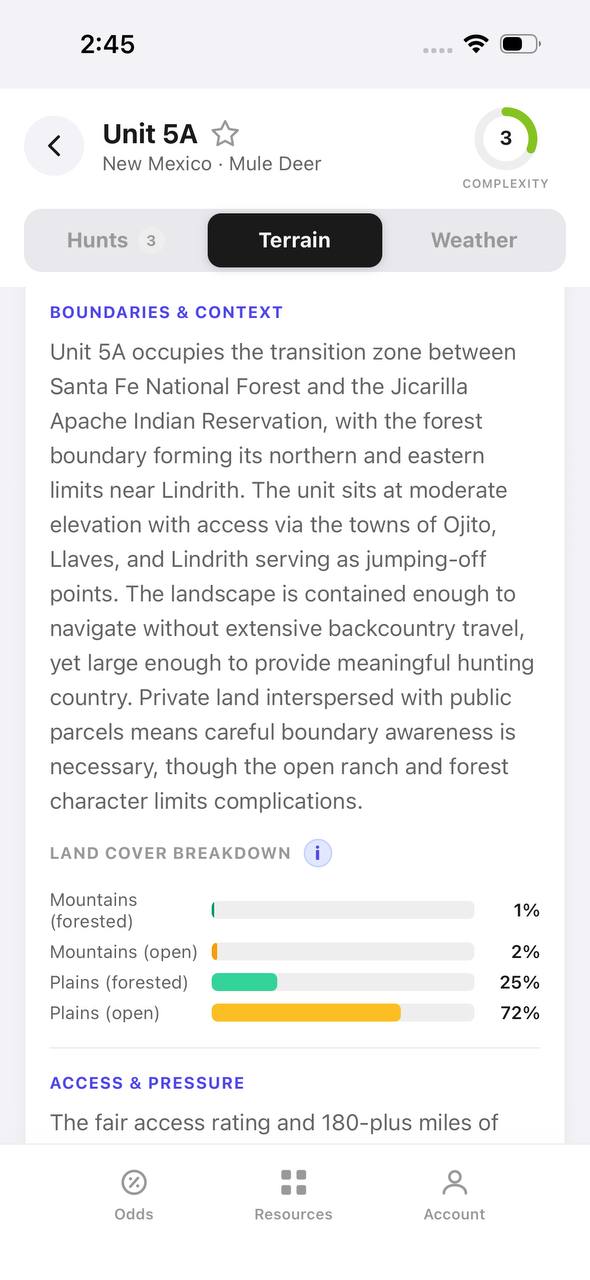
New Mexico mule deer unit 5A terrain tab with boundary description and land cover breakdown

New Mexico · Mule deer, Unit 5A

A written boundary description, not just a shape.

Unit 5A's terrain tab opens with a plain-language paragraph about surrounding land, access towns, and ownership mix, then a land cover breakdown by percentage.

  • 72% open plains and 25% forested plains describe the terrain at a glance.
  • The boundary text calls out the exact reservation and forest lines that define the unit.
  • Access & pressure continues below the fold with mileage detail.
Draw odds
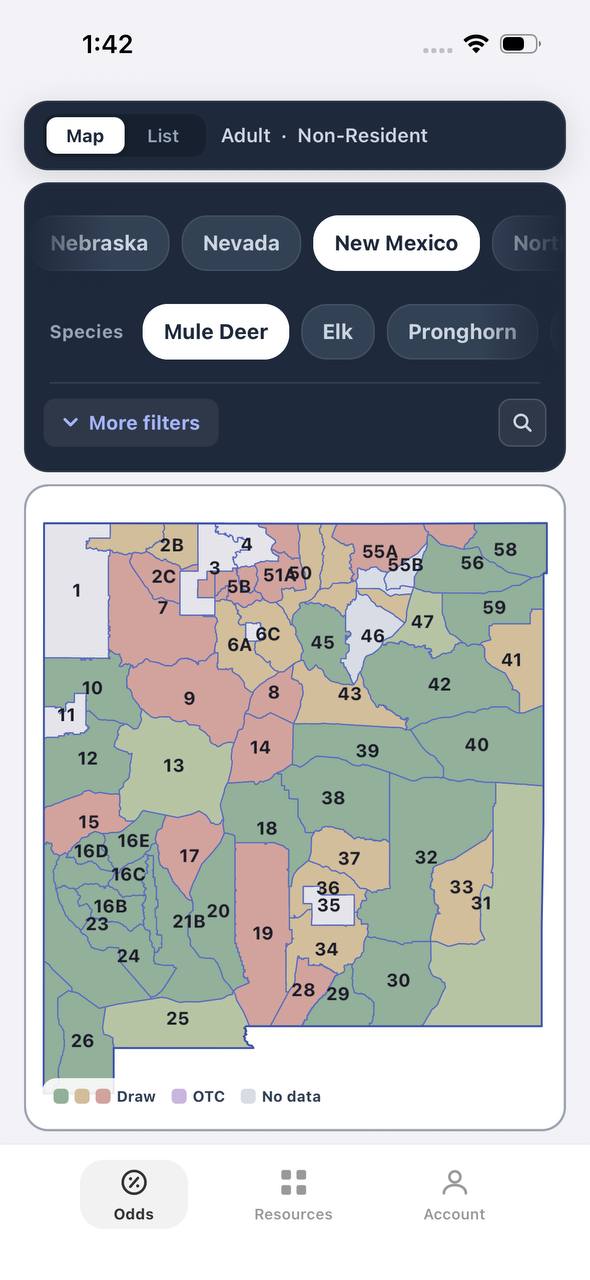
New Mexico mule deer draw odds by unit
AdultNonresident

New Mexico · Mule deer

Mule deer draw odds for every unit in the state.

Adult, Nonresident, Mule deer, all weapons and seasons. Each unit is colored by the same odds calculation used in the dashboard.

  • Green and tan together separate units worth applying to from units that are not.
  • Numbered units follow New Mexico's own game management unit boundaries.
  • Opening a unit shows the exact hunt behind the color.
Favorites
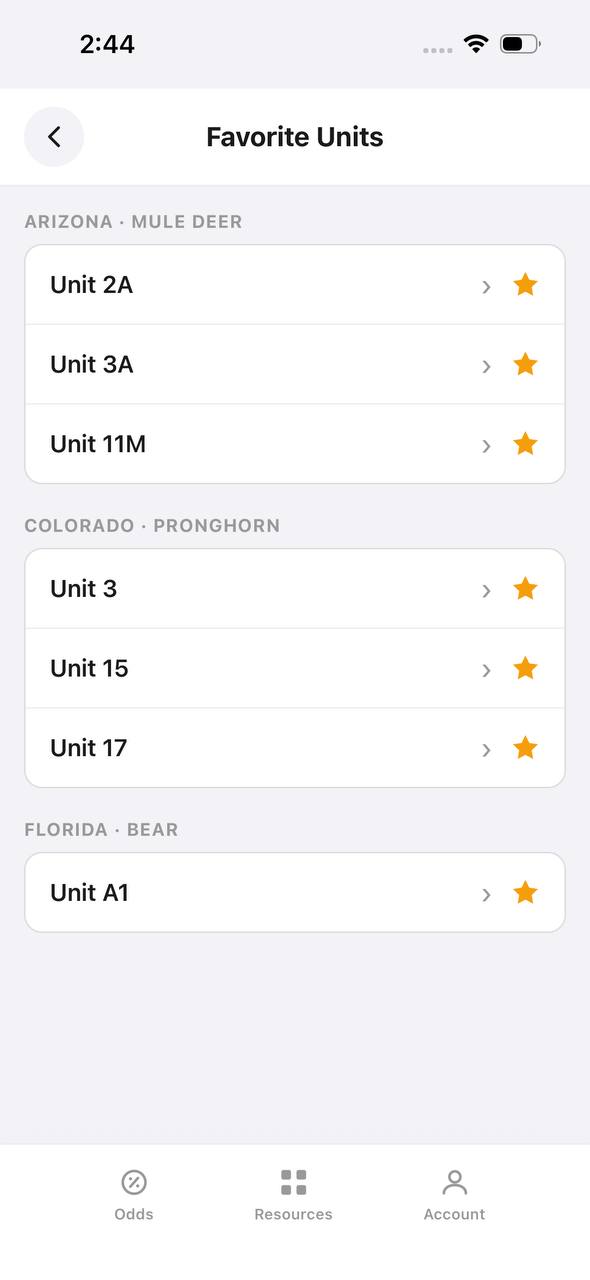
Favorite Units screen grouped by state and species

Favorite Units

Starred units from any state, grouped by species.

Favorite Units collects every starred unit across states and species into one list, grouped by state and species pair, so a saved unit is one tap away.

  • Arizona mule deer and Colorado pronghorn favorites sit side by side here.
  • Each row opens straight into that unit's detail view.
  • Unstarring from this screen removes it from the group instantly.
Deadlines
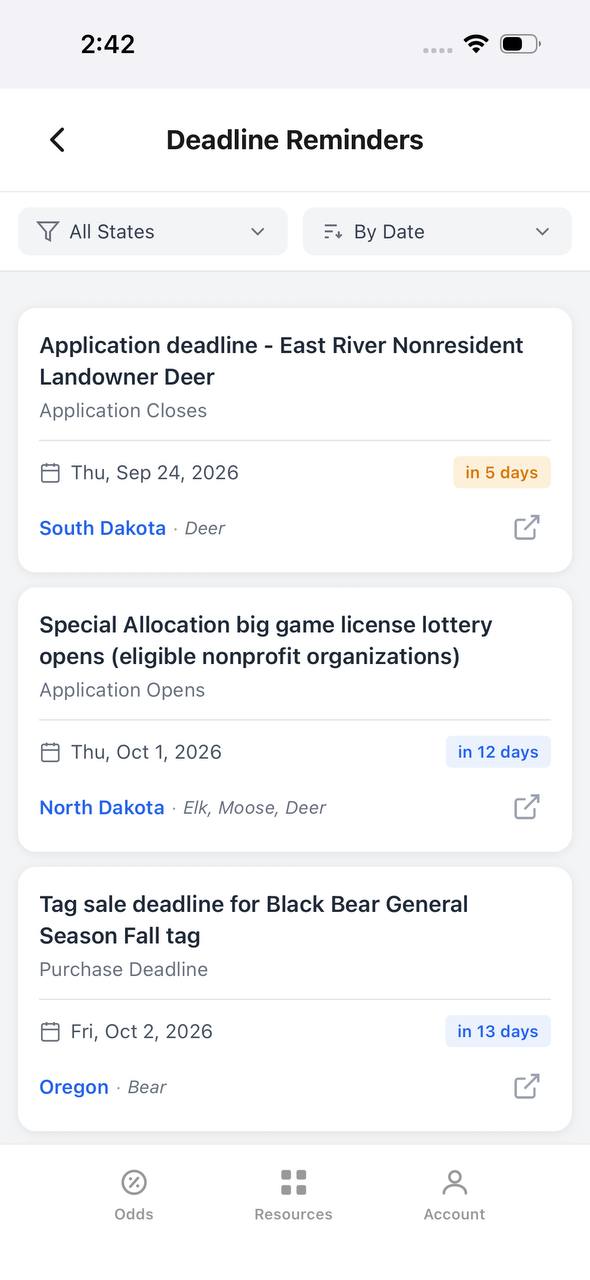
Deadline Reminders screen listing application and purchase deadlines by date

Deadline Reminders

Every application and purchase deadline, sorted by date.

Deadline Reminders filters by state and sorts by date, showing the deadline type, a countdown, and the state and species it applies to, with a link out to the source.

  • Countdown badges shift as a deadline gets close — "in 5 days" here, for example.
  • Application opens and closes are tracked as separate reminder types.
  • Each card links out to confirm the rule at the source.
Interactive map
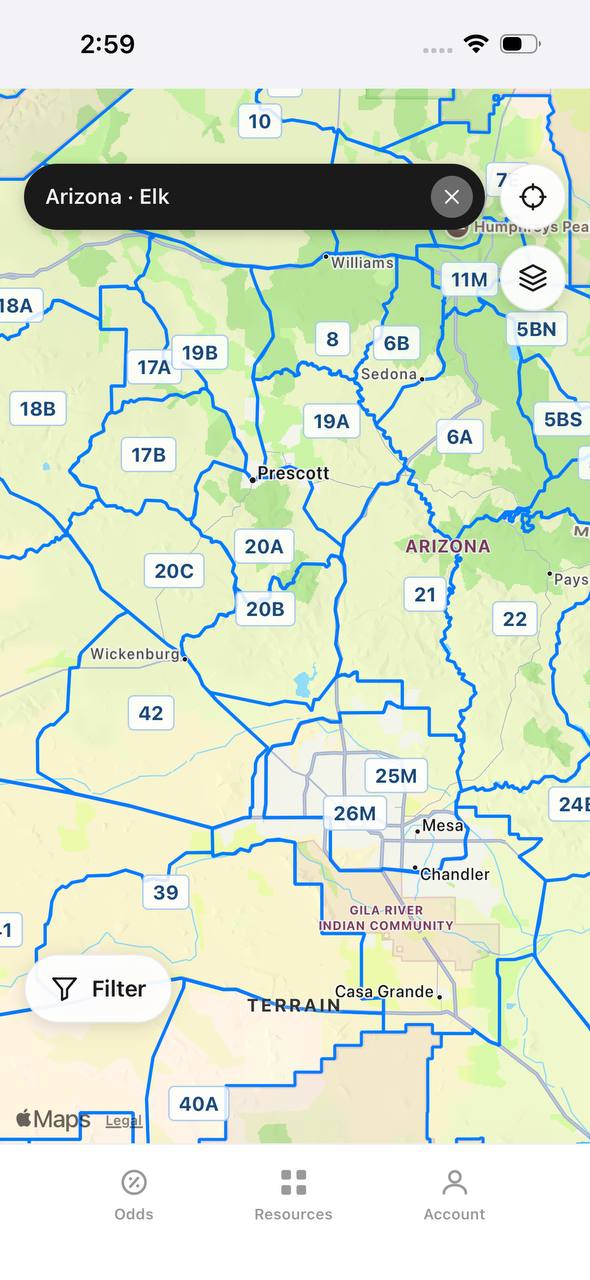
Arizona elk unit boundaries overlaid on an interactive street map

Arizona · Elk

Unit boundaries laid directly over a real map.

This view overlays Arizona elk unit boundaries and labels on top of a street map, with a search bar pinned to state and species and a layer toggle in the corner.

  • Real towns like Prescott and Sedona sit inside their unit boundaries for context.
  • A location button and layer switch float over the map, clear of the unit labels.
  • A Filter button at the bottom opens the same filters used elsewhere in the app.

Free to join

Download mobile app

  • Detailed draw odds
  • Point tracking
  • Deadline reminders
  • 19 states covered
Download on the App StoreGet it on Google Play
Insights
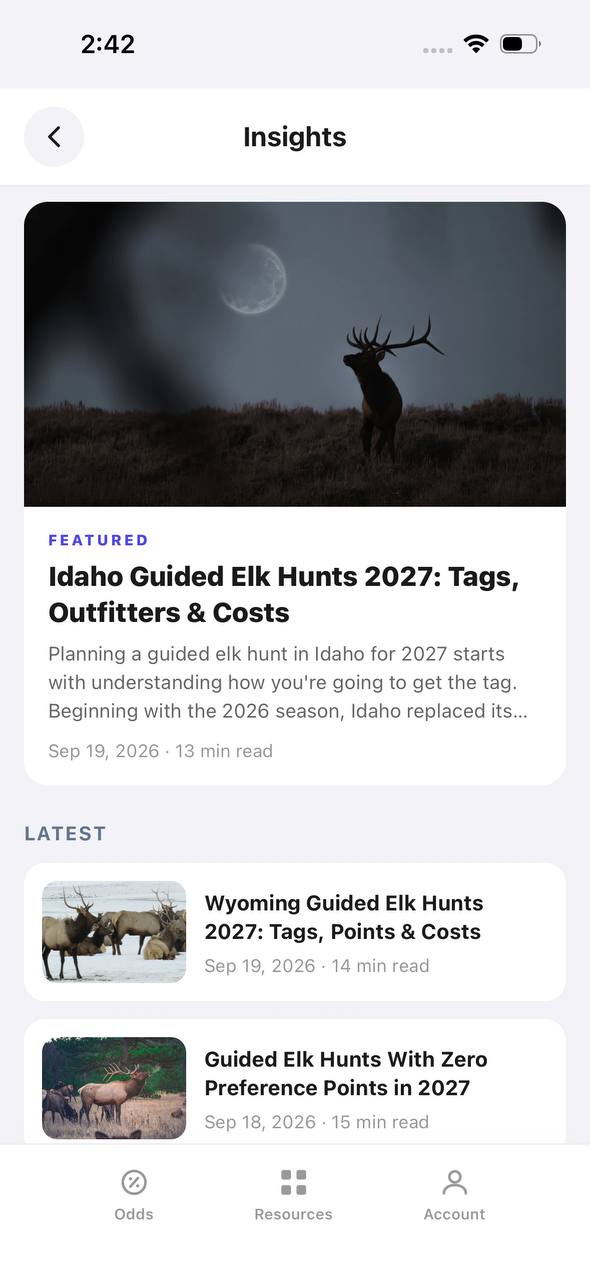
Insights screen with a featured article and a latest articles list

Insights

Hunting articles, built into the app itself.

Insights opens to a featured article with a hero image, then a Latest list of recent posts, each with a thumbnail, read time, and publish date.

  • The featured slot rotates to the newest deep-dive article.
  • Read time and publish date show on every card, not just the featured one.
  • This mirrors the blog content already published on the marketing site.
Download on the App StoreGet it on Google Play

Arizona State Trust Land Access

Arizona State Trust Land comprises roughly 9 million acres scattered throughout elk country, particularly in Units 3A, 3B, 3C, 4A, 4B, 5A, 5B, and 6A. Unlike federal land, State Trust Land requires a separate recreational permit, available as an annual pass or short-term permit. The annual pass costs around $15 for residents and $55 for nonresidents as of recent regulations, though hunters should verify current fees before the 2027 season.

State Trust parcels are often interspersed with national forest land, creating a patchwork that requires careful navigation using OnX or similar mapping software. Some State Trust sections receive minimal hunting pressure due to access confusion, offering opportunity for hunters willing to study boundaries and secure the proper permits. Gates and roads on State Trust Land may be locked, and recreation is limited to foot, horseback, or bicycle travel unless explicitly posted otherwise.

Scouting and E-Scouting Essentials

Successful Arizona elk hunting hinges on pre-season scouting or thorough e-scouting. Units are large — often exceeding 500 square miles — and elk distribution shifts based on monsoon rains, forage availability, and hunting pressure. OnX Hunt, Gaia GPS, or similar platforms allow hunters to identify ridgelines, water sources, old burns, and aspen pockets that concentrate elk.

Focus e-scouting on elevations between 7,000 and 9,500 feet in northern units and 7,500 to 10,500 feet in White Mountain units. Transition zones where ponderosa pine meets meadows or oak brush often hold feeding elk at dawn and dusk. Mark springs, stock tanks, and drainages — Arizona elk rely heavily on water, and late-season dry conditions push herds to reliable sources. If boots-on-ground scouting is possible, July and August offer the best window to pattern bulls in bachelor groups before they disperse for the rut.

Draw odds
Alaska moose draw odds by unit, colored by draw, OTC, or no data
AdultNonresident

Alaska · Moose

Draw, OTC, and no-data units across the whole state.

Adult, Nonresident, Moose, no additional filters. Every unit is colored by its best matching draw odds; if nothing draws, it shows OTC; if neither, no data.

  • Alaska mixes draw and OTC moose hunts within the same region.
  • Green units are worth an application; purple units are OTC.
  • Filters stay applied when a unit is opened for hunt detail.
Draw odds
California mule deer draw odds ranked by unit in a list
AdultNonresident

California · Mule deer

Nonresident odds ranked unit by unit.

Adult, Nonresident, Mule deer, no weapon or season chip, so every matching hunt in a zone is combined into one badge and sorted by best projected odds.

  • D6 leads the list; a range like 8%–14% means more than one hunt code exists in that zone.
  • The list and the map read the same filtered hunt set.
  • 46 units are shown for this species and state alone.

Free to join

Download mobile app

  • Detailed draw odds
  • Point tracking
  • Deadline reminders
  • 19 states covered
Download on the App StoreGet it on Google Play
Unit detail
Wyoming elk unit detail, hunts tab, showing hunt windows on a timeline

Wyoming · Elk, Unit 3

Every hunt window inside one unit, laid out on a timeline.

Unit 3 has two hunt codes for elk. Each one shows its weapon, animal type, and season as a bar on a shared Aug–Jan timeline, plus a day-by-day moon phase strip.

  • Archery, then a long Any Legal Weapon window, then a late season — three opportunities in one unit.
  • The 100% badge at top means no real draw competition for the selected filters right now.
  • Weather & conditions expands below the hunt list without leaving the unit.
Terrain data
Colorado pronghorn unit detail, terrain tab, showing unit outline and key metrics

Colorado · Pronghorn, Unit 3

Unit boundaries and a complexity score at a glance.

The Terrain tab draws the unit outline against its neighbors and scores it for complexity, then breaks out area, public land, access, topography, forest, and water.

  • 849 sq mi, 55% public land, and flat topography make this a fairly approachable unit.
  • Each metric carries a short rating word — Vast, Some, Fair, Flat, Sparse, Moderate — with a tooltip.
  • The outline map shows adjacent units 2, 4, 13, and 301 for context.
State profiles
State Profiles screen listing states with wildlife agency and public land percentage

State Profiles

Each state's wildlife agency and public land share, at a glance.

State Profiles lists every covered state as a photo card naming its wildlife agency and, where available, its public land percentage.

  • Public land percentage shows right in the list, before opening the state.
  • Each card names the exact agency the regulations come from.
  • States without a public land figure yet, like Alabama here, are still listed.
Points wallet
Points Wallet screen with Colorado expanded, showing a point stepper per species

Points Wallet · Colorado

Every state and species point balance in one wallet.

Points Wallet lists each state with a species count; expanding a state, like Colorado here, shows a stepper for every species so a balance can be entered or adjusted directly.

  • Colorado alone tracks points across 10 species independently.
  • Species with no points, like Pronghorn here, still show a zero to stay visible.
  • Desert Bighorn Sheep is flagged as a random draw with no points system.

Free to join

Download mobile app

  • Detailed draw odds
  • Point tracking
  • Deadline reminders
  • 19 states covered
Download on the App StoreGet it on Google Play
Draw odds
Montana white-tailed deer draw odds filtered to any legal weapon, either sex, regular season
AdultNonresidentAny Legal WeaponEitherRegular

Montana · White-tailed deer

Nearly the whole state is OTC for this filter combination.

Adult, Nonresident, White-tailed deer, filtered to Any Legal Weapon, Either, Regular. Under this combination almost every unit turns purple — over the counter.

  • Switching weapon, sex, or season changes the picture completely.
  • Purple means the tag can be bought directly, no draw.
  • This is the tag-and-go read of Montana whitetail, not the point-based one.
Terrain data
New Mexico mule deer unit 5A terrain tab with boundary description and land cover breakdown

New Mexico · Mule deer, Unit 5A

A written boundary description, not just a shape.

Unit 5A's terrain tab opens with a plain-language paragraph about surrounding land, access towns, and ownership mix, then a land cover breakdown by percentage.

  • 72% open plains and 25% forested plains describe the terrain at a glance.
  • The boundary text calls out the exact reservation and forest lines that define the unit.
  • Access & pressure continues below the fold with mileage detail.
Draw odds
New Mexico mule deer draw odds by unit
AdultNonresident

New Mexico · Mule deer

Mule deer draw odds for every unit in the state.

Adult, Nonresident, Mule deer, all weapons and seasons. Each unit is colored by the same odds calculation used in the dashboard.

  • Green and tan together separate units worth applying to from units that are not.
  • Numbered units follow New Mexico's own game management unit boundaries.
  • Opening a unit shows the exact hunt behind the color.
Favorites
Favorite Units screen grouped by state and species

Favorite Units

Starred units from any state, grouped by species.

Favorite Units collects every starred unit across states and species into one list, grouped by state and species pair, so a saved unit is one tap away.

  • Arizona mule deer and Colorado pronghorn favorites sit side by side here.
  • Each row opens straight into that unit's detail view.
  • Unstarring from this screen removes it from the group instantly.
Deadlines
Deadline Reminders screen listing application and purchase deadlines by date

Deadline Reminders

Every application and purchase deadline, sorted by date.

Deadline Reminders filters by state and sorts by date, showing the deadline type, a countdown, and the state and species it applies to, with a link out to the source.

  • Countdown badges shift as a deadline gets close — "in 5 days" here, for example.
  • Application opens and closes are tracked as separate reminder types.
  • Each card links out to confirm the rule at the source.
Interactive map
Arizona elk unit boundaries overlaid on an interactive street map

Arizona · Elk

Unit boundaries laid directly over a real map.

This view overlays Arizona elk unit boundaries and labels on top of a street map, with a search bar pinned to state and species and a layer toggle in the corner.

  • Real towns like Prescott and Sedona sit inside their unit boundaries for context.
  • A location button and layer switch float over the map, clear of the unit labels.
  • A Filter button at the bottom opens the same filters used elsewhere in the app.

Free to join

Download mobile app

  • Detailed draw odds
  • Point tracking
  • Deadline reminders
  • 19 states covered
Download on the App StoreGet it on Google Play
Insights
Insights screen with a featured article and a latest articles list

Insights

Hunting articles, built into the app itself.

Insights opens to a featured article with a hero image, then a Latest list of recent posts, each with a thumbnail, read time, and publish date.

  • The featured slot rotates to the newest deep-dive article.
  • Read time and publish date show on every card, not just the featured one.
  • This mirrors the blog content already published on the marketing site.
Download on the App StoreGet it on Google Play

Application Strategy for 2027

Maximizing your Arizona elk draw requires a strategic approach to your five hunt choices. Place your dream hunt (Unit 9 rifle, for instance) as your first choice even if odds are low — bonus points are consumed only if you draw, and you lose nothing by aiming high. Load subsequent choices with hunts requiring progressively fewer points, ensuring at least one choice sits within your realistic draw range based on current point totals and published odds.

Avoid applying for hunts where your point total puts you just below the draw threshold. If a hunt requires seven points and you have six, odds may be near zero as the draw exhausts higher-point applicants first. Instead, target hunts where your points place you in the middle or upper tier of the applicant pool. Arizona publishes detailed draw odds reports annually, breaking down results by resident/nonresident status and bonus point totals — study these reports before finalizing your 2027 application.

Group applications are permitted, but all applicants in a group are treated as having the fewest bonus points among the group. If you have ten points and your partner has three, the group applies with three points. This can tank draw odds for premium hunts, so carefully weigh the social benefits of hunting together against the statistical cost of pooling points.

Hunt Timing and Weather Considerations

Arizona elk seasons span August through January depending on weapon and unit. Early archery hunts in September often face warm temperatures and scattered thunderstorms, though the rut makes bulls vocal and responsive to calls. Rifle seasons in October and November bring cooler weather and increased elk movement, but also the highest hunter pressure. Late muzzleloader and limited rifle hunts in December and January encounter snow, frozen water sources, and elk transitioning to lower elevations, reducing bull visibility but thinning hunter competition.

Monsoon season, running July through September, dictates water availability and elk distribution. A wet monsoon fills stock tanks and spreads elk across the unit. A dry monsoon concentrates elk near springs and perennial creeks, simplifying scouting but increasing competition at water sources. Check monsoon forecasts and rainfall totals before your hunt and adjust your strategy accordingly — wet years favor glassing broad basins, while dry years reward hunters who locate and monitor key water sources.

Gear and Pack-Out Logistics

Arizona's steep, rugged terrain and limited road access demand fitness and planning. Even general units often require hiking 1-3 miles from trailheads to reach quality elk habitat. Pack a lightweight camp setup if planning to backpack into wilderness zones, or identify dispersed camping spots near forest roads within 2-3 miles of your hunting area. Quality boots, trekking poles, and a reliable GPS are non-negotiable.

Plan your pack-out strategy before the hunt. Arizona bull elk average 600-700 pounds on the hoof, yielding roughly 250-300 pounds of boned-out meat. This translates to 4-6 heavy pack loads if hunting solo, or 2-3 loads per hunter if partnered. Game carts work on forest roads and gentle trails but are useless in rocky, sidehilled timber. Consider hiring a packer with horses or mules if you draw a tag in roadless country — several outfitters offer pack-out-only services for $500-$800 depending on distance.

Draw odds
Alaska moose draw odds by unit, colored by draw, OTC, or no data
AdultNonresident

Alaska · Moose

Draw, OTC, and no-data units across the whole state.

Adult, Nonresident, Moose, no additional filters. Every unit is colored by its best matching draw odds; if nothing draws, it shows OTC; if neither, no data.

  • Alaska mixes draw and OTC moose hunts within the same region.
  • Green units are worth an application; purple units are OTC.
  • Filters stay applied when a unit is opened for hunt detail.
Draw odds
California mule deer draw odds ranked by unit in a list
AdultNonresident

California · Mule deer

Nonresident odds ranked unit by unit.

Adult, Nonresident, Mule deer, no weapon or season chip, so every matching hunt in a zone is combined into one badge and sorted by best projected odds.

  • D6 leads the list; a range like 8%–14% means more than one hunt code exists in that zone.
  • The list and the map read the same filtered hunt set.
  • 46 units are shown for this species and state alone.

Free to join

Download mobile app

  • Detailed draw odds
  • Point tracking
  • Deadline reminders
  • 19 states covered
Download on the App StoreGet it on Google Play
Unit detail
Wyoming elk unit detail, hunts tab, showing hunt windows on a timeline

Wyoming · Elk, Unit 3

Every hunt window inside one unit, laid out on a timeline.

Unit 3 has two hunt codes for elk. Each one shows its weapon, animal type, and season as a bar on a shared Aug–Jan timeline, plus a day-by-day moon phase strip.

  • Archery, then a long Any Legal Weapon window, then a late season — three opportunities in one unit.
  • The 100% badge at top means no real draw competition for the selected filters right now.
  • Weather & conditions expands below the hunt list without leaving the unit.
Terrain data
Colorado pronghorn unit detail, terrain tab, showing unit outline and key metrics

Colorado · Pronghorn, Unit 3

Unit boundaries and a complexity score at a glance.

The Terrain tab draws the unit outline against its neighbors and scores it for complexity, then breaks out area, public land, access, topography, forest, and water.

  • 849 sq mi, 55% public land, and flat topography make this a fairly approachable unit.
  • Each metric carries a short rating word — Vast, Some, Fair, Flat, Sparse, Moderate — with a tooltip.
  • The outline map shows adjacent units 2, 4, 13, and 301 for context.
State profiles
State Profiles screen listing states with wildlife agency and public land percentage

State Profiles

Each state's wildlife agency and public land share, at a glance.

State Profiles lists every covered state as a photo card naming its wildlife agency and, where available, its public land percentage.

  • Public land percentage shows right in the list, before opening the state.
  • Each card names the exact agency the regulations come from.
  • States without a public land figure yet, like Alabama here, are still listed.
Points wallet
Points Wallet screen with Colorado expanded, showing a point stepper per species

Points Wallet · Colorado

Every state and species point balance in one wallet.

Points Wallet lists each state with a species count; expanding a state, like Colorado here, shows a stepper for every species so a balance can be entered or adjusted directly.

  • Colorado alone tracks points across 10 species independently.
  • Species with no points, like Pronghorn here, still show a zero to stay visible.
  • Desert Bighorn Sheep is flagged as a random draw with no points system.

Free to join

Download mobile app

  • Detailed draw odds
  • Point tracking
  • Deadline reminders
  • 19 states covered
Download on the App StoreGet it on Google Play
Draw odds
Montana white-tailed deer draw odds filtered to any legal weapon, either sex, regular season
AdultNonresidentAny Legal WeaponEitherRegular

Montana · White-tailed deer

Nearly the whole state is OTC for this filter combination.

Adult, Nonresident, White-tailed deer, filtered to Any Legal Weapon, Either, Regular. Under this combination almost every unit turns purple — over the counter.

  • Switching weapon, sex, or season changes the picture completely.
  • Purple means the tag can be bought directly, no draw.
  • This is the tag-and-go read of Montana whitetail, not the point-based one.
Terrain data
New Mexico mule deer unit 5A terrain tab with boundary description and land cover breakdown

New Mexico · Mule deer, Unit 5A

A written boundary description, not just a shape.

Unit 5A's terrain tab opens with a plain-language paragraph about surrounding land, access towns, and ownership mix, then a land cover breakdown by percentage.

  • 72% open plains and 25% forested plains describe the terrain at a glance.
  • The boundary text calls out the exact reservation and forest lines that define the unit.
  • Access & pressure continues below the fold with mileage detail.
Draw odds
New Mexico mule deer draw odds by unit
AdultNonresident

New Mexico · Mule deer

Mule deer draw odds for every unit in the state.

Adult, Nonresident, Mule deer, all weapons and seasons. Each unit is colored by the same odds calculation used in the dashboard.

  • Green and tan together separate units worth applying to from units that are not.
  • Numbered units follow New Mexico's own game management unit boundaries.
  • Opening a unit shows the exact hunt behind the color.
Favorites
Favorite Units screen grouped by state and species

Favorite Units

Starred units from any state, grouped by species.

Favorite Units collects every starred unit across states and species into one list, grouped by state and species pair, so a saved unit is one tap away.

  • Arizona mule deer and Colorado pronghorn favorites sit side by side here.
  • Each row opens straight into that unit's detail view.
  • Unstarring from this screen removes it from the group instantly.
Deadlines
Deadline Reminders screen listing application and purchase deadlines by date

Deadline Reminders

Every application and purchase deadline, sorted by date.

Deadline Reminders filters by state and sorts by date, showing the deadline type, a countdown, and the state and species it applies to, with a link out to the source.

  • Countdown badges shift as a deadline gets close — "in 5 days" here, for example.
  • Application opens and closes are tracked as separate reminder types.
  • Each card links out to confirm the rule at the source.
Interactive map
Arizona elk unit boundaries overlaid on an interactive street map

Arizona · Elk

Unit boundaries laid directly over a real map.

This view overlays Arizona elk unit boundaries and labels on top of a street map, with a search bar pinned to state and species and a layer toggle in the corner.

  • Real towns like Prescott and Sedona sit inside their unit boundaries for context.
  • A location button and layer switch float over the map, clear of the unit labels.
  • A Filter button at the bottom opens the same filters used elsewhere in the app.

Free to join

Download mobile app

  • Detailed draw odds
  • Point tracking
  • Deadline reminders
  • 19 states covered
Download on the App StoreGet it on Google Play
Insights
Insights screen with a featured article and a latest articles list

Insights

Hunting articles, built into the app itself.

Insights opens to a featured article with a hero image, then a Latest list of recent posts, each with a thumbnail, read time, and publish date.

  • The featured slot rotates to the newest deep-dive article.
  • Read time and publish date show on every card, not just the featured one.
  • This mirrors the blog content already published on the marketing site.
Download on the App StoreGet it on Google Play

Public Land Pressure and Timing Your Hunt

Opening weekend sees the heaviest pressure, particularly in units accessible from major highways like I-17 and I-40. Elk often retreat into roadless areas, timber pockets, or private land inholdings by day three. If your schedule allows, hunt mid-week or during the final days of the season when pressure drops and elk begin returning to preferred feeding zones.

Wilderness areas such as the Mazatzal Wilderness (Units 22 and 23), Superstition Wilderness (Unit 23), and portions of the Apache-Sitgreaves National Forest offer escape from road hunters. These zones prohibit motorized access and limit hunter density, but demand physical conditioning and backpack camping. Elk in wilderness areas are less pressured and more likely to respond to calls or hold feeding patterns through daylight hours.

Internal Resources for Arizona Elk Hunters

For deeper insights into Arizona's draw system and application strategy, see Understanding Western Draw Systems: A Hunter's Guide. Hunters targeting specific premium units should review Best Elk Units in the West: Where to Invest Your Points for comparative analysis of Arizona's top zones against units in Colorado, Utah, and New Mexico. If you are new to public land hunting, Public Land Hunting: Access, Strategy & Success provides foundational tactics applicable across Western states. Those planning their first archery elk hunt will benefit from Archery Elk Hunting: Calling, Setup & Shot Placement, and rifle hunters should consult Rifle Elk Hunting: Glassing, Stalking & Long-Range Ethics for weapon-specific strategies.

FAQ — Arizona Public Land Elk Hunting

Does Arizona use preference points or bonus points for elk?

Arizona uses bonus points, not preference points. Each bonus point gives you one additional entry in the random draw, improving odds without guaranteeing a tag.

Can nonresidents hunt elk in Arizona without points?

Yes, but odds are extremely low for most units due to the 10% nonresident cap and high demand. Building 3-5 bonus points significantly improves draw probability for mid-tier units.

What is the best Arizona elk unit for first-time public land hunters?

Units 4A, 4B, 5A, and 6A offer solid public land access, manageable draw odds with 2-5 nonresident points, and consistent opportunities at 300-320 class bulls in ponderosa and mixed conifer habitats.

Do I need a permit to hunt Arizona State Trust Land?

Yes. Arizona State Trust Land requires a separate recreational permit in addition to your hunting license. Annual permits cost around $15 for residents and $55 for nonresidents as of recent regulations.

How many elk tags does Arizona issue to nonresidents each year?

Nonresidents receive 10% of each hunt code's total tag quota. Across all hunts and weapons, this typically results in 1,500-2,000 nonresident elk tags annually statewide.

Is it worth applying for Arizona elk as a nonresident?

Yes if you are willing to build points over several years. Arizona produces mature bulls, offers vast public land, and uses a bonus point system that keeps trophy units within reach even for hunters with moderate point totals.