Oregon Mule Deer Draw Odds With Zero Points — 2027 Hunt Outlook
Oregon's mule deer controlled hunts use a preference-point system, but zero-point applicants still draw tags every year. The state's draw is weighted: each preference point equals one additional entry in the lottery, so hunters with zero points compete in the same pool but with fewer chances than veterans. Despite that disadvantage, dozens of units issue tags to first-time applicants annually, especially in the northeast High Desert, Ochoco, and southeast Great Basin regions. If you apply strategically and avoid the handful of trophy units that demand five or more points, you can hunt Oregon mule deer in 2027 without waiting.
Where Zero-Point Hunters Succeed Most Often
Northeast Oregon units like Silvies (Malheur County), Beulah (Malheur County), and Murderers Creek (Grant County) consistently draw first-time rifle hunters. Recent draw reports show nonresident odds in these areas ranging from 15% to 40% with zero points, and resident odds climb higher. Southeast units near the Nevada border — Hart Mountain, Warner, and Beatys Butte — also issue tags to zero-point applicants, though quotas are smaller and competition tighter for the best hunts. Ochoco units in central Oregon (Maury Mountains, South Fork John Day) fill partially with first-timers during rifle seasons, while archery hunts across most controlled units offer better draw odds than rifle at every point level.
Rifle vs. Archery — Which Draws Easier?
Archery-only mule deer tags almost universally draw easier than rifle tags in the same unit. Many archery hunts that require two or three rifle points will draw with zero archery points, and some archery hunts that take one rifle point are nearly guaranteed for zero-point bowhunters. The tradeoff is lower harvest rates and tougher conditions: Oregon's archery mule deer season runs late August into September, when bucks are still in bachelor groups on summer range and velvet is shedding. Success hovers around 20-30% statewide for archery mule deer, compared to 40-60% for rifle in quality units. If you are an experienced bowhunter willing to work hard in warm weather, archery is the fastest path to a controlled-hunt tag. If you want the highest chance of filling your tag, apply for a rifle hunt and accept a slightly lower draw probability.
Nonresident vs. Resident Draw Odds
Oregon allocates controlled-hunt tags by a fixed resident/nonresident split that varies by hunt code. Most mule deer hunts reserve 75-95% of tags for residents, leaving a small nonresident pool. Because fewer nonresidents apply than the national average for Western states, nonresident draw odds often mirror resident odds within a few percentage points — but the absolute number of nonresident tags may be only two or three per hunt. A unit issuing 20 resident tags and 5 nonresident tags might show 25% resident odds and 20% nonresident odds with zero points, meaning both groups have realistic chances but nonresidents face a smaller quota. Check individual hunt statistics on the ODFW website; some hunts show nonresident odds above 50% with zero points, while a handful draw zero nonresidents annually despite applications.
How to Pick Your First-Choice Unit
Start with ODFW's Big Game Statistics and draw-odds PDF, published each spring for the upcoming season. Sort hunts by point level and filter for those that drew zero-point applicants in the prior year. Cross-reference total applicants against total tags: a hunt with 40 applicants and 20 tags will draw roughly half of zero-point entries, while a hunt with 200 applicants and 10 tags will draw only a fraction. Prioritize units where the applicant-to-tag ratio is below 4:1 for your point level and residency. Then scout OnX or Google Earth for public-land access — Oregon's best zero-point units often sit in roadless Wilderness or rugged basalt-canyon country where physical effort replaces draw-odds competition. Avoid High Cascade units (Metolius, Three Sisters) and the premier trophy hunts (Keating, Wagontire) unless you are building points long-term; these hunts require five to ten points and offer no realistic zero-point chance.
Free to join
Download mobile app
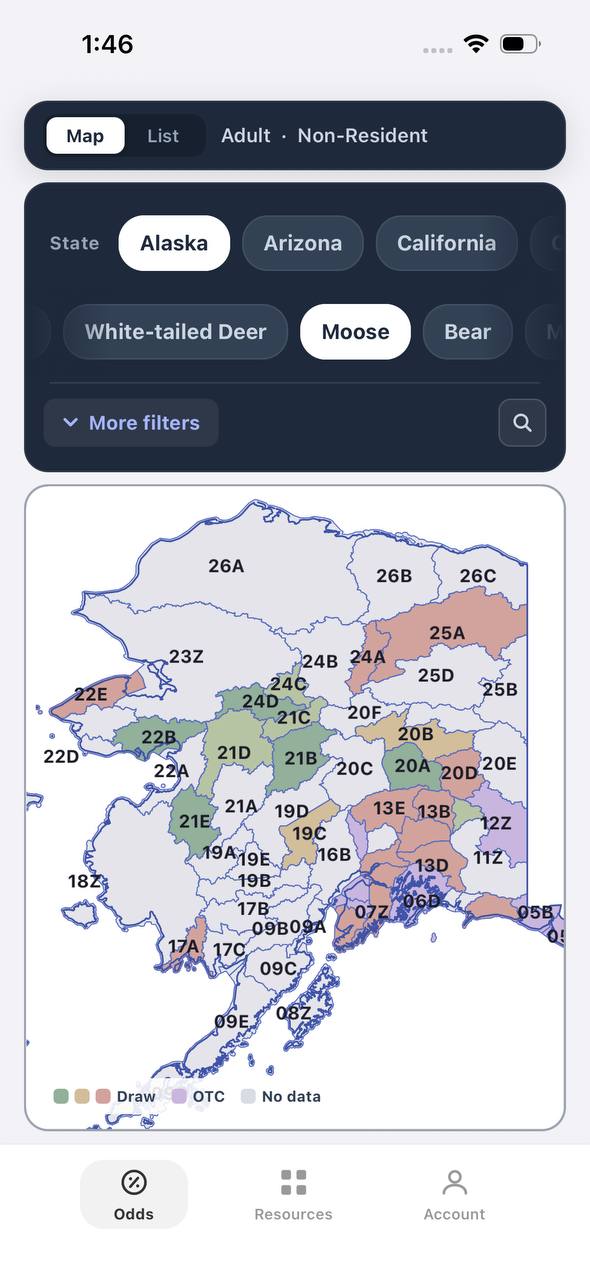
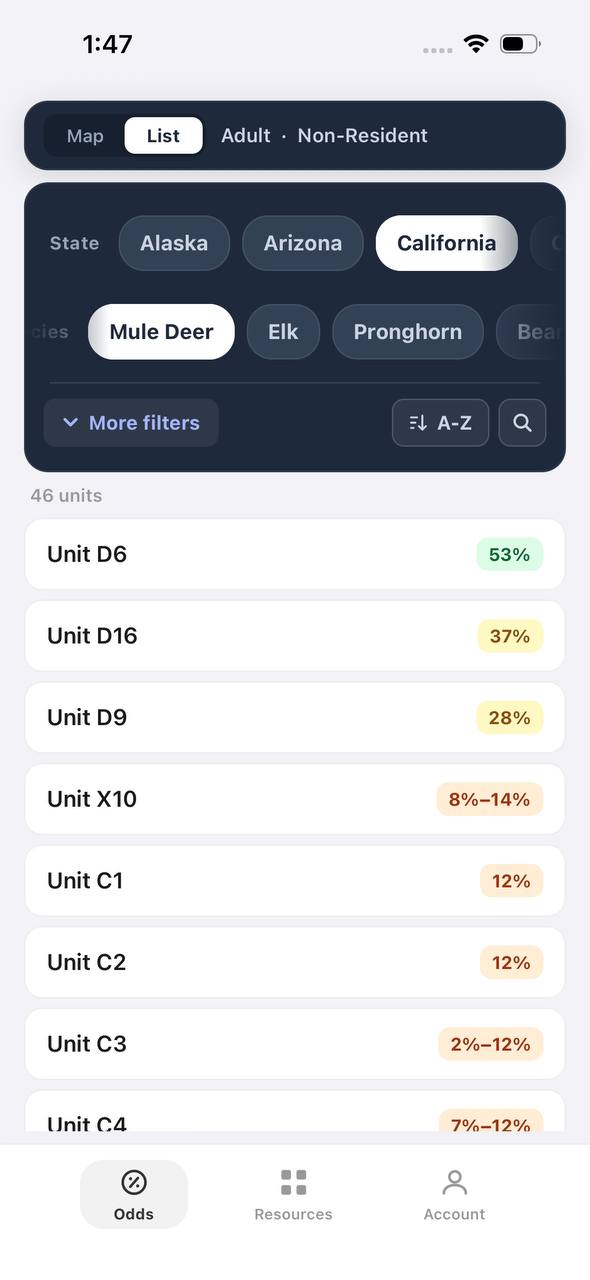
- Detailed draw odds
- Point tracking
- Deadline reminders
- 19 states covered

Free to join
Download mobile app
- Detailed draw odds
- Point tracking
- Deadline reminders
- 19 states covered
Free to join
Download mobile app
- Detailed draw odds
- Point tracking
- Deadline reminders
- 19 states covered
Second and Third Choices — Do They Matter?
Oregon processes all first-choice applications before moving to second choices, and second choices before third. This means your second and third choices only matter if you are not drawn in earlier rounds. Most controlled mule deer hunts fill during the first choice, leaving few tags for lower preferences. However, some archery hunts and a handful of early-rifle or late-season hunts do not fill and advance to second or third choices. Use your second choice for a hunt with slightly better odds than your first, and your third choice for a near-guaranteed draw. Do not list the same hunt twice; the system will ignore duplicate entries. If you list three competitive hunts with similar odds, you are essentially applying three times to hard draws and gaining nothing. A smarter strategy: aggressive first choice (20% odds), conservative second choice (60% odds), guaranteed third choice (general archery or a controlled hunt that went to third choice the prior year).
Application Deadlines and Costs for 2027
Oregon's controlled-hunt application period typically opens in early February and closes in mid-May. The exact 2027 dates will be announced in December 2026 on the ODFW website. Application fees are $8 for residents and $20 for nonresidents, charged per species. If you apply for mule deer, you pay one application fee regardless of how many hunt choices you list. If drawn, you must purchase the appropriate hunting license and deer tag before the season. Nonresident deer tags cost approximately $165-$170, while resident tags run $45-$50. Preference points cost $5 for residents and $15 for nonresidents and are purchased separately during the same application window if you do not apply or if you apply but are not drawn. Preference points are NOT automatically awarded; you must opt in or purchase them.
Common Mistakes That Cost Zero-Point Applicants
The biggest mistake is applying for a first-choice hunt that has not drawn a zero-point applicant in five years. No amount of optimism changes math: if a hunt averaged 8 points to draw last year and 150 applicants competed for 5 tags, your single entry will not win. Second mistake: ignoring weapon season. Rifle hunters who refuse to consider archery cut their draw odds in half across most units. Third mistake: not purchasing a preference point when unsuccessful. If you apply, are not drawn, and forget to buy a point, you waste a year and fall further behind. Fourth mistake: applying for popular units near Portland or Bend (Maury, Murderers Creek East) without researching recent odds — these hunts sound remote but draw heavy local pressure. Fifth mistake: assuming all eastern Oregon hunts are easy to draw. Some desert units (Wagontire, Beatys Butte rifle) are trophy destinations with point creep and tough odds despite remote locations.
FAQ — Oregon Mule Deer Draw With Zero Points
Can you draw an Oregon mule deer tag with zero points?
Yes. Dozens of controlled hunts issue tags to zero-point applicants every year, especially in northeast and southeast Oregon rifle and archery seasons. Draw odds range from 10% to over 50% depending on unit and weapon.
Do nonresidents have a realistic chance with zero points?
Yes, but in a limited number of hunts. Nonresident draw odds with zero points run 10-40% in units like Silvies, Beulah, and some Ochoco hunts. Focus on units with higher tag quotas and fewer total applicants.
Is archery or rifle easier to draw?
Archery is easier. Archery-only mule deer hunts draw with zero or one point in many units that require two to four points for rifle. Success rates are lower, but access to controlled units is faster.
How does Oregon's preference-point system work?
Each preference point equals one additional entry in the draw. A hunter with three points has four total entries (one base entry plus three bonus entries). Zero-point hunters have one entry and compete in the same lottery but with lower probability.
Should I apply for three hard-to-draw units or mix in an easy backup?
Mix in a backup. If all three choices are low-odds hunts, you will likely draw nothing. Use your third choice for a hunt that went to second or third choice last year or a general archery tag if you want to hunt in 2027.
What happens if I apply and do not draw?
You receive one preference point automatically if you applied and were unsuccessful. You do not need to purchase a point separately in that case. If you do not apply at all, you must purchase a point during the application window to keep building.
Was this article helpful?
Previous
New Mexico Mule Deer Draw Odds and Tag Guide 2027
New Mexico's 2027 mule deer draw offers both quality limited-entry hunts and accessible general-season opportunities across varied terrain. Understanding the two-tier system and unit-specific draw odds is essential for building a strategic application.
Related
Oregon Elk Draw Odds With Five Points: 2027 Application Strategy
Five preference points unlock several quality Oregon elk units with draw odds between 20-60%, including premium archery hunts in the Cascades and rifle hunts in northeastern Oregon.
Next
Utah Mule Deer Draw Odds and Tag Guide 2027
Utah's 2027 mule deer draw offers 38,000+ permits across general and limited-entry units, with odds ranging from guaranteed to 1-in-50 depending on weapon, region, and points. General-season tags require zero to three points for most hunters, while premium limited-entry units demand 10-20+ points.