Ten bonus points in Nevada's elk draw gives you 101 entries in the random selection, but the 2025 results show that in most nonresident hunts, ten points alone did not win a tag. Only four tags across all nonresident antlered elk hunts went to applicants at exactly the ten-point level, while many tags required higher point totals or fell to applicants in hunts with lighter competition. The squared-bonus-point system rewards persistence but does not guarantee success at any single point level, especially in high-demand units where applicants with twenty or thirty points submit hundreds of entries each.
How ten bonus points translate to entries in Nevada
Nevada's bonus-point formula is (points²) + 1. Ten points = (10²) + 1 = 101 entries in the random draw. A zero-point applicant has one entry; five points gives twenty-six entries; twenty points yields 401 entries. Each entry is an equal chance in the pool, so ten points give you 101 times the odds of a first-time applicant, but you are still competing against applicants with far more entries if they hold higher point totals. The formula applies separately to antlered elk, antlerless elk, and spike elk; ten antlered points do not carry over to antlerless hunts. Points are lost if you skip two consecutive years of applying in that category, and Nevada enforces a seven-year waiting period after drawing any elk tag before you can apply again.
Nonresident and resident applicants share the same point pool but draw from separate quotas. Approximately 90% of male elk tags are reserved for residents under Nevada's allocation policy, leaving nonresident hunts with far fewer tags and higher competition. The nonresident elk tag costs $1,200 if drawn; the application fee is $19 per draw. Residents pay $120 for the tag. These figures are from the 2026 season and should be confirmed with Nevada Department of Wildlife for 2027.
What happened to ten-point applicants in the 2025 nonresident elk draw
The 2025 draw data for nonresident antlered elk, any legal weapon, shows exactly four tags awarded to ten-point applicants across twenty-three different hunt combinations covering a total quota of ninety-seven tags. Most hunts either required higher points or awarded tags to applicants with fewer points who happened to win in the random draw. The three hunts where ten points won tags were Units 076, 077, 079, and 081 November 6-20 (two tags at ten points), Units 104, 121, and North 108 November 6-20 (one tag at ten points), and Units 221-223 November 21-December 4 (one tag at ten points). In all other hunts, winners either held more points or drew at lower levels in hunts with lighter competition.
The highest-demand hunt in 2025 was Units 111-115 November 6-20, which received entries from 247 ten-point applicants but awarded seven tags to applicants with seven, nine, nine, fifteen, eighteen, twenty-five, and twenty-five points. Units 221-223 November 6-20 drew from 193 ten-point applicants and awarded seven tags to winners with nine, eleven, twelve, fifteen, eighteen, twenty-three, and thirty points. In contrast, Unit 075 October 22-November 5 had only five ten-point applicants for one tag and awarded that tag to someone with more points. The data confirms that ten points is competitive in some hunts but not a guarantee in any of them, and the number of entries at higher point levels often dilutes the advantage of holding ten.
Why ten points is not enough in most Nevada elk hunts
Nevada's nonresident elk quotas are small, often one to nine tags per hunt. Even with 101 entries, you are competing in a pool where applicants with twenty points submit 401 entries and those with thirty points submit 901. In hunts like Units 111-115 or Units 221-223, where applicants at every level from zero to thirty points are applying, the pool can include thousands of entries for a handful of tags. Ten points puts you ahead of lower-point applicants but behind anyone with eleven or more, and the random draw does not favor you over someone with one more point who now has more entries than your 101.
Which Nevada elk hunts had the best outcomes for ten-point applicants in 2025
The 2025 data shows that Units 076, 077, 079, and 081 November 6-20 had the highest success rate for ten-point applicants, with two of eight tags going to that level. This hunt had seventy ten-point applicants. Units 104, 121, and North 108 November 6-20 and Units 221-223 November 21-December 4 each awarded one tag to ten-point applicants, but both hunts had fifty-five to 120 ten-point applicants.
Lower-demand hunts like Unit 075 or the South 108 area had fewer ten-point applicants, but still did not award tags at that level in 2025. The winners in those hunts either had more points or drew at lower levels. The takeaway is that even in hunts with light competition, ten points does not guarantee a tag, and in high-demand hunts, it is rarely competitive.
Free to join
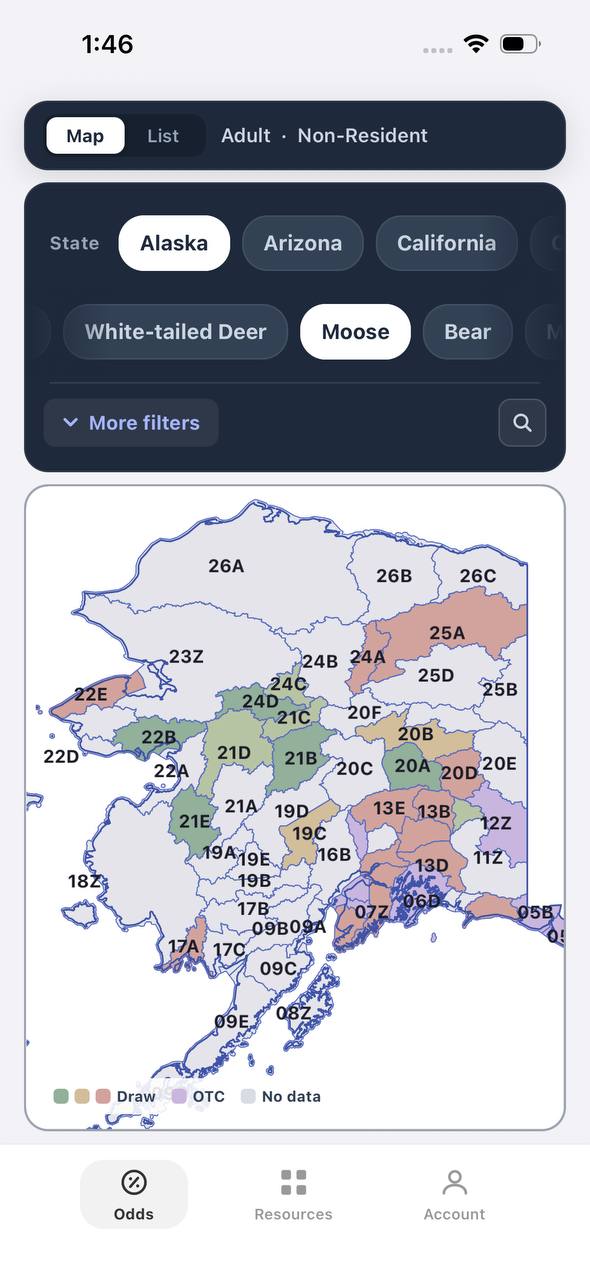
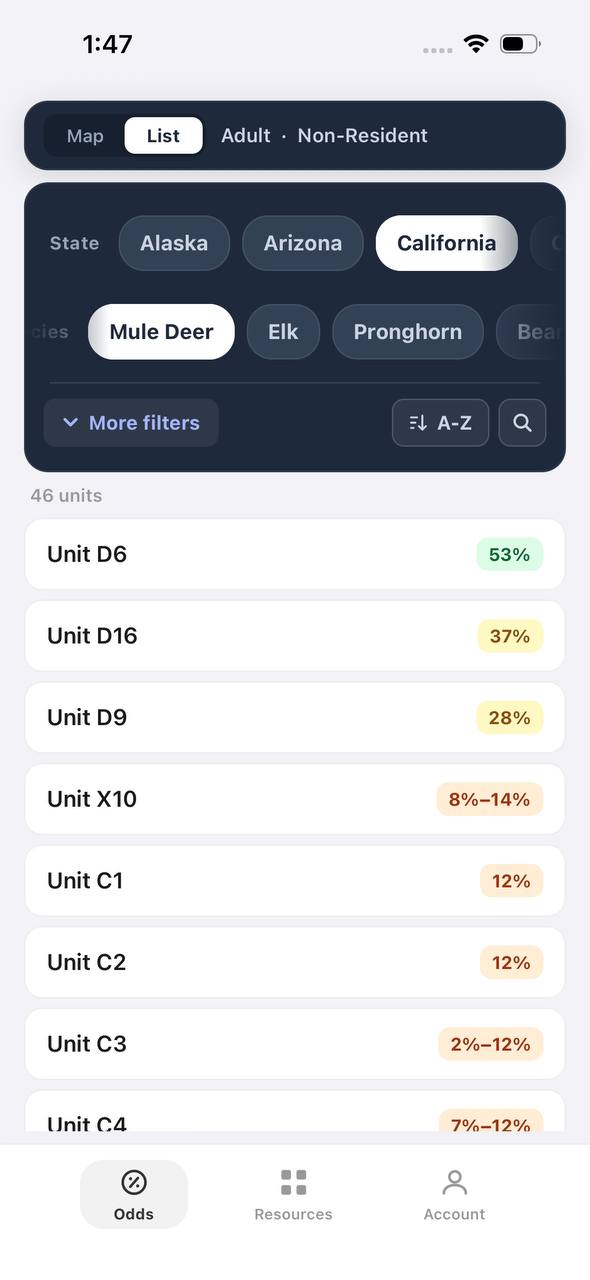
Download mobile app
- Detailed draw odds
- Point tracking
- Deadline reminders
- 19 states covered

Free to join
Download mobile app
- Detailed draw odds
- Point tracking
- Deadline reminders
- 19 states covered
Free to join
Download mobile app
- Detailed draw odds
- Point tracking
- Deadline reminders
- 19 states covered

Choosing hunts with ten points in Nevada
If you are applying with ten points, your best strategy is to spread your five hunt choices across hunts with moderate quotas and moderate point creep, avoiding both the most popular units and the hunts with only one or two tags. The 2025 data shows that hunts with quotas of six to nine tags sometimes awarded tags at the ten-point level, while hunts with quotas of one to three tags rarely did. Units with light overall competition may still require higher points if only a handful of applicants at each level are competing for a single tag.
Resident vs nonresident odds with ten points
This analysis covers only nonresident antlered elk hunts from the 2025 draw. Resident hunts draw from a separate quota pool, approximately 90% of tags under Nevada's allocation policy, and resident competition levels are not the same as nonresident. The bonus-point formula is the same for both groups, so ten points gives a resident 101 entries, but the number of applicants at each point level and the total number of tags differ significantly. Resident draw odds with ten points were not analyzed in this research and should be verified directly with Nevada Department of Wildlife's published resident bonus-point data.
Nevada does not publish separate point-level statistics for archery, muzzleloader, or antlerless elk hunts in the same detail as the any-legal-weapon antlered data reviewed here. If you are applying for those categories, the same point mechanics apply, but the competition and success rates at ten points are unverified.
What to expect for the 2027 Nevada elk draw
The 2027 elk draw dates, quotas, and unit boundaries have not been finalized as of October 2026. The 2026-2027 season regulations adopted changes to some elk hunts, including elimination of the Unit 251 antlered depredation hunt and the addition of a new early spike hunt in Units 161-164, but final 2027 quotas and point-level results will not be available until after the 2027 draw. The application fee and tag cost listed here are from the 2026 season and should be confirmed with Nevada Department of Wildlife before applying.
Nevada's bonus-point system has not changed in recent years, and the (points²) + 1 formula remains the standard. The seven-year waiting period after drawing a tag and the two-year grace period for skipping applications are still in effect. If you currently hold ten points and submit an application in the 2027 draw cycle, you will add one more point before the draw, giving you more entries than you held in 2026. Missing one year does not reset your points, but missing two consecutive years will reset you to zero in that category.
Plan your Nevada elk 2027 hunt with TAGZ
TAGZ tracks Nevada elk units, quotas, and draw trends so you can compare hunts and build a multi-year strategy based on real data, not guesses. You can filter by point level, quota size, and season dates to find hunts where ten or eleven points give you a realistic chance, or plan a long-term strategy to build points in less competitive hunts while avoiding the high-demand units where even twenty points may not be enough. Stop guessing. Start planning with TAGZ. Understanding Nevada's bonus point strategy helps you decide where to apply, and comparing Nevada elk draw odds with zero points or five points shows how quickly competition increases. If you are also researching other states, Colorado elk application strategy offers a different point system and timeline.
Official Nevada hunting sources
- Nevada Department of Wildlife Elk Bonus Point Data (2025)
- 2026 Big Game Application FAQ
- Nevada Bonus Point Mechanics
- Apply for Nevada Hunting
- Nevada Revised Statutes 502.250 (Tag Fees)
Last verified: October 22, 2026. This analysis uses 2025 draw data and 2026 fee/regulation information. Final 2027 quotas, hunt dates, and point-level results are not yet available. Confirm all requirements with Nevada Department of Wildlife before applying.
Was this article helpful?
Previous
Alaska Nonresident Sheep Draw Odds 2027
Alaska nonresident sheep hunts are lottery draws with no points system. Applications open November 1-December 15, 2026, for the 2027 season (RY2027). Nonresidents must hunt with a licensed guide or qualifying relative.

Related
Nevada Nonresident Elk Draw Odds 2027
Nevada's nonresident elk draw uses squared bonus points, with 2025 data showing top units requiring 10-25+ points while some tags went to 1-5 point holders. Learn how the system works, which hunts offer the best odds, and how to build points strategically.
Next
Alaska Brown Bear Draw Odds 2027
Alaska brown bear draw odds are unconfirmed for 2027, but recent undersubscribed hunts show opportunity exists alongside highly competitive Kodiak draws.