Nevada Big Game Draw Guide 2027: Deadlines, Bonus Points & Application Strategy
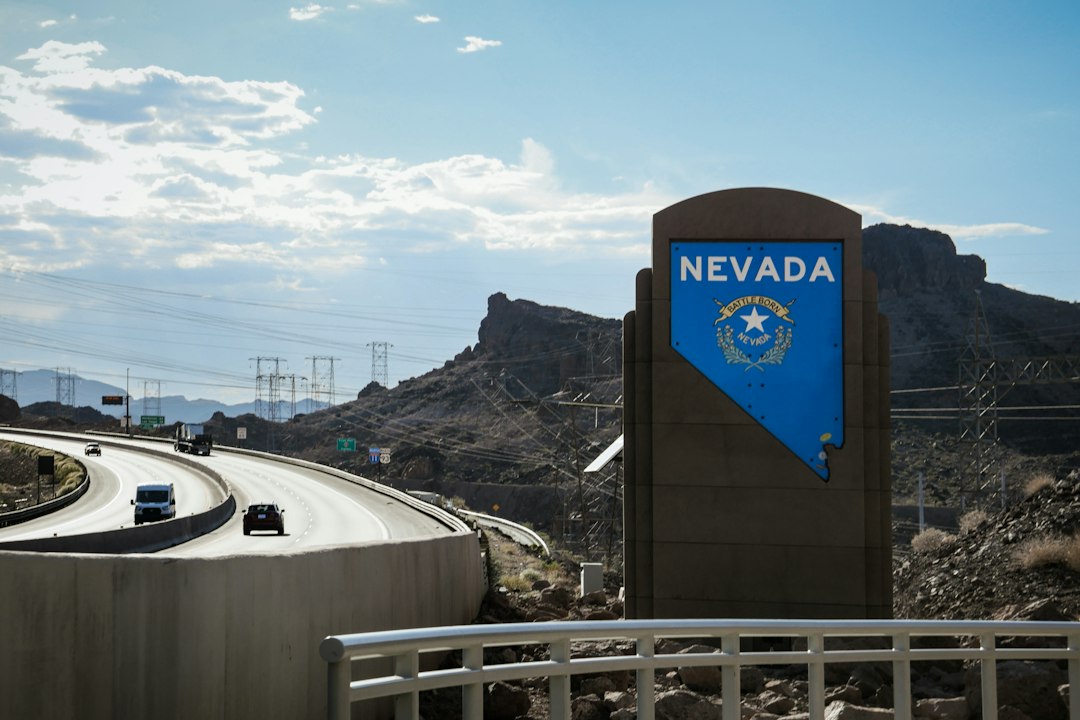
Nevada's 2027 big game draw opens in early March, with applications due by the first Tuesday in May. The state uses a bonus point system that squares your points to improve draw odds each year, and resident hunters receive 80 percent of most tags while nonresidents compete for the remaining 20 percent. Understanding how bonus points work, which species offer the best odds, and how to structure your application choices can make the difference between drawing a coveted tag and burning another year of points.
Nevada's Bonus Point System Explained
Nevada awards one bonus point per species per year when you apply or purchase a point. Your total bonus points are squared when your name goes into the draw, meaning five points become 25 entries while 10 points become 100 entries. This system rewards long-term applicants but still allows first-time hunters a chance — a hunter with zero points has one entry, while a hunter with one point has four entries (one for the application plus one squared bonus point equals two entries, but the math actually gives you one entry for applying plus one bonus point squared, which is one, for a total of two entries). The squaring effect accelerates odds as points accumulate, making consistent applications critical. Bonus points are species-specific, so your elk points do not help with mule deer or pronghorn applications. Points cost the same as the application fee, currently $10 per species for residents and $150 per species for nonresidents, and must be purchased by the application deadline to count toward the current draw.
Application Deadlines & Drawing Timeline
Applications for Nevada's 2027 big game draw open in early March and close at 11:59 PM Pacific Time on the first Tuesday in May. The exact 2027 deadline will be announced by Nevada Department of Wildlife in late 2026, but based on the established pattern, expect applications to close on May 6, 2027. Draw results are typically released in mid to late June, giving successful applicants several months to plan hunts that run from late August through November depending on species and unit. Late-season hunts for deer and elk can extend into December in some units. If you miss the May deadline, you cannot apply for that year, but you can still purchase a bonus point during a separate point-only period that typically runs through mid-December. Missing the application window entirely means losing a year of point accumulation unless you purchase a point during the point-only period.
Resident vs. Nonresident Tag Allocation
Nevada allocates up to 80 percent of most big game tags to residents, with the remaining 20 percent available to nonresidents. This split applies to elk, mule deer, pronghorn, mountain goat, and California bighorn sheep. Desert bighorn sheep tags follow a different allocation with up to 90 percent going to residents and 10 percent to nonresidents. The allocation is calculated on a unit-by-unit basis, so a unit with 100 elk tags would offer approximately 80 to residents and 20 to nonresidents. When the math results in a fraction, Nevada rounds in favor of residents. Nonresident applicants face significantly longer odds than residents in the same units, making bonus point accumulation even more critical for out-of-state hunters. Nonresidents must also purchase a $160 hunting license before applying, while residents pay $50 for a hunting license and lower application fees.
Species-Specific Draw Odds & Strategies
Elk tags in Nevada are among the most competitive in the West, with most units requiring five to 15 bonus points for nonresidents to draw any-bull tags. Resident odds are better but still challenging in premium units like the Ruby Mountains or Jarbidge. Mule deer tags vary widely by unit and season — archery hunts in less-pressured units may draw with zero to three points, while rifle hunts in trophy units like the Rubies can take 10 or more points for nonresidents. Pronghorn tags offer some of the best odds for first-time applicants, with multiple units drawing in the zero to two point range for both residents and nonresidents, though top-tier units still require five-plus points. Desert bighorn sheep and California bighorn sheep are true once-in-a-lifetime draws, with most successful nonresident applicants holding 15 to 20-plus bonus points. Mountain goat tags are similarly difficult, with only a handful issued each year.
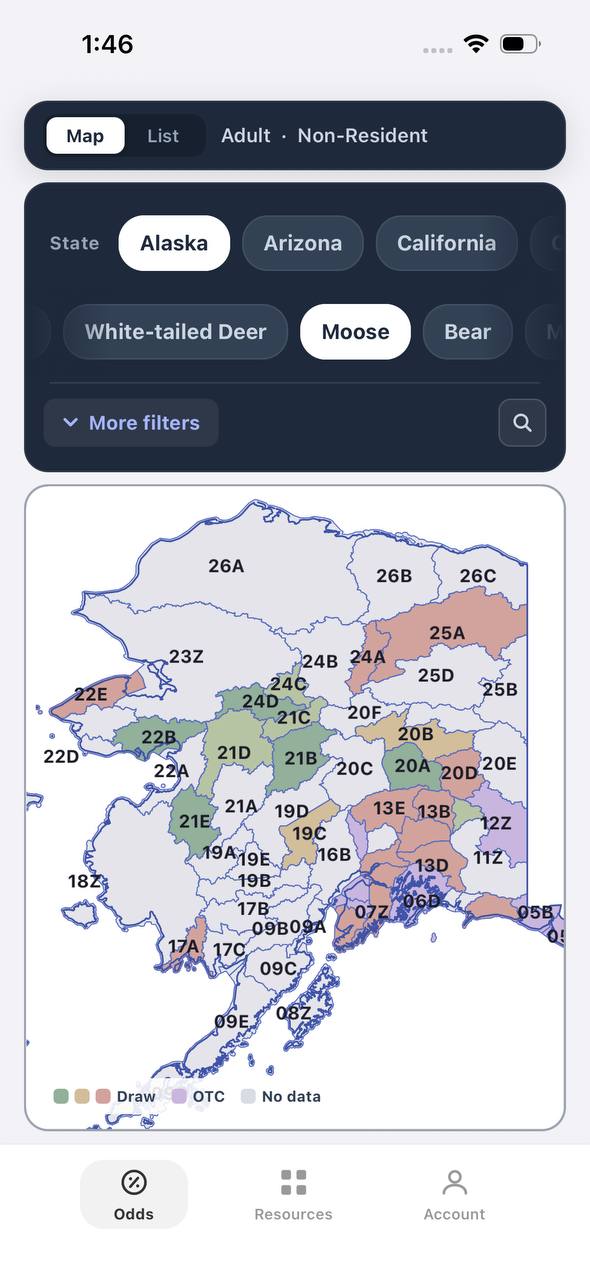
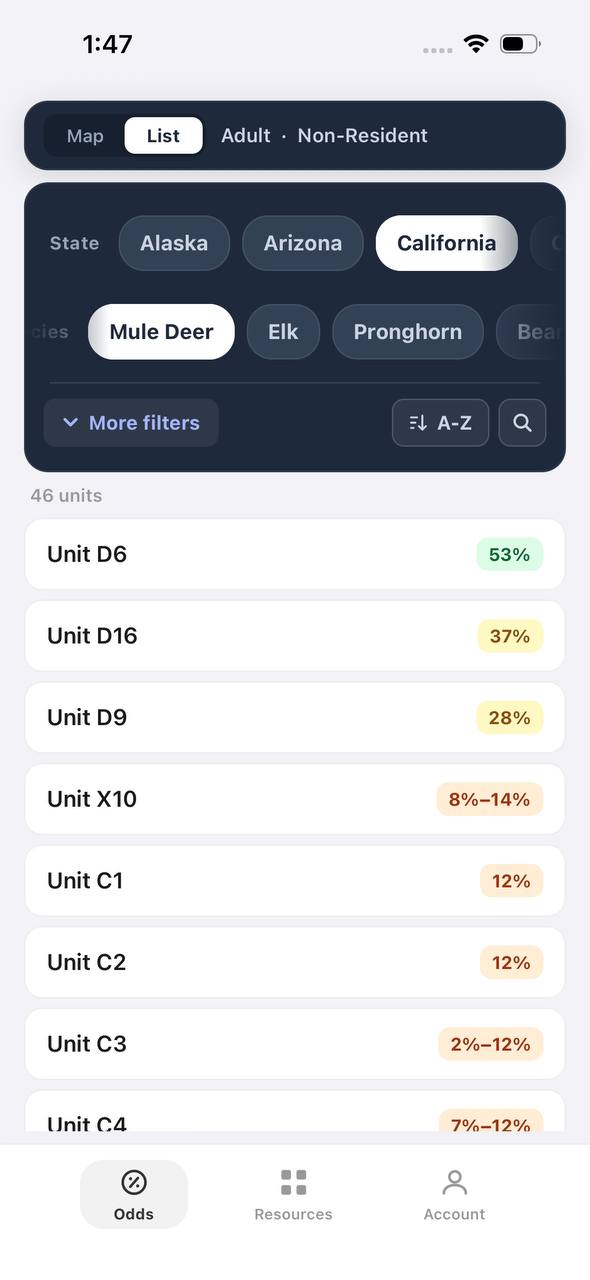
Free to join
Download mobile app
- Detailed draw odds
- Point tracking
- Deadline reminders
- 19 states covered

Free to join
Download mobile app
- Detailed draw odds
- Point tracking
- Deadline reminders
- 19 states covered
Free to join
Download mobile app
- Detailed draw odds
- Point tracking
- Deadline reminders
- 19 states covered
How to Structure Your Application Choices
Nevada allows up to five hunt choices per application, ranked in order of preference. The draw system evaluates your first choice using all your squared bonus points, and if you are not drawn, it moves to your second choice with the same number of entries, and so on through your fifth choice. This structure allows you to apply for a dream hunt as your first choice while listing more realistic hunts as backup options. A common strategy is to front-load your choices with one or two low-odds premium hunts, then include three mid-tier hunts that match your current point total and offer reasonable draw odds. You can also apply for multiple seasons or weapon types within the same species, such as listing an archery elk hunt as your first choice and a rifle elk hunt in a different unit as your second choice. Each choice must be a different hunt code — you cannot list the same hunt code twice. If you draw any of your five choices, your bonus points for that species reset to zero, so carefully evaluate whether a mid-tier hunt is worth burning accumulated points or if you should focus only on your top-choice units.
Controlled Hunt vs. Unlimited Archery Hunts
Nevada offers a limited number of unlimited archery deer hunts in certain units where no draw is required. These hunts allow any licensed hunter to purchase a tag over the counter, though tag sales are limited and often sell out quickly when they go on sale in July. Unlimited archery hunts are typically in more remote or difficult units where hunter pressure and harvest success are naturally limited. If you are a nonresident with few or no bonus points and want to hunt Nevada deer in 2027, purchasing an unlimited archery tag may be your best option rather than applying for a controlled draw hunt with low odds. Controlled draw hunts cover all other weapon types and most popular units, and they require going through the application process with bonus points playing a major role in draw odds. Elk, pronghorn, bighorn sheep, and mountain goat hunts are all controlled draws with no over-the-counter options.
Preference vs. Bonus Points: Nevada's Unique Approach
Unlike states that use true preference point systems where the highest point holders are guaranteed tags, Nevada's bonus point system is weighted randomness. A hunter with 20 bonus points has 400 entries in the draw (20 squared), but a hunter with zero points still has one entry and could theoretically win. In practice, tags in high-demand units nearly always go to applicants with many points because their squared entries dominate the draw pool. Lower-demand units may see tags awarded to hunters with zero to two points simply because fewer total applicants are in the pool. This system creates more variability than true preference points, which can be an advantage or disadvantage depending on your point total and risk tolerance. Hunters chasing trophy units should expect to invest five to 15 years of bonus point accumulation, while hunters willing to hunt less-pressured units can draw tags with minimal points.
Application Fees & License Requirements
Resident application fees for 2027 are $10 per species, while nonresident application fees are $150 per species. If you apply for multiple species, you pay the application fee for each. Residents must hold a valid Nevada hunting license ($50) before applying, and nonresidents must purchase a $160 hunting license. License sales for 2027 typically open in January, and you must have your license in hand before submitting your application. If you draw a tag, you will pay the tag fee upon notification — resident elk tags cost $120, nonresident elk tags cost $1,200, resident deer tags cost $60, and nonresident deer tags cost $300. Pronghorn tags are $60 for residents and $300 for nonresidents. Bighorn sheep and mountain goat tags carry significantly higher fees, with nonresident bighorn sheep tags exceeding $2,400. Tag fees are non-refundable once drawn, so make sure you can commit to the hunt before applying.
Leftover Tags & Second Draws
Nevada does not conduct a formal second draw like some Western states, but leftover tags from the initial draw are made available for purchase on a first-come, first-served basis starting in late June or early July. Leftover tags are typically from less-desirable units or late-season hunts where harvest success is lower or access is difficult. The number of leftover tags varies year to year depending on how many applicants there were for each hunt and how many tags went unfilled. Purchasing a leftover tag does not require bonus points and does not cost you any accumulated points, making it a good option for hunters who want to hunt Nevada in 2027 but did not draw in the initial lottery. Leftover tags are posted on the Nevada Department of Wildlife website and sell out quickly for any hunt with decent access or reasonable odds.
FAQ — Nevada Big Game Draw
When is the 2027 Nevada big game application deadline?
Applications close at 11:59 PM Pacific Time on the first Tuesday in May 2027, which is expected to be May 6, 2027. Applications open in early March, and results are released in mid to late June.
How do Nevada bonus points work?
Nevada squares your bonus points to determine your number of entries in the draw. Five bonus points become 25 entries, 10 points become 100 entries, and so on. Points are species-specific and cost $10 for residents or $150 for nonresidents.
What percentage of Nevada big game tags go to nonresidents?
Up to 20 percent of elk, mule deer, pronghorn, mountain goat, and California bighorn sheep tags are allocated to nonresidents, with residents receiving up to 80 percent. Desert bighorn sheep tags are 10 percent nonresident and 90 percent resident.
Can I apply for multiple species in the same year?
Yes. You can apply for elk, deer, pronghorn, bighorn sheep, and mountain goat in the same year, and you can draw tags for multiple species. Each species requires a separate application fee, and you accumulate bonus points separately for each species.
Do I lose my Nevada bonus points if I draw a tag?
Yes. If you draw a tag for a species, your bonus points for that species reset to zero. Points for other species remain intact. This makes choosing your application strategy critical if you have accumulated many points.
Are there any over-the-counter big game tags in Nevada?
Yes. Nevada offers unlimited archery deer tags in select units, sold over the counter starting in July. These tags do not require a draw application, but they sell out quickly and are limited in number and unit availability.
Was this article helpful?
Previous
Wyoming Elk Draw Odds With Three Points: 2027 Analysis
Three preference points give nonresidents realistic odds in 25+ Wyoming elk units for 2027, including quality General tags and select Limited Quota hunts in underrated regions.
Related
DIY vs Guided Grizzly Bear Hunting: How to Choose Your Hunt
Grizzly hunts demand either extensive backcountry experience and local knowledge or a qualified guide who can manage logistics, navigate bear behavior, and ensure legal compliance. Most hunters opt for guided hunts due to regulatory requirements and the complexity of bear country.
Next
Alaska Moose Draw Odds 2027: Unit-by-Unit Breakdown & Application Strategy
Alaska's moose draws are competitive, especially for nonresidents in high-demand units like 13B and 20A. Understanding tier systems, point structures, and resident-priority rules is key to planning a successful 2027 application.