Kansas awards every nonresident whitetail deer permit through an April lottery. In 2026, all 18 units drew applicants at zero preference points, meaning odds favored new applicants as much as veterans. Permit holders harvest one whitetail (buck or doe) and receive a bonus antlerless tag at no extra charge. Fees run about $475-$477.50 for adults plus a $125 nonresident hunting license, and unsuccessful applicants automatically receive a preference point. Whether you hunt river corridors in the east or milo stubble in the west, understanding the draw timeline, quotas and unit characteristics will help you plan a Kansas whitetail hunt in 2027.
How does the Kansas nonresident deer draw work?
Kansas Department of Wildlife and Parks (KDWP) holds a single nonresident whitetail lottery each spring. The 2026 application window ran April 1-24; hunters applied online at gooutdoorskansas.gov or by phone. You must hold a valid nonresident hunting license at the time you apply. The application allows you to designate a primary unit, add one adjacent unit, and specify equipment preference (archery, muzzleloader or firearm). You may list up to four unit-combination choices and may join a group application. Groups allow family or friends to hunt together if all members draw.
Every unsuccessful applicant automatically receives one preference point at no extra cost. You may also purchase a point during the April window without applying for a permit by selecting "Apply for points only" (cost $25 in 2026). Points expire if you do not apply or purchase a point within five consecutive years. In 2026, however, every unit awarded permits to applicants with zero points; the system functioned as a random draw rather than a true preference-point ladder. If you are drawn, KDWP charges the full permit fee to your card the day results are announced; if not drawn, only the application fee is deducted.
What are the fees and permit details?
Official KDWP pages listed adult whitetail permits at $475.00 or $477.50 in 2026 (including a $25 or $27.50 nonrefundable application fee; the difference may reflect an online processing charge). Youth permits (age 15 and under) cost about $115-$117.50. A nonresident hunting license runs $125 adult or $40 youth in 2026. Add an internet convenience fee if you apply online. The full permit price is charged only if you draw. Verify current 2027 fees on the KDWP site before applying, as prices may shift year to year.
Your either-sex permit allows harvest of one whitetail (buck, doe or fawn) plus one additional whitetail antlerless at no extra cost. This bonus tag is useful during extended antlerless-only (WAO) seasons in January. Anyone born on or after July 1, 1957 must show proof of hunter education. After harvest, tag the deer immediately and complete electronic check-in as required by Kansas law.
Which units had the best 2026 draw odds?
In 2026, KDWP authorized nonresident either-sex permits across 18 units, with quotas ranging from 228 in Unit 18 to 3,564 in Unit 11. Third-party data suggest that every unit drew applicants at zero points, meaning first-time applicants had the same statistical chance as those holding multiple points. Units with larger quotas absorbed more applications and still drew zero-point hunters. Unit 11 authorized 3,564 permits; Unit 12 authorized 2,303; Unit 8 authorized 1,841. Smaller-quota units like Unit 18 (228 permits) and Unit 17 (619 permits) also drew zero-point applicants but received fewer total applications.
Exact first-choice applicant counts for 2026 are not yet confirmed on official KDWP records. A third-party republication showed Units 11, 12, 14 and 8 received thousands of applications each, while Units 1, 2, 17 and 18 (the far-western mule deer-whitetail overlap zones) received fewer. If official numbers confirm these patterns, expect Units 11, 12, 14 and 8 to remain high-demand but still drawable at zero points unless quotas shrink or applications surge. Monitor the KDWP quotas-and-draw-stats page for updated 2027 figures once the agency publishes them.
What is the Mule Deer Stamp option?
Hunters who draw an archery or muzzleloader whitetail permit in Units 1, 2, 17 or 18 may apply for a Mule Deer Stamp during the April lottery. The stamp costs $150 on top of the either-sex permit and converts your tag to an either-species license, allowing harvest of one mule deer or one whitetail (plus the bonus antlerless tag for whitetail). In 2026, Units 1, 2, 17 and 18 authorized small numbers of stamps (19, 15, 30 and 15 respectively). This option targets the short-grass prairie in far western Kansas where mule deer range overlaps whitetail habitat. Mule Deer Stamp draws do not use preference points; they are a separate random lottery among eligible permit holders.
Free to join
Download mobile app
- Detailed draw odds
- Point tracking
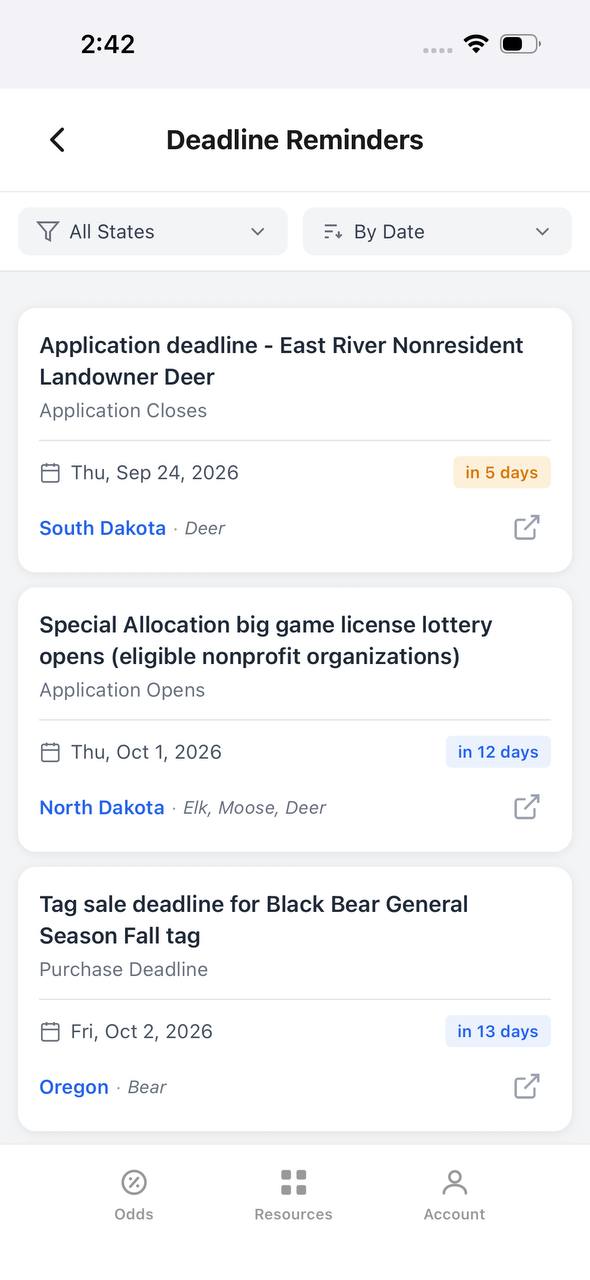
- Deadline reminders
- 19 states covered

Free to join
Download mobile app
- Detailed draw odds
- Point tracking
- Deadline reminders
- 19 states covered
Free to join
Download mobile app
- Detailed draw odds
- Point tracking
- Deadline reminders
- 19 states covered
When are the 2026-2027 Kansas deer seasons?
Kansas offers multiple seasons across gear types. The 2026-2027 dates (subject to annual changes) began with youth and disability hunts September 5-13, 2026. Early muzzleloader opened September 14-27; archery ran September 14 through December 31. A pre-rut firearm antlerless season occurred October 10-12 (extended October 13-18 in Unit 12). Regular firearm season spanned December 2-13, 2026. Extended WAO (whitetail antlerless only) seasons ran in January 2027: Units 3, 4-10 and 16 had openings January 1-10 or January 1-17; Units 11-15 and 19 extended through January 24; an extended archery WAO followed January 25-31 in Unit 19. Units 1, 2, 17 and 18 do not offer extended WAO seasons. If you draw an either-sex permit and do not fill it during the main season, you may hunt antlerless deer in the January WAO where available.
Check the KDWP big-game season calendar each year for updates. Weather and rut timing vary; peak rut activity in Kansas generally falls in mid-November, aligning with the regular firearm season, but cold fronts and lunar phase can shift deer movement week to week.
Where can nonresidents hunt in Kansas?
Kansas hosts over one million acres of Walk-In Hunting Access (WIHA) and improved Walk-In Hunting Access (iWIHA), private land enrolled by cooperating landowners. WIHA tracts open for fall hunting September 1 or November 1 and close January 31, March 31 or May 31 depending on the property. Check the KDWP Hunting Atlas online for current boundaries and access dates. Your first WAO permit is valid on WIHA; additional WAO permits (numbers 2-5) are restricted to Elk City and Berentz-Dick wildlife areas plus WIHA, not other KDWP wildlife areas.
Public wildlife areas managed by KDWP offer additional options but vary by region. Some have limited acreage or concentrated pressure during firearm season. Scout ahead of the season; identify bedding cover, food sources and travel routes. Whitetails in Kansas use riparian timber, shelterbelts, crop edges and thick draws. Pressure pushes deer into cover during opening weekend of firearm season, but patient still-hunting or stand placement along travel corridors can produce opportunities mid-week or late in the season.
Free to join
Download mobile app
- Detailed draw odds
- Point tracking
- Deadline reminders
- 19 states covered
Free to join
Download mobile app
- Detailed draw odds
- Point tracking
- Deadline reminders
- 19 states covered
Free to join
Download mobile app
- Detailed draw odds
- Point tracking
- Deadline reminders
- 19 states covered
What leftover or additional permits exist?
Kansas historically offered leftover permits after the April draw if quotas were not filled. The 2026 and 2025 quota-and-draw-stats pages showed no leftover permits listed, suggesting all units sold out in the lottery. No official leftover-sale procedure or dates are confirmed for 2027. If leftovers become available, KDWP typically announces the sale window on its website; watch for updates in late spring or summer. Kansas also issues special permits (Hunt-Own-Land, Tenant, WAO-only) with different fees and eligibility; these are not part of the main nonresident draw. Review the KDWP license-and-fee schedule for details on those categories.
How do preference points affect your strategy?
Kansas preference points cost $25 each and can be purchased only during the April application window. If you do not draw, you automatically receive one point at no extra charge. Points expire if you skip five consecutive years without an application or point purchase. In 2026, every unit drew applicants at zero points, so holding points offered no advantage. This random-draw dynamic may continue if demand remains steady and quotas stable. If you apply in 2027 and do not draw, you will enter 2028 with one point, but that point may not improve odds unless future demand surges or KDWP shifts to a true preference system where points determine draw order.
Given the zero-point-draw pattern, there is no reason to bank points for years. Apply for your preferred unit each cycle. If you draw, hunt. If not, your automatic point accumulates without extra cost. If KDWP tightens quotas or applications spike, points might become more valuable; until then, treat the draw as a near-random lottery with broad opportunity across all units.
What are the challenges and realities of Kansas whitetail hunting?
Kansas is known for producing mature whitetails, but success is not guaranteed. Public-land hunters face competition during firearm season, especially opening weekend. Stands near roads or parking areas see heavy traffic; walk farther or hunt midweek for less pressure. Archery and muzzleloader seasons offer longer windows and lighter crowds, though weather can be warm in September and unpredictable in late fall.
Habitat and scouting considerations
Whitetails in Kansas use agricultural habitat heavily; identify cornfields, soybean stubble and winter wheat that draw deer during feeding periods. Timber along creeks and rivers holds bedding deer; glass edges at dawn and dusk. Weather drives movement. A cold front during the rut can trigger significant activity; warm, windless days produce minimal daylight sightings. Scout before the season to locate sign (rubs, scrapes, trails) and identify funnels or pinch points between bedding and feeding areas.
If you hunt WIHA, respect access rules and avoid trespassing onto adjacent private land. Carry maps, check boundaries and confirm tract-specific dates. Harvest rates vary by unit and season; official harvest statistics are not confirmed in this research, so verify recent success data on the KDWP website before choosing a unit. For Iowa nonresident deer draw information on a neighboring state, see our related guide. For another state with a different draw structure, explore Idaho nonresident deer draw strategies and how Idaho's system compares to Kansas.
Free to join
Download mobile app
- Detailed draw odds
- Point tracking
- Deadline reminders
- 19 states covered
Free to join
Download mobile app
- Detailed draw odds
- Point tracking
- Deadline reminders
- 19 states covered
Free to join
Download mobile app
- Detailed draw odds
- Point tracking
- Deadline reminders
- 19 states covered
Plan your Kansas deer 2027 hunt with TAGZ
TAGZ helps you compare Kansas units, track application deadlines and organize your western big-game strategy across multiple states. Enter Kansas deer as a target, review quota trends and monitor when the 2027 application window opens. TAGZ does not predict draw results or guarantee tags, but it centralizes official data so you can make informed decisions about which unit and equipment type best fit your hunting goals. Stop guessing. Start planning with TAGZ.
Official Kansas hunting sources
- KDWP deer applications and fees: https://ksoutdoors.gov/Hunting/Applications-and-Fees/Deer
- KDWP deer overview: https://www.ksoutdoors.gov/outdoor-activities/hunting-in-kansas/what-to-hunt/big-game/deer
- KDWP news release (April 13, 2026): https://www.ksoutdoors.gov/Home/Components/News/News/26/346
- KDWP hunting licenses and permit fees: https://www.ksoutdoors.gov/licenses-permits-fees/hunting-licenses-permit-fees
- KDWP big-game seasons and deadlines: https://ksoutdoors.com/Hunting/When-to-Hunt/Big-Game
- KDWP quotas and draw stats: https://ksoutdoors.com/Hunting/Applications-and-Fees/Deer/Quotas-and-Draw-Stats
- KDWP Walk-In Hunting Access (WIHA): https://www.ksoutdoors.gov/outdoor-activities/hunting-in-kansas/where-to-hunt
Last verified: October 22, 2026. Data reflects the 2026 draw cycle and 2026-2027 season. The 2027 application window, fees, quotas and exact season dates are not yet published by KDWP. Permit fees listed as approximately $475-$477.50 adult and $115-$117.50 youth reflect conflicting figures on official pages; verify current fees before applying. Leftover permit procedures, official 2026 applicant counts and harvest statistics remain unconfirmed. Confirm all requirements, deadlines and regulations directly with KDWP before submitting your 2027 application.
FAQ — Kansas nonresident deer draw
When is the 2027 Kansas deer application deadline? The 2026 window ran April 1-24. KDWP has not yet announced the 2027 dates, but expect a similar April timeframe. Monitor the KDWP deer applications page for the official opening.
Do I need preference points to draw a Kansas whitetail permit? In 2026, every unit drew applicants at zero points. Points currently offer no advantage, but unsuccessful applicants automatically receive one point. If demand increases or quotas drop in future years, points might become more important.
What is the Kansas Mule Deer Stamp and who can apply? The Mule Deer Stamp ($150) is available to archery or muzzleloader whitetail permit holders in Units 1, 2, 17 or 18. It converts your either-sex whitetail tag to an either-species tag, allowing harvest of one mule deer or one whitetail. The stamp is a separate random lottery during the April draw and does not use preference points.
Can I hunt WIHA with my nonresident either-sex permit? Yes. Your first WAO permit is valid on WIHA tracts. Additional WAO permits (numbers 2-5) are restricted to Elk City and Berentz-Dick wildlife areas plus WIHA. Check the KDWP Hunting Atlas for current boundaries and access dates before hunting.
What if I do not fill my either-sex permit during the regular season? Unfilled either-sex permits are valid during extended WAO seasons in January where offered. Units 3, 4-10, 11-15, 16 and 19 have extended antlerless-only hunts; Units 1, 2, 17 and 18 do not. Check the KDWP big-game calendar for exact dates and unit-specific regulations.
Was this article helpful?
Previous
Wisconsin Deer Hunting Guide 2027: Seasons, Tags & Regulations
Wisconsin's 2027 deer seasons offer multiple weapon choices and a straightforward tag system. Plan your hunt with this breakdown of season dates, license requirements, and harvest rules.
Related
Questions to Ask Before Booking a Desert Bighorn Sheep Hunt
Essential questions to ask before booking a desert bighorn sheep hunt, covering outfitter verification, costs, hunt details, physical demands and state-specific requirements across seven western states.
Next
Wisconsin Nonresident Deer Hunting 2027: Licenses, Costs & Rules
Wisconsin offers nonresident deer hunters both gun and bow licenses with straightforward application processes and reasonable costs. Understanding the bonus point system, preference system options, and license types helps nonresidents maximize their chances of drawing quality tags.