Guided Elk Hunts With No Preference Points: 2027 Guide

ElkColoradoOTC
14 min read·Sep 18, 2026·TAGZ
Guided Elk Hunts With No Preference Points: 2027 Guide

Hunters with zero preference points can still book guided elk hunts across multiple Western states. The key is knowing which states offer pathways beyond limited-entry draws: OTC licenses in Colorado, random draws in Idaho and Wyoming, point-free systems in New Mexico, and outfitter-allocated tags in Idaho. Understanding the tag pathway before you book prevents expensive surprises later.

One of the biggest misconceptions in Western elk hunting is believing that no points equals no options. That's not accurate. You may not realistically draw every famous limited-entry elk hunt, but you can absolutely hunt elk this year or next by choosing the right state and license type. The difference between "no points required" and "OTC" matters more than most hunters realize.

What "No Preference Points Required" Actually Means

A guided hunt that doesn't require years of point building might use an OTC license you purchase directly, a random drawing where everyone has a chance regardless of point total, or a general-license drawing that isn't necessarily for a highly limited individual unit. Zero-point limited hunts exist where historical results show specific hunts have been available to applicants with zero points. Some states allocate licenses specifically for hunters using qualifying licensed outfitters, and landowner vouchers or authorizations can provide another pathway. Leftover or reissued licenses sometimes become available after a drawing. These are very different systems, and understanding the difference can save you from booking a hunt and later discovering you don't have a tag.

Colorado Guided Elk Hunts With No Preference Points

Colorado remains one of the clearest states to research if you want to book a guided elk hunt without building years of preference points. Colorado currently offers certain over-the-counter rifle elk licenses available to nonresidents that don't require preference points. That means you can potentially find an outfitter operating in an eligible OTC area, confirm the appropriate season and license, purchase the eligible OTC elk license, and hunt without waiting years to draw. For someone who wants to hunt elk sooner, that's a legitimate pathway.

Not every Colorado unit is OTC. This is important because Colorado OTC licenses are valid only in eligible units and seasons. Booking a Colorado outfitter doesn't magically make a limited license OTC. Always ask what exact license this hunt requires. For more context on how Colorado's system works, see best elk units you can draw with 0 points 2026.

Be especially careful with outdated archery information. Colorado changed most traditional nonresident OTC archery elk opportunities west of I-25 to limited licenses beginning with the 2025 season. Certain OTC nonresident archery opportunities remain east of I-25. So if an article says "Colorado is OTC archery for nonresidents," that's too broad under the current system.

A limited license doesn't automatically require ten preference points. Some Colorado elk hunt codes may historically be available at low or zero points. Other opportunities can appear through secondary draw, leftover licenses, or reissued licenses. Historical results don't guarantee what will happen in 2027, but they're worth researching.

Colorado's Landowner Preference Program can create another pathway to limited licenses. Some outfitters may have relationships with landowners who have secured transferable vouchers. Before booking, determine whether the voucher is already secured, what hunt code it covers, whether it's transferable, whether it's private-land-only or unrestricted, whether the voucher is included in the hunt price, and what additional license costs apply. A landowner voucher isn't automatically the same thing as a guaranteed elk license.

Idaho Guided Elk Hunts With No Preference Points

Idaho is particularly interesting because Idaho doesn't have preference or bonus points for its traditional controlled-hunt system. You don't start "behind" someone who has been building elk points for ten years. Those points don't exist. That makes Idaho fundamentally different from preference-point states for hunters starting from scratch.

Older information describing Idaho nonresident general elk tags as a simple OTC or first-come purchase is outdated. Beginning with the 2026 season, Idaho moved standard nonresident general deer and elk tag distribution to an application and random drawing. That means a nonresident shouldn't simply book an Idaho elk hunt assuming they'll purchase a general tag OTC afterward.

The good news is that Idaho still doesn't use preference points. A first-time applicant can have an opportunity. The important variables are things like elk zone, A or B tag, applicant demand, tag quota, residency, and specific controlled hunt where applicable. For the first 2026 nonresident general elk drawing, Idaho reported an overall applicant success rate of approximately 32.15 percent. But that's statewide, and individual elk-zone and tag-type results can differ substantially.

This is where Idaho becomes particularly relevant for someone searching specifically for a guided hunt. Idaho allocates part of its nonresident general elk quota for outfitted hunters. For the 2026 season, 2,975 nonresident elk tags were allocated for outfitted hunter use. That can create a different tag pathway for someone booking with an eligible Idaho outfitter. But don't assume every outfitter has unlimited tags. Ask whether they have an outfitter-allocated elk tag available for you, what zone, A tag or B tag, what season, whether the tag is actually secured, and what happens if the allocation isn't available.

Montana Guided Elk Hunts With No Preference Points

Montana is commonly misunderstood in zero-point elk articles. For most nonresident hunters, Montana's standard General Elk License isn't simply an OTC purchase. Most nonresidents need to successfully obtain the appropriate combination license through Montana's drawing. Nonresidents typically apply for Elk Combination or Big Game Combination depending on what they want to hunt. Montana uses preference points in this combination-license process, so booking a Montana outfitter doesn't automatically eliminate the drawing.

Can you hunt Montana elk with no points? Potentially. A zero-point hunter can still apply. But whether you draw depends on the current applicant pool, license availability, and Montana's drawing rules. Don't let an outfitter simply tell you "It's basically guaranteed." Ask for the actual license pathway.

Montana also has limited elk permits. These are different from the General Elk Combination. Some famous elk areas require limited permits with very difficult drawing odds. A famous limited-permit elk area shouldn't be marketed as a simple no-point OTC hunt.
Draw odds
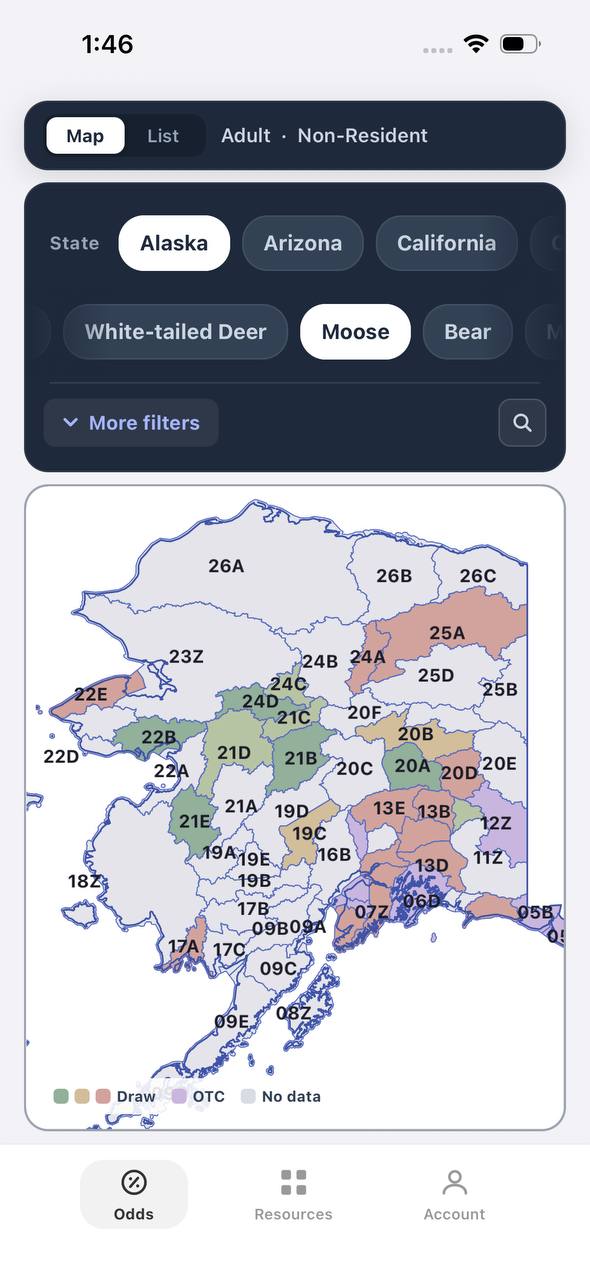
Alaska moose draw odds by unit, colored by draw, OTC, or no data
AdultNonresident

Alaska · Moose

Draw, OTC, and no-data units across the whole state.

Adult, Nonresident, Moose, no additional filters. Every unit is colored by its best matching draw odds; if nothing draws, it shows OTC; if neither, no data.

  • Alaska mixes draw and OTC moose hunts within the same region.
  • Green units are worth an application; purple units are OTC.
  • Filters stay applied when a unit is opened for hunt detail.
Draw odds
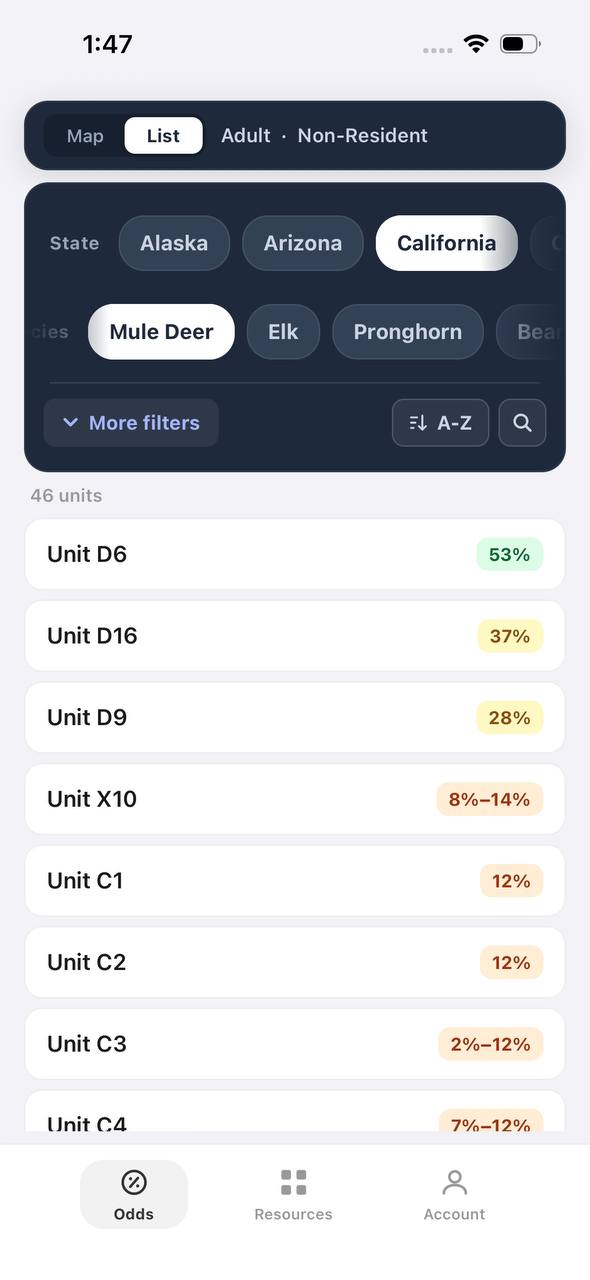
California mule deer draw odds ranked by unit in a list
AdultNonresident

California · Mule deer

Nonresident odds ranked unit by unit.

Adult, Nonresident, Mule deer, no weapon or season chip, so every matching hunt in a zone is combined into one badge and sorted by best projected odds.

  • D6 leads the list; a range like 8%–14% means more than one hunt code exists in that zone.
  • The list and the map read the same filtered hunt set.
  • 46 units are shown for this species and state alone.

Free to join

Download mobile app

  • Detailed draw odds
  • Point tracking
  • Deadline reminders
  • 19 states covered
Download on the App StoreGet it on Google Play
Unit detail
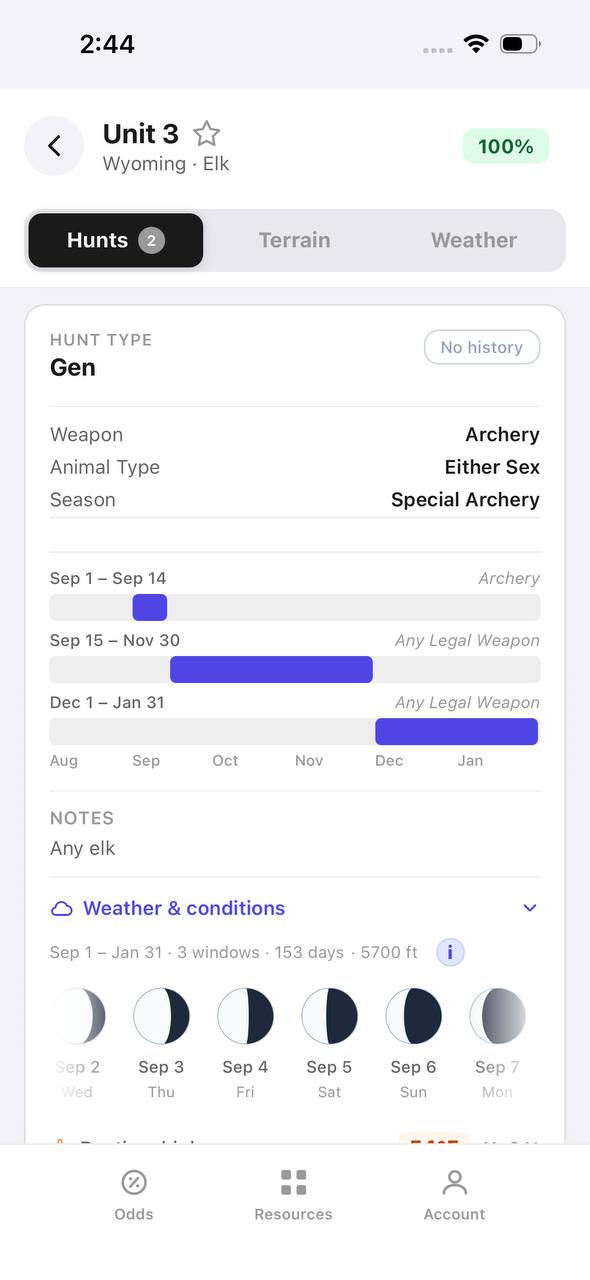
Wyoming elk unit detail, hunts tab, showing hunt windows on a timeline

Wyoming · Elk, Unit 3

Every hunt window inside one unit, laid out on a timeline.

Unit 3 has two hunt codes for elk. Each one shows its weapon, animal type, and season as a bar on a shared Aug–Jan timeline, plus a day-by-day moon phase strip.

  • Archery, then a long Any Legal Weapon window, then a late season — three opportunities in one unit.
  • The 100% badge at top means no real draw competition for the selected filters right now.
  • Weather & conditions expands below the hunt list without leaving the unit.
Terrain data
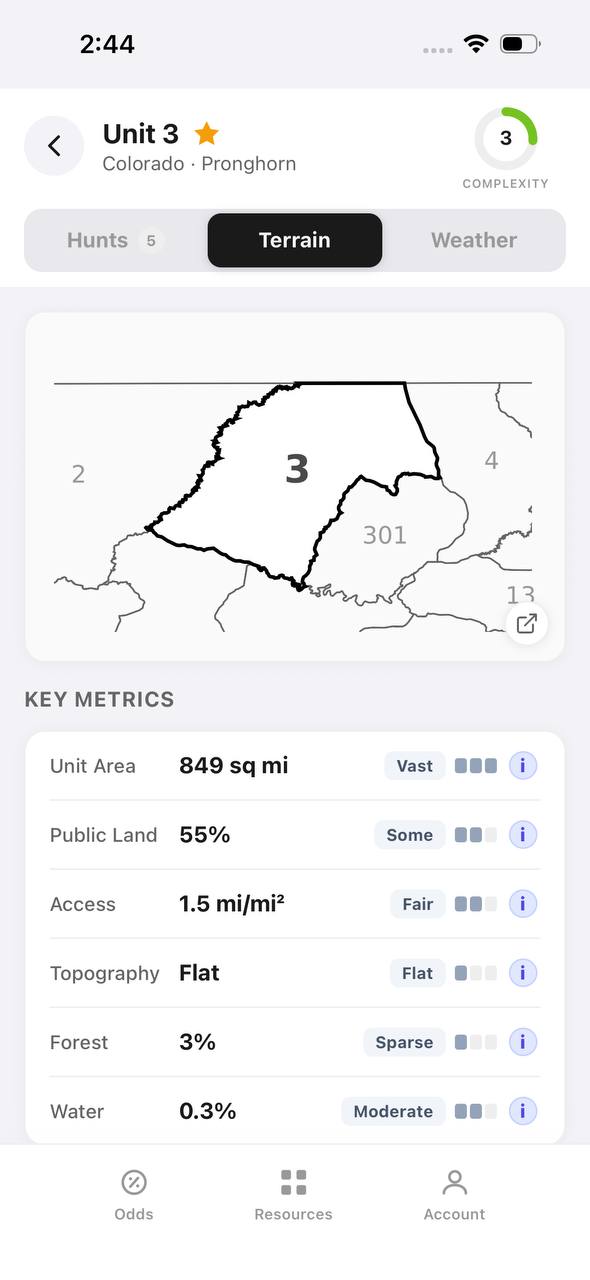
Colorado pronghorn unit detail, terrain tab, showing unit outline and key metrics

Colorado · Pronghorn, Unit 3

Unit boundaries and a complexity score at a glance.

The Terrain tab draws the unit outline against its neighbors and scores it for complexity, then breaks out area, public land, access, topography, forest, and water.

  • 849 sq mi, 55% public land, and flat topography make this a fairly approachable unit.
  • Each metric carries a short rating word — Vast, Some, Fair, Flat, Sparse, Moderate — with a tooltip.
  • The outline map shows adjacent units 2, 4, 13, and 301 for context.
State profiles
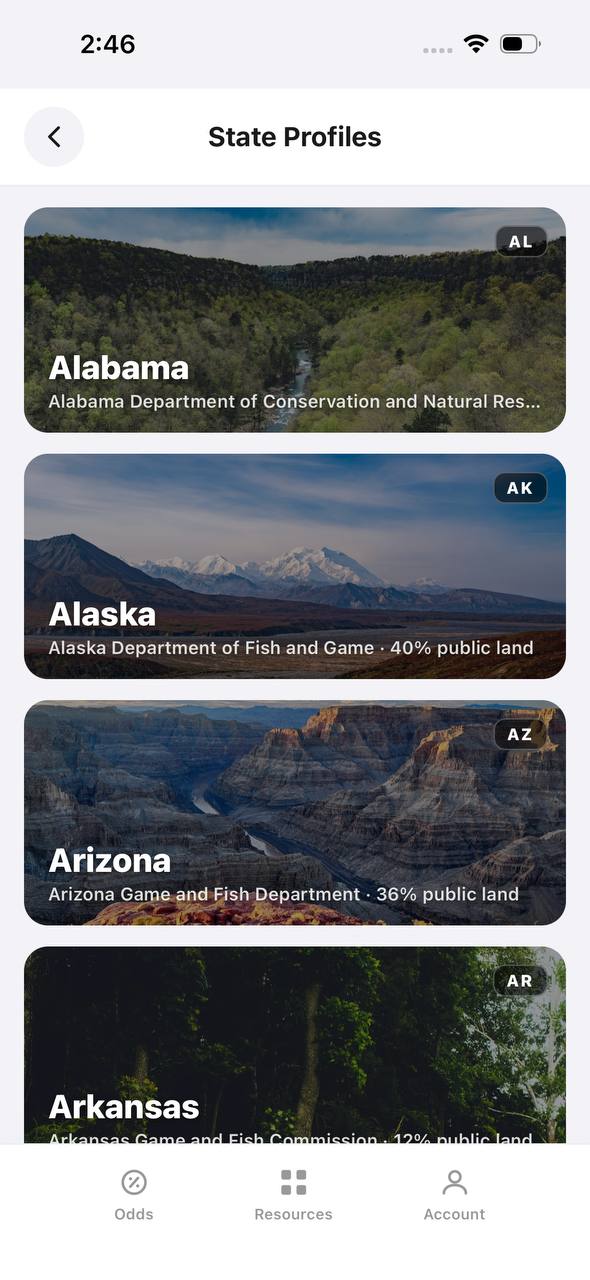
State Profiles screen listing states with wildlife agency and public land percentage

State Profiles

Each state's wildlife agency and public land share, at a glance.

State Profiles lists every covered state as a photo card naming its wildlife agency and, where available, its public land percentage.

  • Public land percentage shows right in the list, before opening the state.
  • Each card names the exact agency the regulations come from.
  • States without a public land figure yet, like Alabama here, are still listed.
Points wallet
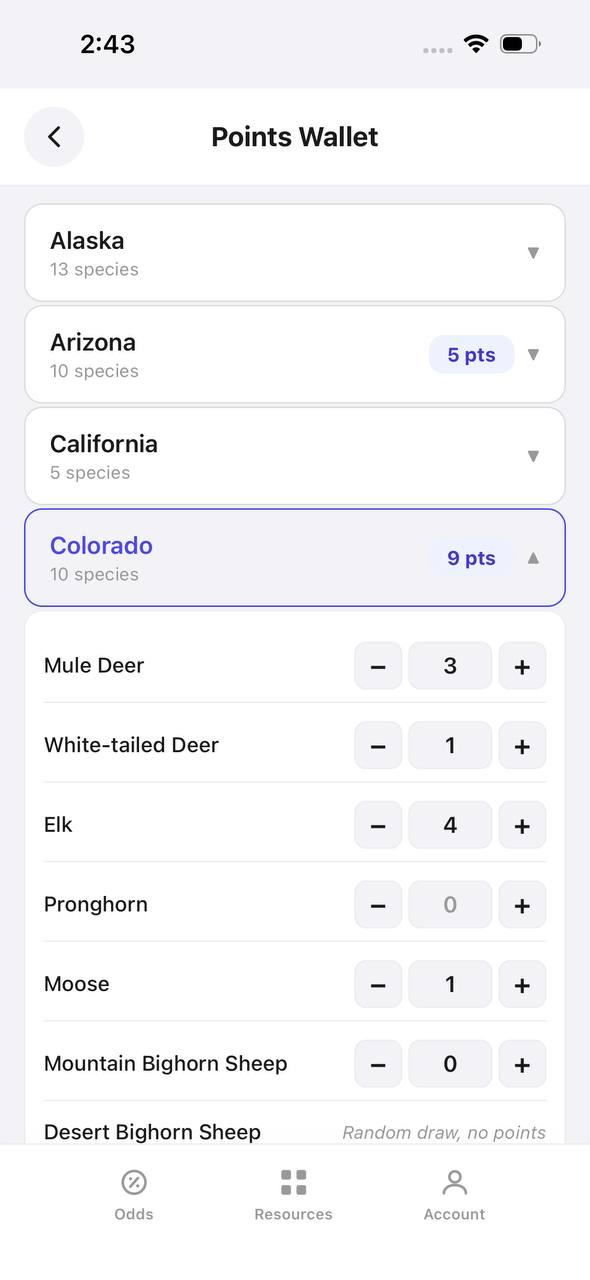
Points Wallet screen with Colorado expanded, showing a point stepper per species

Points Wallet · Colorado

Every state and species point balance in one wallet.

Points Wallet lists each state with a species count; expanding a state, like Colorado here, shows a stepper for every species so a balance can be entered or adjusted directly.

  • Colorado alone tracks points across 10 species independently.
  • Species with no points, like Pronghorn here, still show a zero to stay visible.
  • Desert Bighorn Sheep is flagged as a random draw with no points system.

Free to join

Download mobile app

  • Detailed draw odds
  • Point tracking
  • Deadline reminders
  • 19 states covered
Download on the App StoreGet it on Google Play
Draw odds
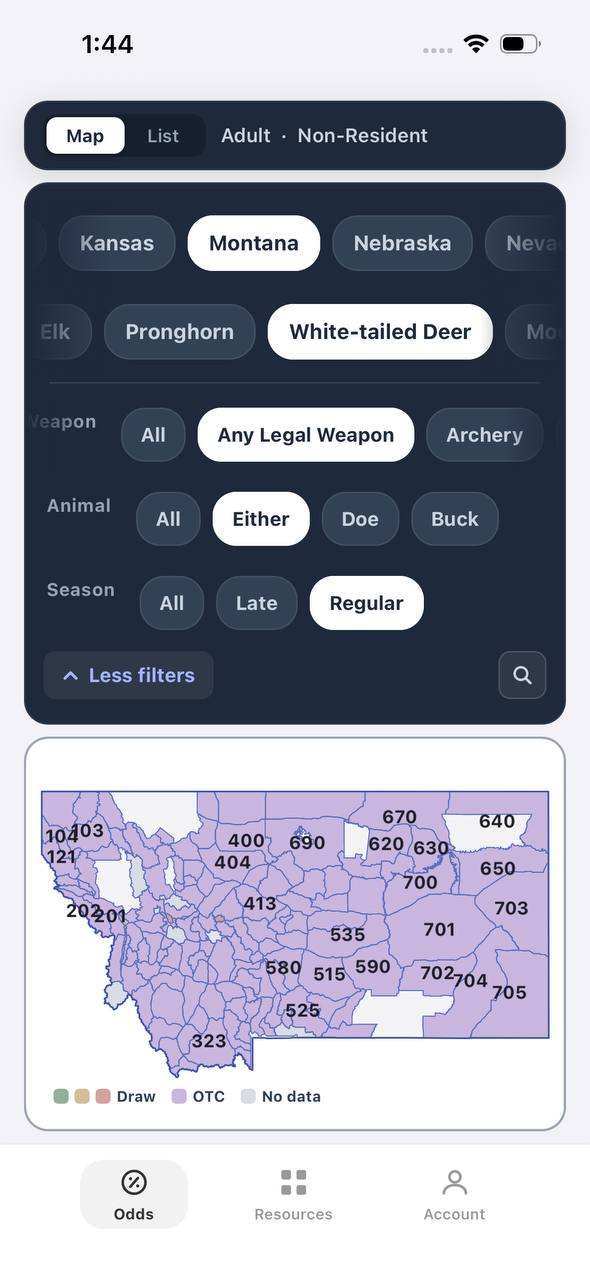
Montana white-tailed deer draw odds filtered to any legal weapon, either sex, regular season
AdultNonresidentAny Legal WeaponEitherRegular

Montana · White-tailed deer

Nearly the whole state is OTC for this filter combination.

Adult, Nonresident, White-tailed deer, filtered to Any Legal Weapon, Either, Regular. Under this combination almost every unit turns purple — over the counter.

  • Switching weapon, sex, or season changes the picture completely.
  • Purple means the tag can be bought directly, no draw.
  • This is the tag-and-go read of Montana whitetail, not the point-based one.
Terrain data
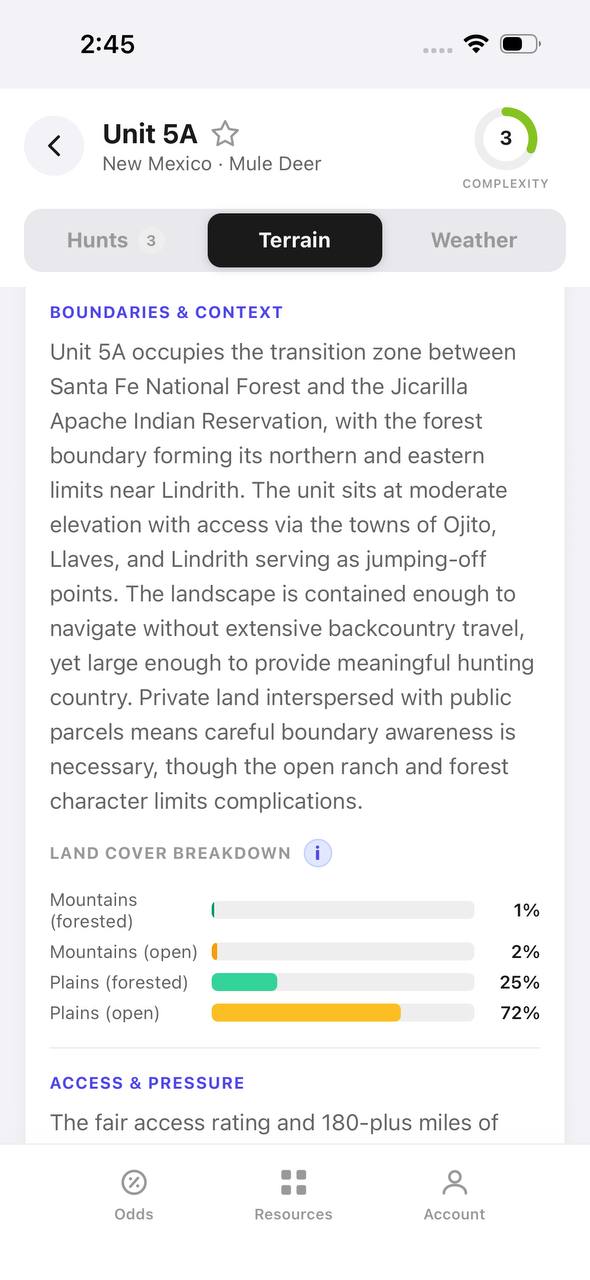
New Mexico mule deer unit 5A terrain tab with boundary description and land cover breakdown

New Mexico · Mule deer, Unit 5A

A written boundary description, not just a shape.

Unit 5A's terrain tab opens with a plain-language paragraph about surrounding land, access towns, and ownership mix, then a land cover breakdown by percentage.

  • 72% open plains and 25% forested plains describe the terrain at a glance.
  • The boundary text calls out the exact reservation and forest lines that define the unit.
  • Access & pressure continues below the fold with mileage detail.
Draw odds
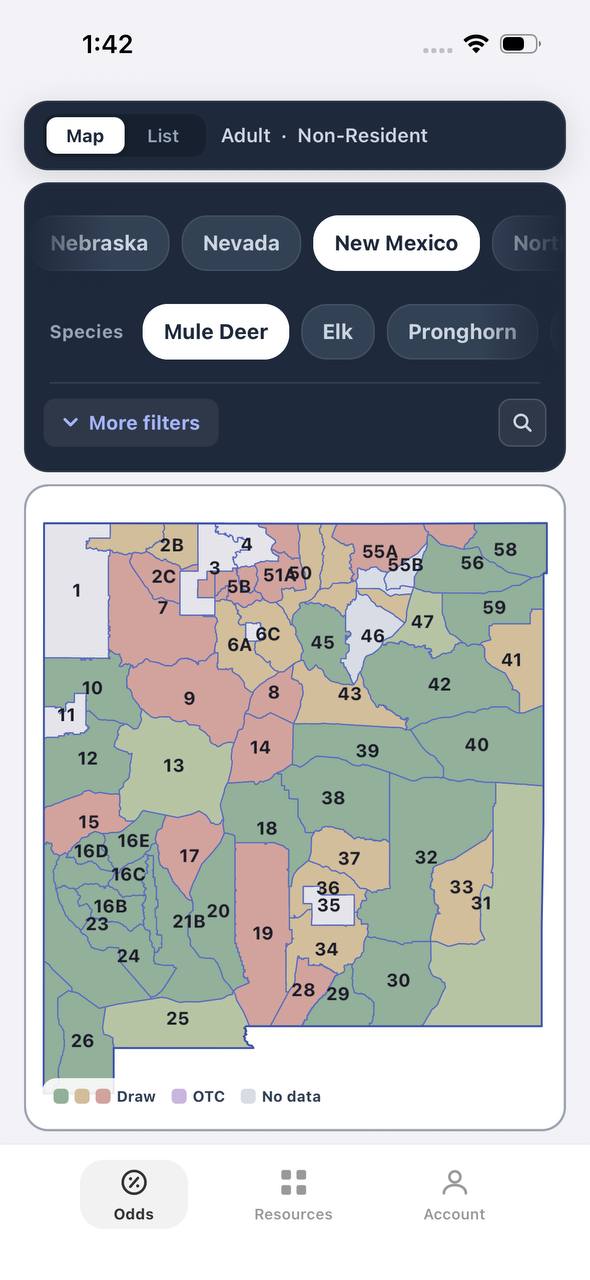
New Mexico mule deer draw odds by unit
AdultNonresident

New Mexico · Mule deer

Mule deer draw odds for every unit in the state.

Adult, Nonresident, Mule deer, all weapons and seasons. Each unit is colored by the same odds calculation used in the dashboard.

  • Green and tan together separate units worth applying to from units that are not.
  • Numbered units follow New Mexico's own game management unit boundaries.
  • Opening a unit shows the exact hunt behind the color.
Favorites
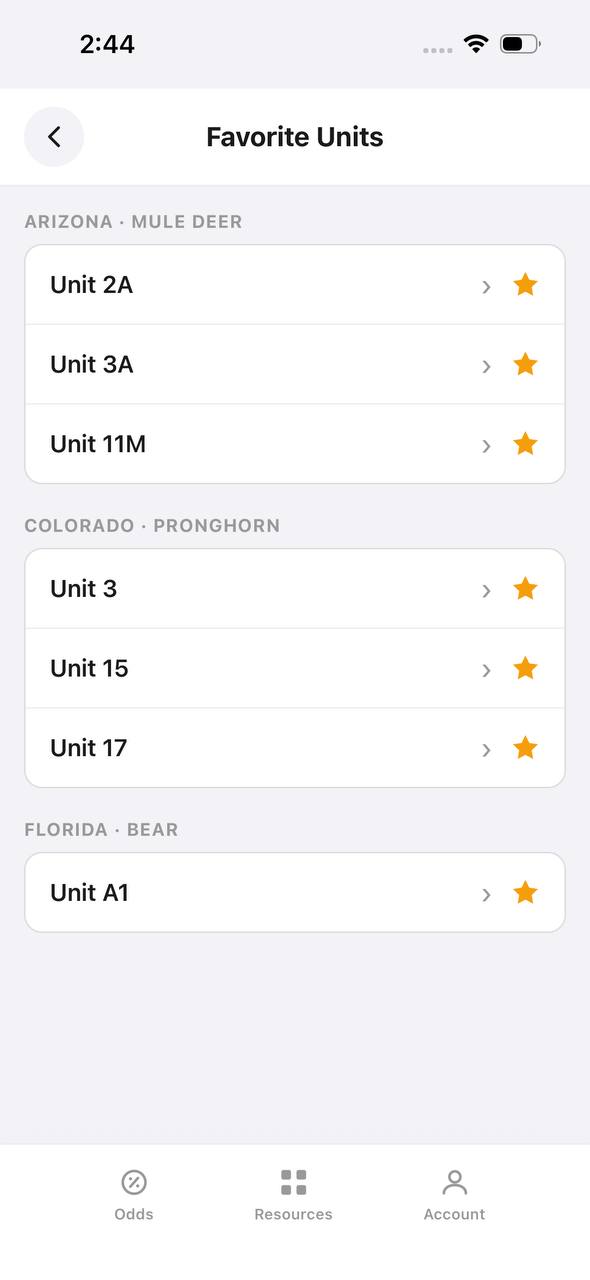
Favorite Units screen grouped by state and species

Favorite Units

Starred units from any state, grouped by species.

Favorite Units collects every starred unit across states and species into one list, grouped by state and species pair, so a saved unit is one tap away.

  • Arizona mule deer and Colorado pronghorn favorites sit side by side here.
  • Each row opens straight into that unit's detail view.
  • Unstarring from this screen removes it from the group instantly.
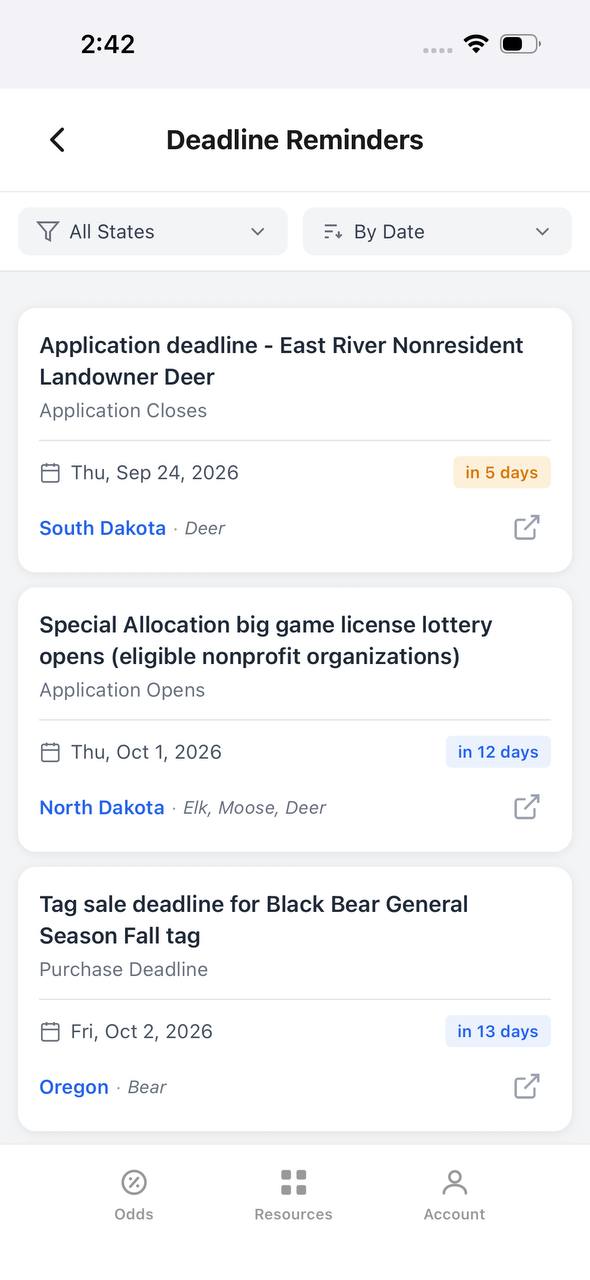
Deadlines
Deadline Reminders screen listing application and purchase deadlines by date

Deadline Reminders

Every application and purchase deadline, sorted by date.

Deadline Reminders filters by state and sorts by date, showing the deadline type, a countdown, and the state and species it applies to, with a link out to the source.

  • Countdown badges shift as a deadline gets close — "in 5 days" here, for example.
  • Application opens and closes are tracked as separate reminder types.
  • Each card links out to confirm the rule at the source.
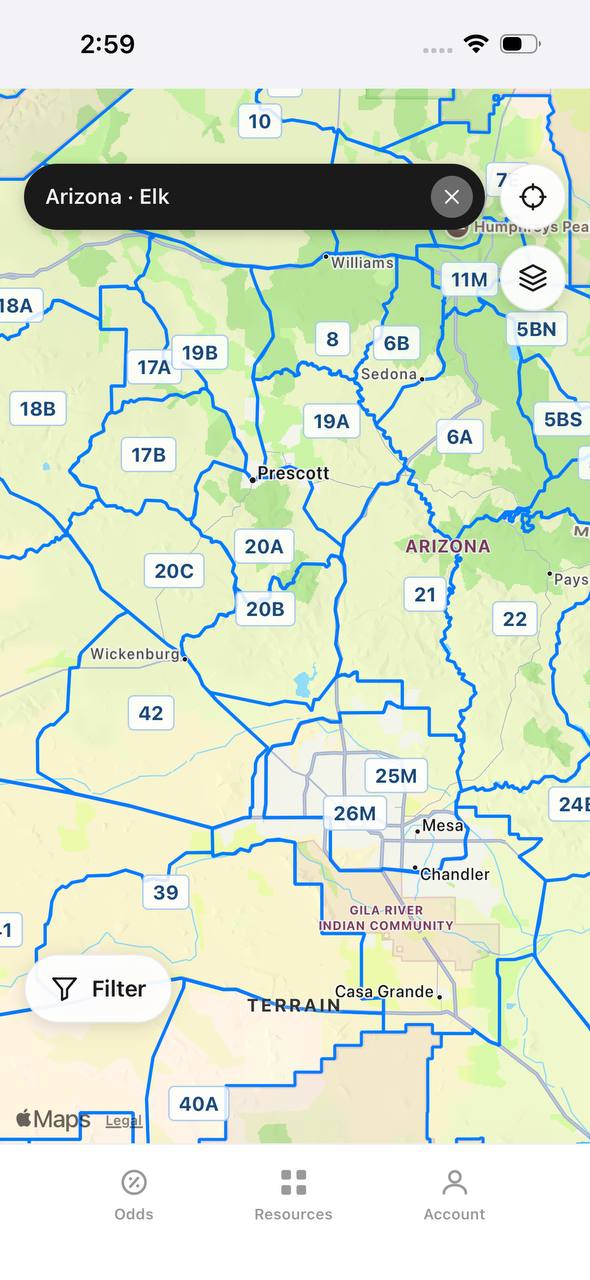
Interactive map
Arizona elk unit boundaries overlaid on an interactive street map

Arizona · Elk

Unit boundaries laid directly over a real map.

This view overlays Arizona elk unit boundaries and labels on top of a street map, with a search bar pinned to state and species and a layer toggle in the corner.

  • Real towns like Prescott and Sedona sit inside their unit boundaries for context.
  • A location button and layer switch float over the map, clear of the unit labels.
  • A Filter button at the bottom opens the same filters used elsewhere in the app.

Free to join

Download mobile app

  • Detailed draw odds
  • Point tracking
  • Deadline reminders
  • 19 states covered
Download on the App StoreGet it on Google Play
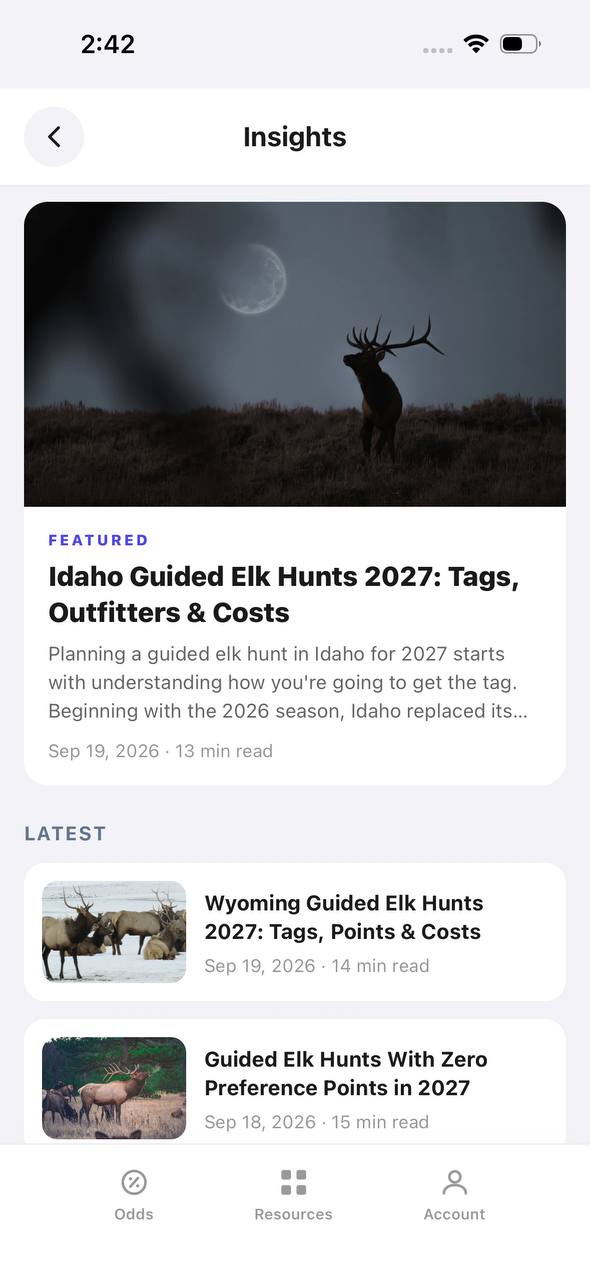
Insights
Insights screen with a featured article and a latest articles list

Insights

Hunting articles, built into the app itself.

Insights opens to a featured article with a hero image, then a Latest list of recent posts, each with a thumbnail, read time, and publish date.

  • The featured slot rotates to the newest deep-dive article.
  • Read time and publish date show on every card, not just the featured one.
  • This mirrors the blog content already published on the marketing site.
Download on the App StoreGet it on Google Play

Wyoming Guided Elk Hunts With No Preference Points

Wyoming is another state where the word "General" causes confusion. A Wyoming General Elk License for a nonresident is still obtained through Wyoming's drawing. It isn't simply an OTC elk license. Wyoming uses preference points for nonresident elk. Historically, applicable licenses have been divided between 75 percent preference-point allocation and 25 percent random allocation. That random portion matters for hunters with zero points.

Can you draw Wyoming elk with zero points? Yes, potentially. A zero-point hunter can have a chance in the random portion of applicable drawings. Some opportunities can also have more favorable historical demand than the famous limited areas. But you need to research the specific hunt area, license type, regular versus special applicant pool, historical odds, and season. For more on how Wyoming's guided hunts work in practice, see wyoming guided elk hunts 2027 preference points draw odds costs.

Simply hiring a guide doesn't bypass Wyoming's nonresident elk drawing. An outfitter may help you understand the application process and choose appropriate hunts, but the state controls license allocation.

New Mexico Guided Elk Hunts With No Preference Points

New Mexico should absolutely be included in this article because New Mexico doesn't use preference points for its standard big-game draw. A first-time applicant has a chance. That makes New Mexico fundamentally different from a pure preference-point system. Hunters apply for specific hunt choices. Because there isn't a preference-point ladder, you don't need to spend years accumulating points before having a chance. However, many desirable elk hunts have very difficult draw odds. Zero points doesn't mean easy odds; it means you're not disadvantaged by a lack of accumulated preference points.

New Mexico also has landowner-based elk licensing pathways. Under applicable private-land programs, landowner authorizations can provide another route to an elk license. Some guided hunts are built around these opportunities. Before booking, verify authorization type, ranch, unit, season, weapon, license cost, private-land access, and whether the authorization is included. "Landowner tag" doesn't mean unrestricted statewide elk hunting.

Which State Should a Zero-Point Hunter Research?

Instead of ranking states, match the state to the type of opportunity you're seeking. If you want an OTC pathway, research eligible Colorado rifle elk opportunities. If you don't want a preference-point system, research Idaho and New Mexico. If you're specifically booking with an outfitter, research Idaho's outfitter allocation in addition to other states' normal licensing systems. If you're willing to enter a general-license draw, research Montana. If you're comfortable with a point system that also includes random opportunity, research Wyoming. The right state depends on your hunting goals.

Draw odds
Alaska moose draw odds by unit, colored by draw, OTC, or no data
AdultNonresident

Alaska · Moose

Draw, OTC, and no-data units across the whole state.

Adult, Nonresident, Moose, no additional filters. Every unit is colored by its best matching draw odds; if nothing draws, it shows OTC; if neither, no data.

  • Alaska mixes draw and OTC moose hunts within the same region.
  • Green units are worth an application; purple units are OTC.
  • Filters stay applied when a unit is opened for hunt detail.
Draw odds
California mule deer draw odds ranked by unit in a list
AdultNonresident

California · Mule deer

Nonresident odds ranked unit by unit.

Adult, Nonresident, Mule deer, no weapon or season chip, so every matching hunt in a zone is combined into one badge and sorted by best projected odds.

  • D6 leads the list; a range like 8%–14% means more than one hunt code exists in that zone.
  • The list and the map read the same filtered hunt set.
  • 46 units are shown for this species and state alone.

Free to join

Download mobile app

  • Detailed draw odds
  • Point tracking
  • Deadline reminders
  • 19 states covered
Download on the App StoreGet it on Google Play
Unit detail
Wyoming elk unit detail, hunts tab, showing hunt windows on a timeline

Wyoming · Elk, Unit 3

Every hunt window inside one unit, laid out on a timeline.

Unit 3 has two hunt codes for elk. Each one shows its weapon, animal type, and season as a bar on a shared Aug–Jan timeline, plus a day-by-day moon phase strip.

  • Archery, then a long Any Legal Weapon window, then a late season — three opportunities in one unit.
  • The 100% badge at top means no real draw competition for the selected filters right now.
  • Weather & conditions expands below the hunt list without leaving the unit.
Terrain data
Colorado pronghorn unit detail, terrain tab, showing unit outline and key metrics

Colorado · Pronghorn, Unit 3

Unit boundaries and a complexity score at a glance.

The Terrain tab draws the unit outline against its neighbors and scores it for complexity, then breaks out area, public land, access, topography, forest, and water.

  • 849 sq mi, 55% public land, and flat topography make this a fairly approachable unit.
  • Each metric carries a short rating word — Vast, Some, Fair, Flat, Sparse, Moderate — with a tooltip.
  • The outline map shows adjacent units 2, 4, 13, and 301 for context.
State profiles
State Profiles screen listing states with wildlife agency and public land percentage

State Profiles

Each state's wildlife agency and public land share, at a glance.

State Profiles lists every covered state as a photo card naming its wildlife agency and, where available, its public land percentage.

  • Public land percentage shows right in the list, before opening the state.
  • Each card names the exact agency the regulations come from.
  • States without a public land figure yet, like Alabama here, are still listed.
Points wallet
Points Wallet screen with Colorado expanded, showing a point stepper per species

Points Wallet · Colorado

Every state and species point balance in one wallet.

Points Wallet lists each state with a species count; expanding a state, like Colorado here, shows a stepper for every species so a balance can be entered or adjusted directly.

  • Colorado alone tracks points across 10 species independently.
  • Species with no points, like Pronghorn here, still show a zero to stay visible.
  • Desert Bighorn Sheep is flagged as a random draw with no points system.

Free to join

Download mobile app

  • Detailed draw odds
  • Point tracking
  • Deadline reminders
  • 19 states covered
Download on the App StoreGet it on Google Play
Draw odds
Montana white-tailed deer draw odds filtered to any legal weapon, either sex, regular season
AdultNonresidentAny Legal WeaponEitherRegular

Montana · White-tailed deer

Nearly the whole state is OTC for this filter combination.

Adult, Nonresident, White-tailed deer, filtered to Any Legal Weapon, Either, Regular. Under this combination almost every unit turns purple — over the counter.

  • Switching weapon, sex, or season changes the picture completely.
  • Purple means the tag can be bought directly, no draw.
  • This is the tag-and-go read of Montana whitetail, not the point-based one.
Terrain data
New Mexico mule deer unit 5A terrain tab with boundary description and land cover breakdown

New Mexico · Mule deer, Unit 5A

A written boundary description, not just a shape.

Unit 5A's terrain tab opens with a plain-language paragraph about surrounding land, access towns, and ownership mix, then a land cover breakdown by percentage.

  • 72% open plains and 25% forested plains describe the terrain at a glance.
  • The boundary text calls out the exact reservation and forest lines that define the unit.
  • Access & pressure continues below the fold with mileage detail.
Draw odds
New Mexico mule deer draw odds by unit
AdultNonresident

New Mexico · Mule deer

Mule deer draw odds for every unit in the state.

Adult, Nonresident, Mule deer, all weapons and seasons. Each unit is colored by the same odds calculation used in the dashboard.

  • Green and tan together separate units worth applying to from units that are not.
  • Numbered units follow New Mexico's own game management unit boundaries.
  • Opening a unit shows the exact hunt behind the color.
Favorites
Favorite Units screen grouped by state and species

Favorite Units

Starred units from any state, grouped by species.

Favorite Units collects every starred unit across states and species into one list, grouped by state and species pair, so a saved unit is one tap away.

  • Arizona mule deer and Colorado pronghorn favorites sit side by side here.
  • Each row opens straight into that unit's detail view.
  • Unstarring from this screen removes it from the group instantly.
Deadlines
Deadline Reminders screen listing application and purchase deadlines by date

Deadline Reminders

Every application and purchase deadline, sorted by date.

Deadline Reminders filters by state and sorts by date, showing the deadline type, a countdown, and the state and species it applies to, with a link out to the source.

  • Countdown badges shift as a deadline gets close — "in 5 days" here, for example.
  • Application opens and closes are tracked as separate reminder types.
  • Each card links out to confirm the rule at the source.
Interactive map
Arizona elk unit boundaries overlaid on an interactive street map

Arizona · Elk

Unit boundaries laid directly over a real map.

This view overlays Arizona elk unit boundaries and labels on top of a street map, with a search bar pinned to state and species and a layer toggle in the corner.

  • Real towns like Prescott and Sedona sit inside their unit boundaries for context.
  • A location button and layer switch float over the map, clear of the unit labels.
  • A Filter button at the bottom opens the same filters used elsewhere in the app.

Free to join

Download mobile app

  • Detailed draw odds
  • Point tracking
  • Deadline reminders
  • 19 states covered
Download on the App StoreGet it on Google Play
Insights
Insights screen with a featured article and a latest articles list

Insights

Hunting articles, built into the app itself.

Insights opens to a featured article with a hero image, then a Latest list of recent posts, each with a thumbnail, read time, and publish date.

  • The featured slot rotates to the newest deep-dive article.
  • Read time and publish date show on every card, not just the featured one.
  • This mirrors the blog content already published on the marketing site.
Download on the App StoreGet it on Google Play

Guided vs DIY Elk Hunting

Hiring a guide doesn't change the biological difficulty of elk hunting, but it can provide major logistical advantages. Depending on the outfitter, a guided hunt may provide local knowledge, scouting, camp, lodging, meals, transportation, horses or pack animals, field care, pack-out assistance, and private-land access. That's especially valuable for a first-time Western elk hunter who doesn't know the country. But a guide doesn't guarantee harvest.

A good outfitter can improve certain parts of your hunt. Local knowledge, scouting, access, and logistics can all matter. But don't treat an advertised outfitter success rate as a guarantee that you'll kill an elk. Ask how the outfitter calculates its statistics. For example, is that opportunity rate or harvest rate? Bull only or all elk? Rifle only or all seasons? One year or multiple years? How many hunters were included? Context matters.

Are Zero-Point Guided Hunts Cheaper?

Not necessarily. The number of preference points required to draw a license doesn't determine the outfitter's price. A guided OTC hunt can still be expensive because you're paying for guide labor, lodging, meals, horses, private-land access, scouting, transportation, camp, pack-out, and other services. Likewise, some difficult-to-draw hunts can be reasonably priced once you actually draw. Don't assume easy tag equals cheap hunt.

Pricing varies dramatically. A guided elk hunt can range from several thousand dollars into five figures depending on state, private versus public land, hunt length, guide ratio, lodging, meals, horses, trophy expectations, landowner authorization or voucher, season, and included services. Always ask for the complete price.

Depending on the outfitter, additional expenses can include hunting license, elk tag, application fees, preference points, travel, hotel before and after the hunt, meat processing, meat shipping, taxidermy, and guide tips. Read the contract before paying the deposit.

Draw odds
Alaska moose draw odds by unit, colored by draw, OTC, or no data
AdultNonresident

Alaska · Moose

Draw, OTC, and no-data units across the whole state.

Adult, Nonresident, Moose, no additional filters. Every unit is colored by its best matching draw odds; if nothing draws, it shows OTC; if neither, no data.

  • Alaska mixes draw and OTC moose hunts within the same region.
  • Green units are worth an application; purple units are OTC.
  • Filters stay applied when a unit is opened for hunt detail.
Draw odds
California mule deer draw odds ranked by unit in a list
AdultNonresident

California · Mule deer

Nonresident odds ranked unit by unit.

Adult, Nonresident, Mule deer, no weapon or season chip, so every matching hunt in a zone is combined into one badge and sorted by best projected odds.

  • D6 leads the list; a range like 8%–14% means more than one hunt code exists in that zone.
  • The list and the map read the same filtered hunt set.
  • 46 units are shown for this species and state alone.

Free to join

Download mobile app

  • Detailed draw odds
  • Point tracking
  • Deadline reminders
  • 19 states covered
Download on the App StoreGet it on Google Play
Unit detail
Wyoming elk unit detail, hunts tab, showing hunt windows on a timeline

Wyoming · Elk, Unit 3

Every hunt window inside one unit, laid out on a timeline.

Unit 3 has two hunt codes for elk. Each one shows its weapon, animal type, and season as a bar on a shared Aug–Jan timeline, plus a day-by-day moon phase strip.

  • Archery, then a long Any Legal Weapon window, then a late season — three opportunities in one unit.
  • The 100% badge at top means no real draw competition for the selected filters right now.
  • Weather & conditions expands below the hunt list without leaving the unit.
Terrain data
Colorado pronghorn unit detail, terrain tab, showing unit outline and key metrics

Colorado · Pronghorn, Unit 3

Unit boundaries and a complexity score at a glance.

The Terrain tab draws the unit outline against its neighbors and scores it for complexity, then breaks out area, public land, access, topography, forest, and water.

  • 849 sq mi, 55% public land, and flat topography make this a fairly approachable unit.
  • Each metric carries a short rating word — Vast, Some, Fair, Flat, Sparse, Moderate — with a tooltip.
  • The outline map shows adjacent units 2, 4, 13, and 301 for context.
State profiles
State Profiles screen listing states with wildlife agency and public land percentage

State Profiles

Each state's wildlife agency and public land share, at a glance.

State Profiles lists every covered state as a photo card naming its wildlife agency and, where available, its public land percentage.

  • Public land percentage shows right in the list, before opening the state.
  • Each card names the exact agency the regulations come from.
  • States without a public land figure yet, like Alabama here, are still listed.
Points wallet
Points Wallet screen with Colorado expanded, showing a point stepper per species

Points Wallet · Colorado

Every state and species point balance in one wallet.

Points Wallet lists each state with a species count; expanding a state, like Colorado here, shows a stepper for every species so a balance can be entered or adjusted directly.

  • Colorado alone tracks points across 10 species independently.
  • Species with no points, like Pronghorn here, still show a zero to stay visible.
  • Desert Bighorn Sheep is flagged as a random draw with no points system.

Free to join

Download mobile app

  • Detailed draw odds
  • Point tracking
  • Deadline reminders
  • 19 states covered
Download on the App StoreGet it on Google Play
Draw odds
Montana white-tailed deer draw odds filtered to any legal weapon, either sex, regular season
AdultNonresidentAny Legal WeaponEitherRegular

Montana · White-tailed deer

Nearly the whole state is OTC for this filter combination.

Adult, Nonresident, White-tailed deer, filtered to Any Legal Weapon, Either, Regular. Under this combination almost every unit turns purple — over the counter.

  • Switching weapon, sex, or season changes the picture completely.
  • Purple means the tag can be bought directly, no draw.
  • This is the tag-and-go read of Montana whitetail, not the point-based one.
Terrain data
New Mexico mule deer unit 5A terrain tab with boundary description and land cover breakdown

New Mexico · Mule deer, Unit 5A

A written boundary description, not just a shape.

Unit 5A's terrain tab opens with a plain-language paragraph about surrounding land, access towns, and ownership mix, then a land cover breakdown by percentage.

  • 72% open plains and 25% forested plains describe the terrain at a glance.
  • The boundary text calls out the exact reservation and forest lines that define the unit.
  • Access & pressure continues below the fold with mileage detail.
Draw odds
New Mexico mule deer draw odds by unit
AdultNonresident

New Mexico · Mule deer

Mule deer draw odds for every unit in the state.

Adult, Nonresident, Mule deer, all weapons and seasons. Each unit is colored by the same odds calculation used in the dashboard.

  • Green and tan together separate units worth applying to from units that are not.
  • Numbered units follow New Mexico's own game management unit boundaries.
  • Opening a unit shows the exact hunt behind the color.
Favorites
Favorite Units screen grouped by state and species

Favorite Units

Starred units from any state, grouped by species.

Favorite Units collects every starred unit across states and species into one list, grouped by state and species pair, so a saved unit is one tap away.

  • Arizona mule deer and Colorado pronghorn favorites sit side by side here.
  • Each row opens straight into that unit's detail view.
  • Unstarring from this screen removes it from the group instantly.
Deadlines
Deadline Reminders screen listing application and purchase deadlines by date

Deadline Reminders

Every application and purchase deadline, sorted by date.

Deadline Reminders filters by state and sorts by date, showing the deadline type, a countdown, and the state and species it applies to, with a link out to the source.

  • Countdown badges shift as a deadline gets close — "in 5 days" here, for example.
  • Application opens and closes are tracked as separate reminder types.
  • Each card links out to confirm the rule at the source.
Interactive map
Arizona elk unit boundaries overlaid on an interactive street map

Arizona · Elk

Unit boundaries laid directly over a real map.

This view overlays Arizona elk unit boundaries and labels on top of a street map, with a search bar pinned to state and species and a layer toggle in the corner.

  • Real towns like Prescott and Sedona sit inside their unit boundaries for context.
  • A location button and layer switch float over the map, clear of the unit labels.
  • A Filter button at the bottom opens the same filters used elsewhere in the app.

Free to join

Download mobile app

  • Detailed draw odds
  • Point tracking
  • Deadline reminders
  • 19 states covered
Download on the App StoreGet it on Google Play
Insights
Insights screen with a featured article and a latest articles list

Insights

Hunting articles, built into the app itself.

Insights opens to a featured article with a hero image, then a Latest list of recent posts, each with a thumbnail, read time, and publish date.

  • The featured slot rotates to the newest deep-dive article.
  • Read time and publish date show on every card, not just the featured one.
  • This mirrors the blog content already published on the marketing site.
Download on the App StoreGet it on Google Play

Questions to Ask Before Booking a Zero-Point Elk Hunt

Before you book, ask the outfitter what exact license you need, whether you need preference or bonus points, whether the tag is OTC, drawn, allocated, or landowner-based, whether the tag is already secured, what happens if you don't draw, what unit or hunt area you'll hunt, what season and weapon, whether the hunt is public land, private land, or both, what the advertised price includes, what costs are additional, what the guide-to-hunter ratio is, how physically difficult the hunt is, how harvested meat is packed out, what the cancellation and refund policy is, and whether they can provide references from recent hunters. Those questions matter far more than an advertisement saying "No points needed."

How TAGZ Helps Find No-Point Elk Hunts

TAGZ is built for exactly this kind of research. Instead of searching Google for "Where can I hunt elk with zero points," you can set your actual hunter profile. Enter your residency, age group, and point totals. Then choose elk and compare opportunities across supported states. Starting from zero? Set it to zero. TAGZ can help you explore opportunities based on that point level where the state's system uses points. Then change state, season, weapon, animal type, and license type to see how the available opportunities change.

Maybe Colorado gives you an OTC rifle option. Maybe an Idaho outfitter has an allocated tag. Maybe you're willing to enter Montana's combination drawing. Maybe Wyoming's random component interests you. Maybe you want to take a chance in New Mexico's point-free draw. TAGZ helps organize that research in one platform.

TAGZ's signature color-coded maps make it easier to visually identify where your profile may have stronger draw opportunities. Instead of researching only famous elk units, you can look across the state. That's especially useful for zero-point hunters because some of the best opportunities may be hunts you've never heard of. For a broader look at hunting elk without points, see can you hunt elk without points.

Once you find an opportunity, investigate the hunt itself. TAGZ provides unit intelligence that can include terrain, public and private land characteristics, access, season information, draw history, and other available hunting data. Then contact outfitters operating in areas that actually fit your strategy.

A Better Way to Book Your First Guided Elk Hunt

Decide your budget first and know your total budget, not just the outfitter fee. Set your TAGZ profile by entering your residency and points. Search elk at zero points and see what opportunities fit your profile. Choose several states instead of locking yourself into one destination immediately. Determine the tag pathway: OTC, draw, outfitter allocation, or landowner authorization. Research units and find country you're physically and financially prepared to hunt. Contact outfitters with an actual understanding of the licensing system. Verify the tag and never send a major nonrefundable deposit based solely on "Don't worry, we'll get you a tag." Verify state regulations by checking the official wildlife agency. Then train, because getting the license is only the beginning.

For more on how many points you really need for a guided hunt, see how many preference points do you need for a guided elk hunt. If you're curious about hunts available at very low point levels, see find the best elk hunting units you can draw with 0-3 points in 2026.

FAQ — Guided Elk Hunts With No Preference Points

Can I book a guided elk hunt with zero preference points? Yes. Several Western states provide potential pathways through OTC licenses, random drawings, outfitter allocations, landowner programs, and hunts historically obtainable at zero points.

What state has OTC elk for nonresidents? Colorado currently provides certain nonresident OTC rifle elk opportunities. Eligibility depends on the unit and season.

Does Idaho have preference points? No. Idaho doesn't use preference or bonus points for its traditional controlled-hunt system.

Can an Idaho outfitter get me a tag? Idaho has an outfitter allocation for part of its nonresident general elk quota. Hunters should confirm actual tag availability with the outfitter before booking.

Does hiring a guide guarantee an elk tag? No. Hiring a guide by itself doesn't guarantee a hunting license.

Are zero-point guided hunts cheaper? Not necessarily. Outfitter pricing depends on services, land access, hunt length, accommodations, guide ratio, and other factors, not simply draw difficulty.