Best Equipment for Florida Alligator Hunting: Gear That Actually Works
AlligatorFloridaGear
11 min read·Jul 22, 2026·TAGZ
Best Equipment for Florida Alligator Hunting: Gear That Actually Works

Florida alligator hunting is not like chasing any other big game in North America. You are dealing with an apex predator that weighs hundreds of pounds, lives in water, and does not go down easy. The right equipment is not just about success—it is about safety. Hunters who show up unprepared quickly learn that gators require specialized gear designed for close-quarters confrontations in dark, muddy water.

This guide covers the essential equipment that Florida alligator hunters actually use, from initial hookup to final dispatch. Whether you are preparing for your first gator hunt or upgrading your setup, these recommendations come from guides and hunters who work the swamps every season.

Harpoon System: Your Primary Contact Tool

The harpoon is your first point of contact with a gator. Florida regulations require hunters to use a harpoon, gig, snare, or other device to initially secure the alligator before dispatching it. Most experienced hunters rely on a quality harpoon system because it gives you control from a safe distance.

A good alligator harpoon consists of a detachable head attached to 200–300 feet of heavy braided rope, typically 3/8-inch diameter or thicker. The rope connects to a float—either a foam buoy or plastic jug—that stays visible when the gator dives. Look for barbed harpoon heads designed specifically for alligators, not cheap spearfishing points that will pull out.

The pole itself should be 8–10 feet of sturdy fiberglass or aluminum. You need enough length to reach from the boat without leaning over the gunwale, but not so much that it becomes unwieldy in close quarters. Some hunters prefer detachable poles that break down for transport. Others swear by one-piece construction for reliability when a big gator is thrashing.

Attach your float line to a cleat or anchor point in the boat, not to the harpoon pole. When you stick a gator, the head detaches and the rope pays out as the animal runs. The float marks the gator's location and tires it out as it drags the resistance through the water.

Bang Stick: The Humane Dispatch Tool

Once you have the gator secured and tired out, you need a reliable method to dispatch it quickly and humanely. The bang stick—also called a power head—is the standard tool for this job. It is essentially a specialized firearm barrel attached to a pole that fires a single cartridge on contact with the gator's skull.

Most Florida gator hunters use bang sticks chambered in .357 Magnum, .44 Magnum, or 12-gauge shotgun shells loaded with slugs. The .44 Magnum offers a good balance of stopping power and manageable recoil through the pole. Twelve-gauge delivers more energy but requires a heavier, bulkier pole.

Quality matters with bang sticks. Cheap models can jam, misfire, or break when you need them most. Look for machined aluminum or stainless steel construction with a reliable firing pin system. The pole should be 6–8 feet long—long enough to keep your hands away from the gator's head but short enough to maintain control and accuracy.

Always carry backup bang stick loads. A big gator may require more than one shot, and you want to be prepared. Store shells in a waterproof container and keep them easily accessible. Some hunters carry a second complete bang stick as insurance.

Heavy Fishing Rod and Reel Setup

Many Florida gator hunters start with a heavy fishing rod to bait and hook their target before using the harpoon. This technique is legal and effective, especially for covering water and locating active gators at night. You need serious tackle—this is not bass fishing gear.

A 7–8 foot heavy or extra-heavy saltwater rod paired with a conventional reel capable of holding 300–400 yards of 80–130 pound braided line is standard. Penn Senator and Shimano Tiagra reels are popular choices because they offer the drag power and line capacity needed for big gators. Your reel should have a smooth, powerful drag system that can handle sustained runs without burning out.

Terminal tackle includes 4/0 to 7/0 circle hooks rigged with 200–300 pound steel leader cable. Circle hooks are preferred because they tend to hook in the corner of the mouth or throat rather than being swallowed deep. Bait options include fresh-cut mullet, chicken quarters, or beaver meat. Some hunters swear by road-killed nutria or other oily, bloody baits that put out strong scent.

The rod and reel setup serves to tire the gator and bring it close enough to harpoon. You are not trying to land it on the rod alone—once the gator is within range, you switch to the harpoon for secure control.

Lighting Equipment for Night Hunting

Alligator hunting in Florida happens almost exclusively at night when gators are most active and their eyes reflect light. Effective lighting is not optional—it is essential for spotting, approaching, and safely handling gators in total darkness.

A powerful handheld spotlight with at least 1000 lumens is your primary search tool. Many hunters use rechargeable LED spotlights with adjustable beams that can switch between flood and spot modes. The Million Mile spot lights and similar high-power models are popular because they can illuminate gator eyes from hundreds of yards away. Gator eyes reflect orange or red when hit with white light at night, making them relatively easy to spot in dark water.

Headlamps are critical for hands-free work when you are fighting a gator, setting the harpoon, or using the bang stick. Choose a model with red and white light modes. Red light preserves your night vision and does not spook gators as much as white light during the approach. White light provides better visibility for close work. Look for headlamps with at least 300 lumens on high and good battery life.

Many hunters also mount a permanent flood light or LED light bar on their boat for area illumination during the fight. This frees up your hands and provides consistent lighting when things get chaotic. Make sure all lighting systems have fully charged batteries and carry spares.
Draw odds
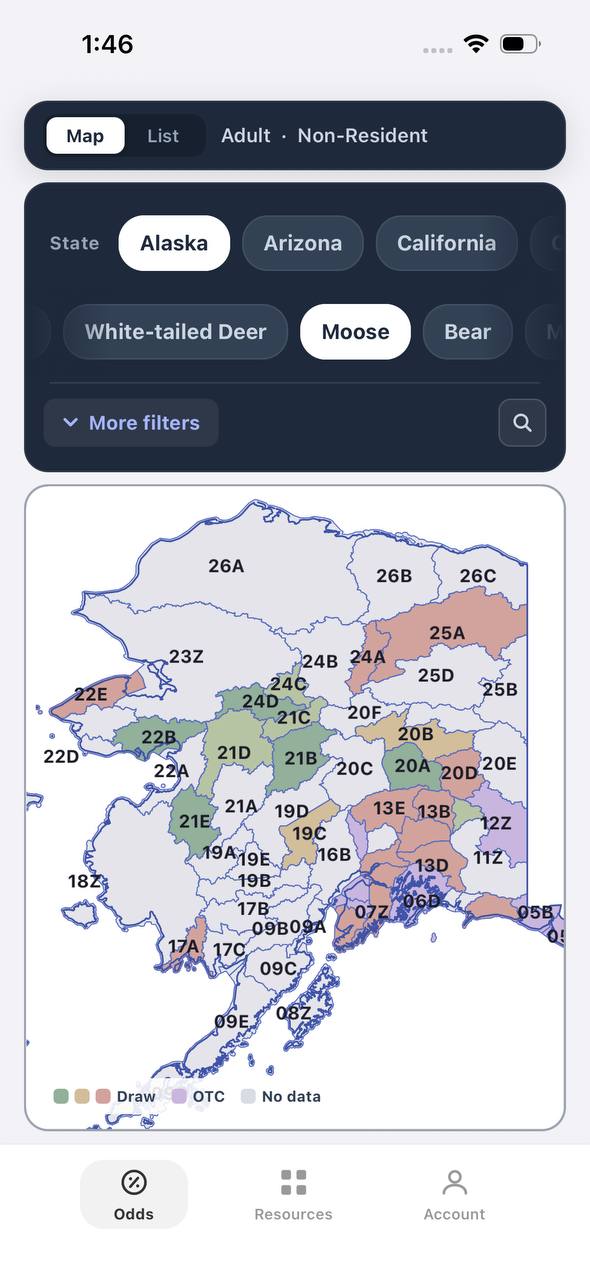
Alaska moose draw odds by unit, colored by draw, OTC, or no data
AdultNonresident

Alaska · Moose

Draw, OTC, and no-data units across the whole state.

Adult, Nonresident, Moose, no additional filters. Every unit is colored by its best matching draw odds; if nothing draws, it shows OTC; if neither, no data.

  • Alaska mixes draw and OTC moose hunts within the same region.
  • Green units are worth an application; purple units are OTC.
  • Filters stay applied when a unit is opened for hunt detail.
Draw odds
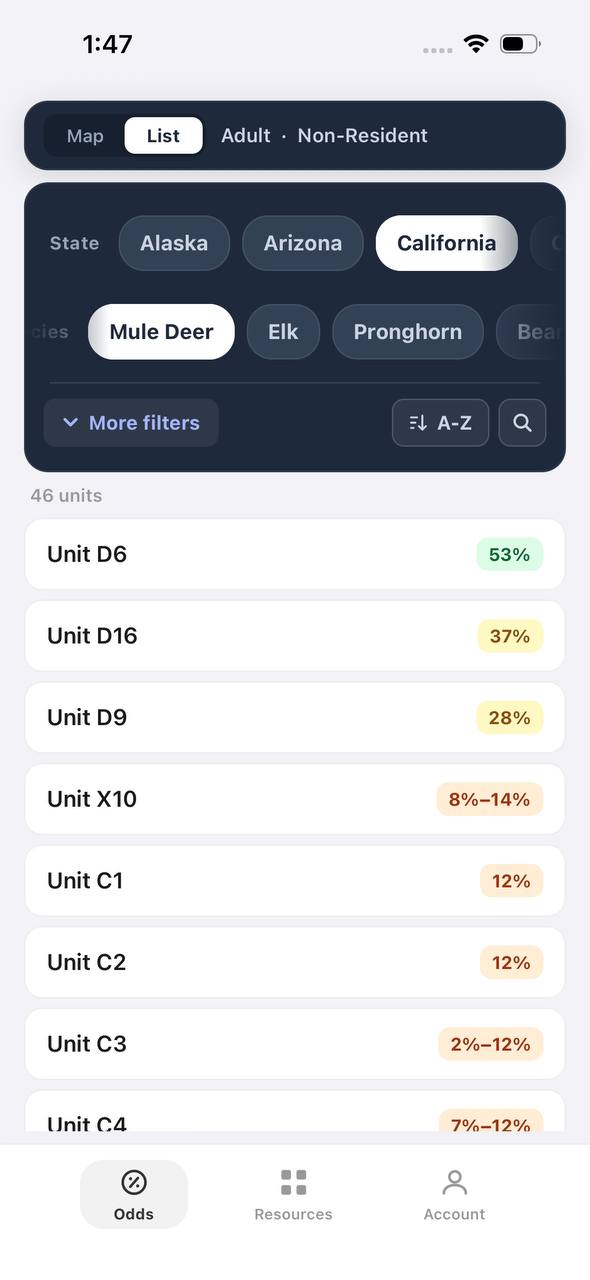
California mule deer draw odds ranked by unit in a list
AdultNonresident

California · Mule deer

Nonresident odds ranked unit by unit.

Adult, Nonresident, Mule deer, no weapon or season chip, so every matching hunt in a zone is combined into one badge and sorted by best projected odds.

  • D6 leads the list; a range like 8%–14% means more than one hunt code exists in that zone.
  • The list and the map read the same filtered hunt set.
  • 46 units are shown for this species and state alone.

Free to join

Download mobile app

  • Detailed draw odds
  • Point tracking
  • Deadline reminders
  • 19 states covered
Download on the App StoreGet it on Google Play
Unit detail
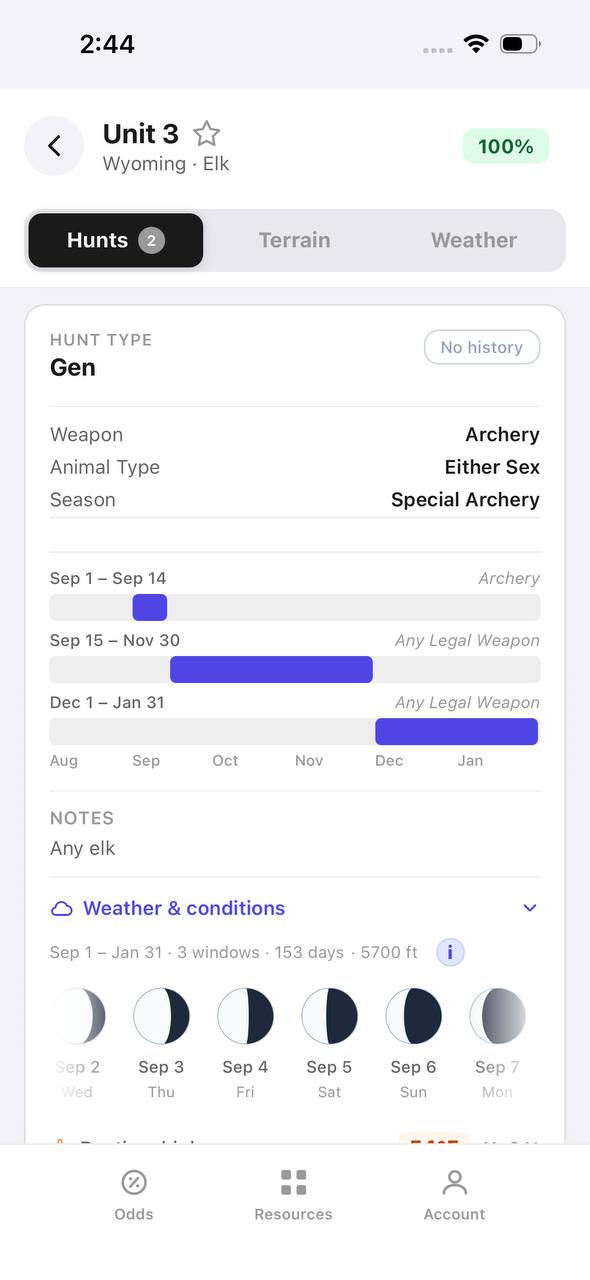
Wyoming elk unit detail, hunts tab, showing hunt windows on a timeline

Wyoming · Elk, Unit 3

Every hunt window inside one unit, laid out on a timeline.

Unit 3 has two hunt codes for elk. Each one shows its weapon, animal type, and season as a bar on a shared Aug–Jan timeline, plus a day-by-day moon phase strip.

  • Archery, then a long Any Legal Weapon window, then a late season — three opportunities in one unit.
  • The 100% badge at top means no real draw competition for the selected filters right now.
  • Weather & conditions expands below the hunt list without leaving the unit.
Terrain data
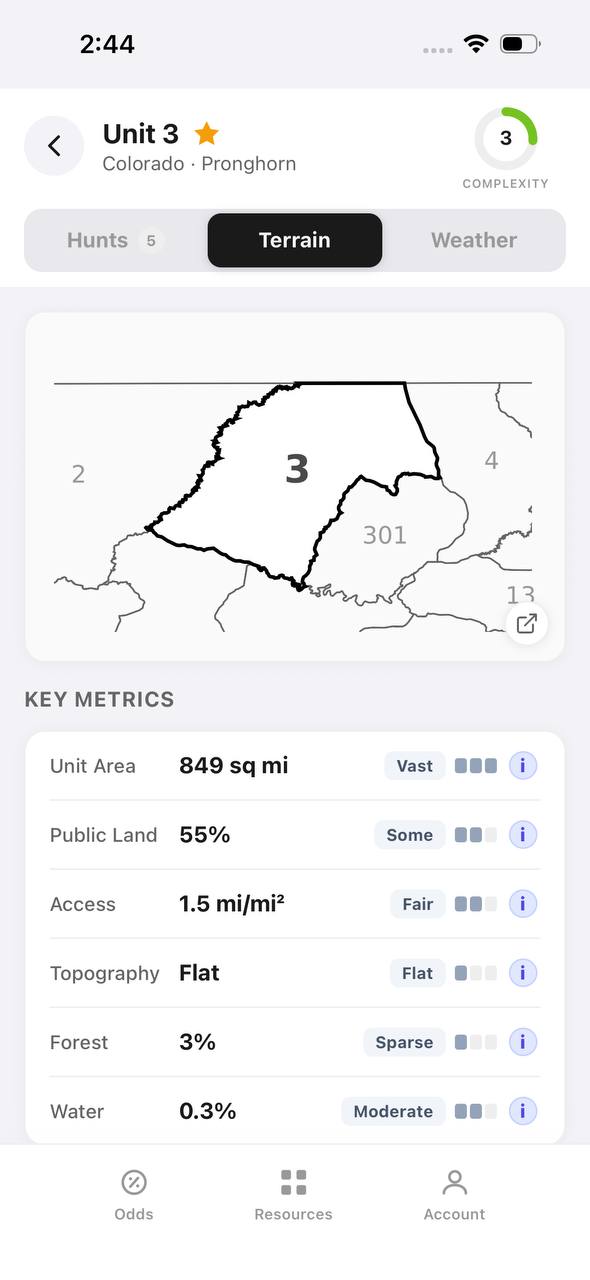
Colorado pronghorn unit detail, terrain tab, showing unit outline and key metrics

Colorado · Pronghorn, Unit 3

Unit boundaries and a complexity score at a glance.

The Terrain tab draws the unit outline against its neighbors and scores it for complexity, then breaks out area, public land, access, topography, forest, and water.

  • 849 sq mi, 55% public land, and flat topography make this a fairly approachable unit.
  • Each metric carries a short rating word — Vast, Some, Fair, Flat, Sparse, Moderate — with a tooltip.
  • The outline map shows adjacent units 2, 4, 13, and 301 for context.
State profiles
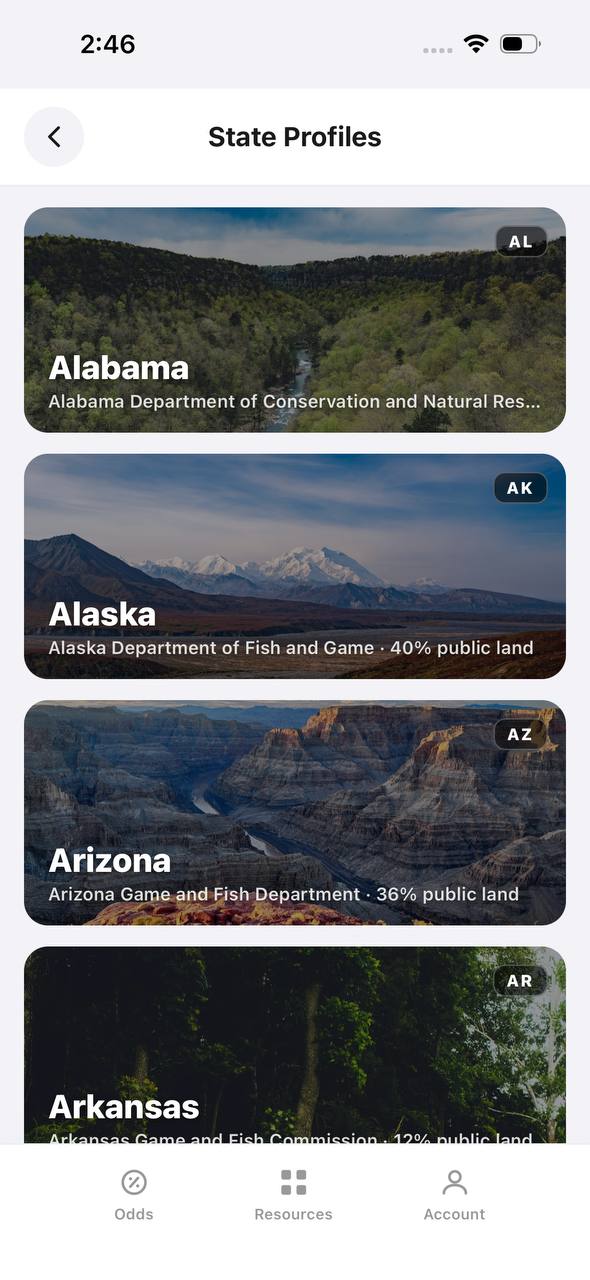
State Profiles screen listing states with wildlife agency and public land percentage

State Profiles

Each state's wildlife agency and public land share, at a glance.

State Profiles lists every covered state as a photo card naming its wildlife agency and, where available, its public land percentage.

  • Public land percentage shows right in the list, before opening the state.
  • Each card names the exact agency the regulations come from.
  • States without a public land figure yet, like Alabama here, are still listed.
Points wallet
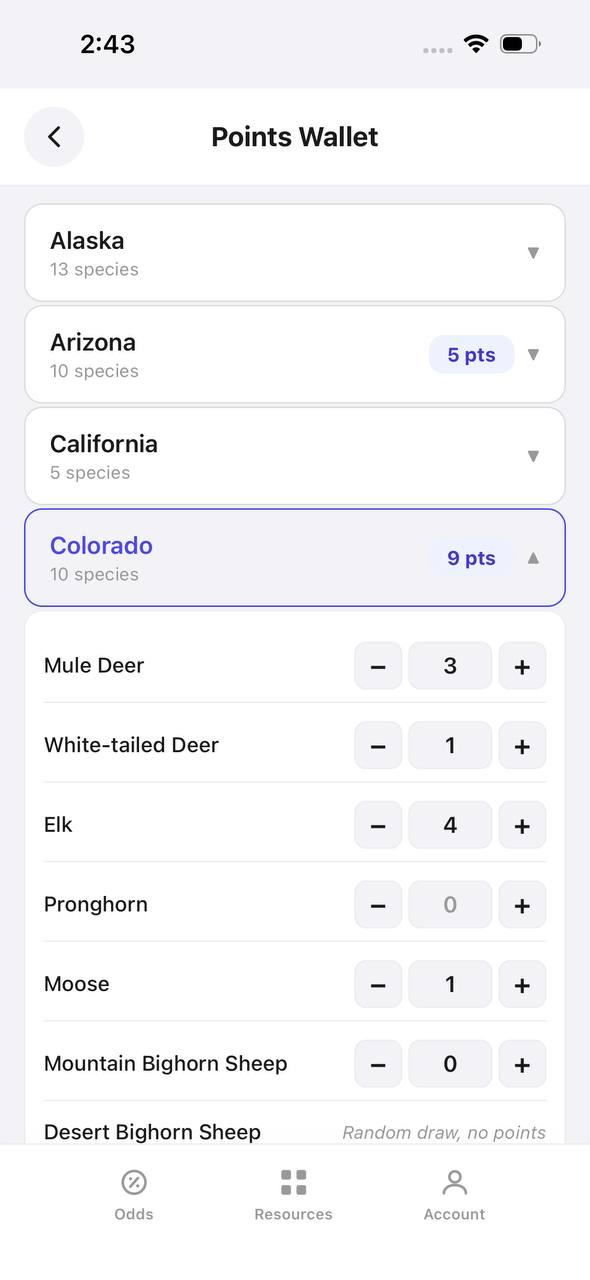
Points Wallet screen with Colorado expanded, showing a point stepper per species

Points Wallet · Colorado

Every state and species point balance in one wallet.

Points Wallet lists each state with a species count; expanding a state, like Colorado here, shows a stepper for every species so a balance can be entered or adjusted directly.

  • Colorado alone tracks points across 10 species independently.
  • Species with no points, like Pronghorn here, still show a zero to stay visible.
  • Desert Bighorn Sheep is flagged as a random draw with no points system.

Free to join

Download mobile app

  • Detailed draw odds
  • Point tracking
  • Deadline reminders
  • 19 states covered
Download on the App StoreGet it on Google Play
Draw odds
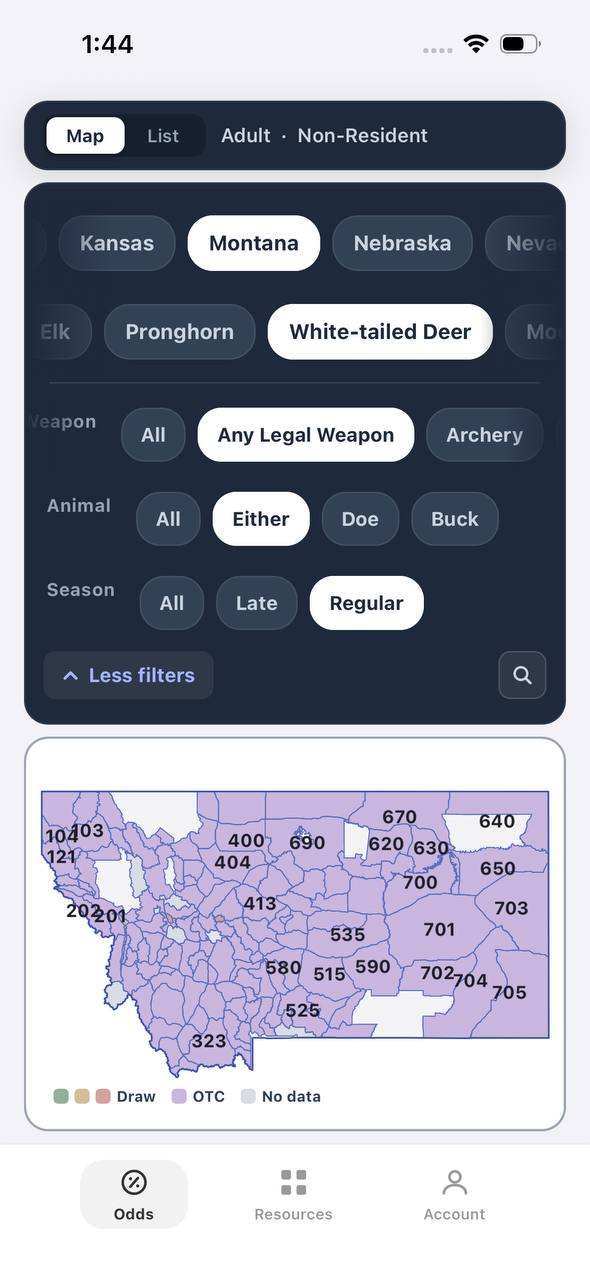
Montana white-tailed deer draw odds filtered to any legal weapon, either sex, regular season
AdultNonresidentAny Legal WeaponEitherRegular

Montana · White-tailed deer

Nearly the whole state is OTC for this filter combination.

Adult, Nonresident, White-tailed deer, filtered to Any Legal Weapon, Either, Regular. Under this combination almost every unit turns purple — over the counter.

  • Switching weapon, sex, or season changes the picture completely.
  • Purple means the tag can be bought directly, no draw.
  • This is the tag-and-go read of Montana whitetail, not the point-based one.
Terrain data
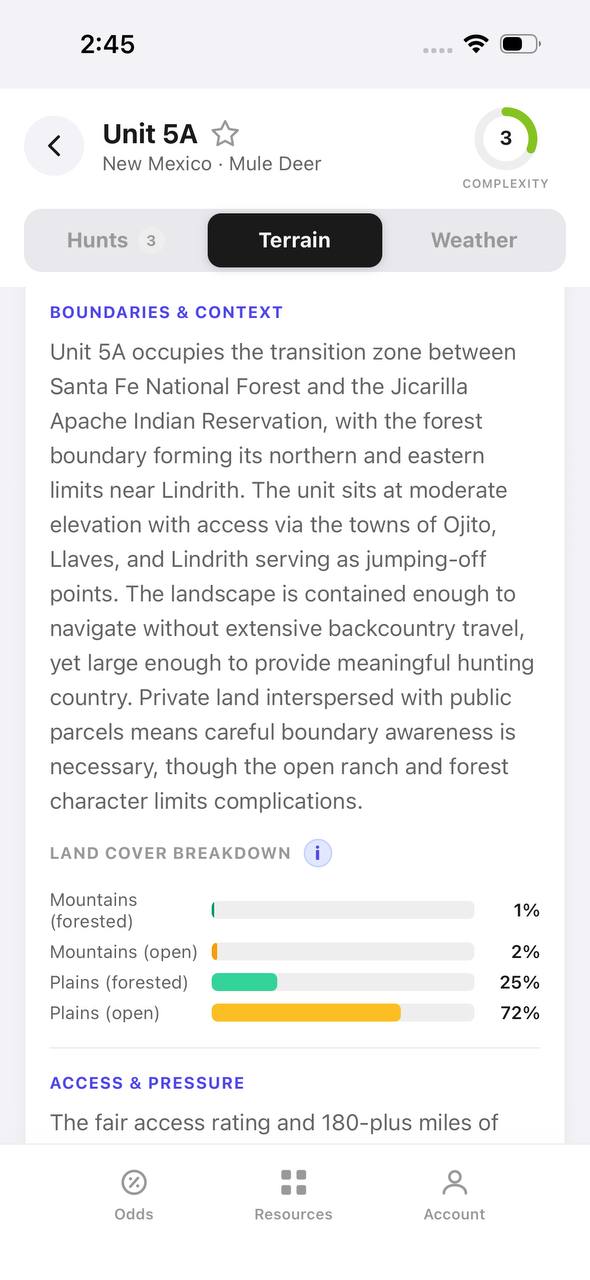
New Mexico mule deer unit 5A terrain tab with boundary description and land cover breakdown

New Mexico · Mule deer, Unit 5A

A written boundary description, not just a shape.

Unit 5A's terrain tab opens with a plain-language paragraph about surrounding land, access towns, and ownership mix, then a land cover breakdown by percentage.

  • 72% open plains and 25% forested plains describe the terrain at a glance.
  • The boundary text calls out the exact reservation and forest lines that define the unit.
  • Access & pressure continues below the fold with mileage detail.
Draw odds
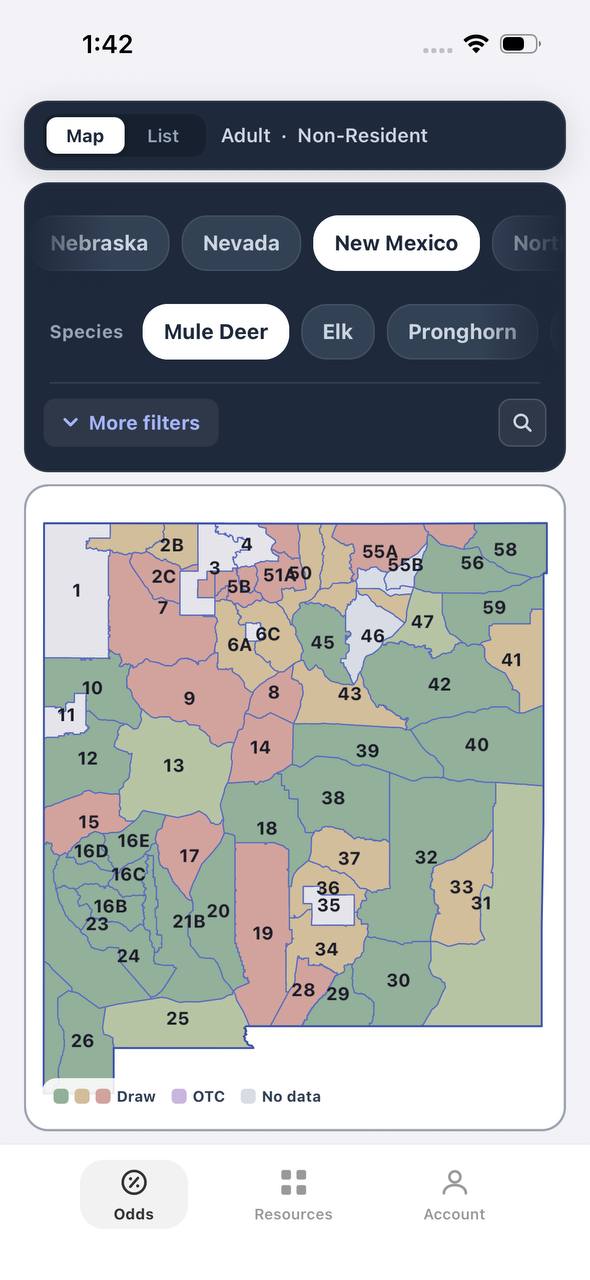
New Mexico mule deer draw odds by unit
AdultNonresident

New Mexico · Mule deer

Mule deer draw odds for every unit in the state.

Adult, Nonresident, Mule deer, all weapons and seasons. Each unit is colored by the same odds calculation used in the dashboard.

  • Green and tan together separate units worth applying to from units that are not.
  • Numbered units follow New Mexico's own game management unit boundaries.
  • Opening a unit shows the exact hunt behind the color.
Favorites
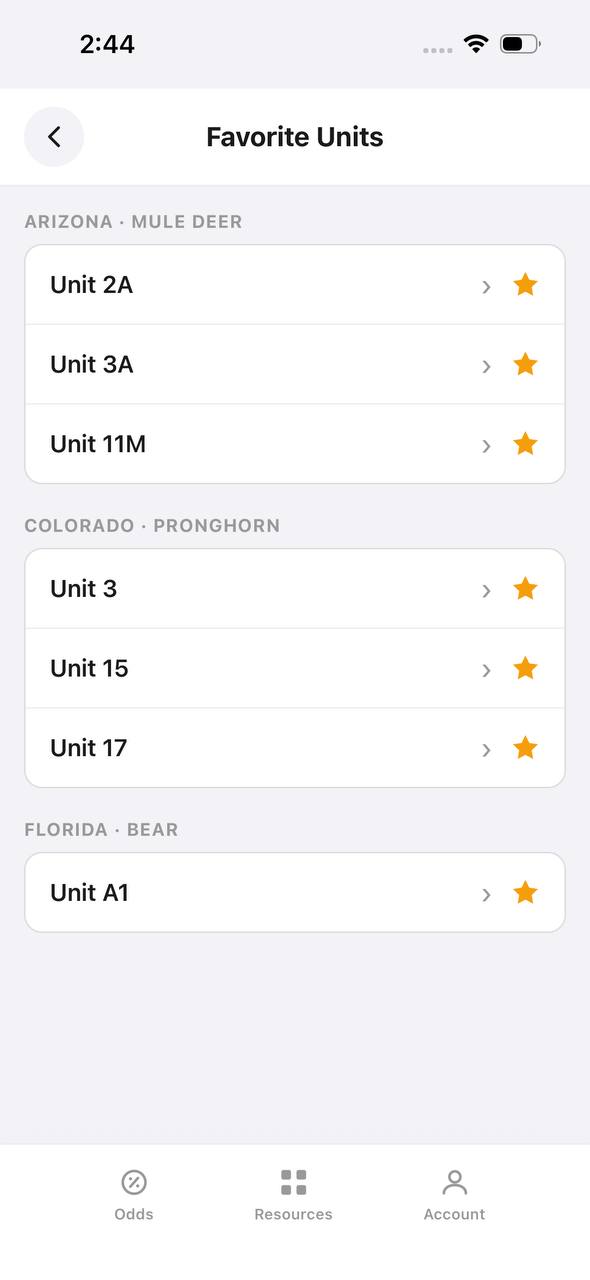
Favorite Units screen grouped by state and species

Favorite Units

Starred units from any state, grouped by species.

Favorite Units collects every starred unit across states and species into one list, grouped by state and species pair, so a saved unit is one tap away.

  • Arizona mule deer and Colorado pronghorn favorites sit side by side here.
  • Each row opens straight into that unit's detail view.
  • Unstarring from this screen removes it from the group instantly.
Deadlines
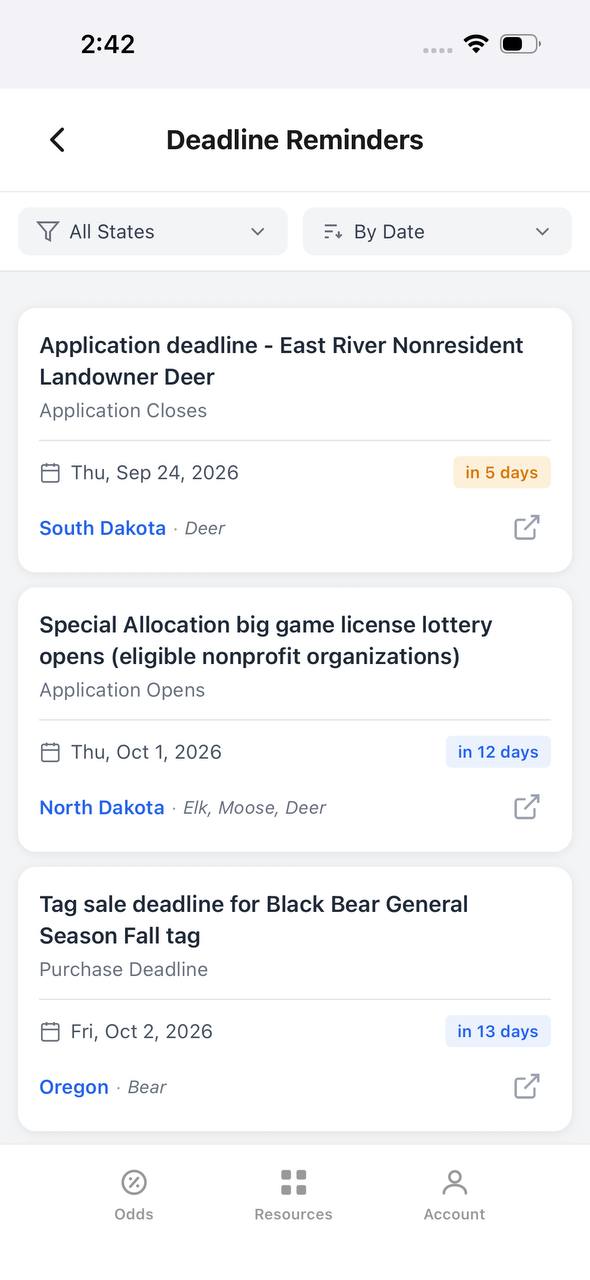
Deadline Reminders screen listing application and purchase deadlines by date

Deadline Reminders

Every application and purchase deadline, sorted by date.

Deadline Reminders filters by state and sorts by date, showing the deadline type, a countdown, and the state and species it applies to, with a link out to the source.

  • Countdown badges shift as a deadline gets close — "in 5 days" here, for example.
  • Application opens and closes are tracked as separate reminder types.
  • Each card links out to confirm the rule at the source.
Interactive map
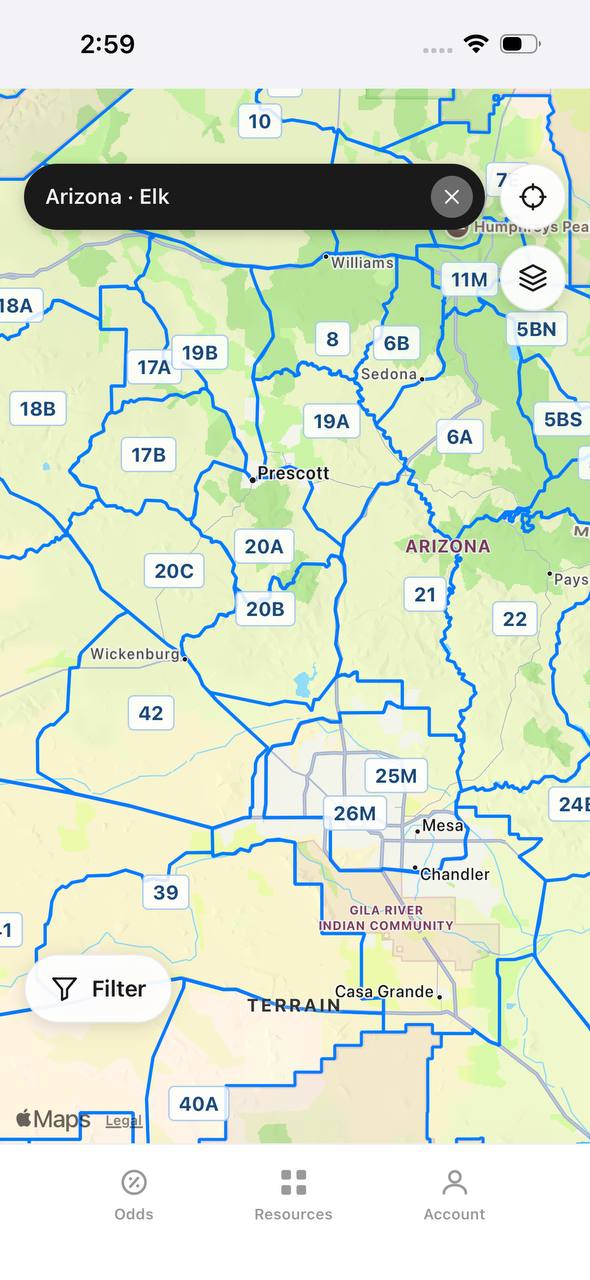
Arizona elk unit boundaries overlaid on an interactive street map

Arizona · Elk

Unit boundaries laid directly over a real map.

This view overlays Arizona elk unit boundaries and labels on top of a street map, with a search bar pinned to state and species and a layer toggle in the corner.

  • Real towns like Prescott and Sedona sit inside their unit boundaries for context.
  • A location button and layer switch float over the map, clear of the unit labels.
  • A Filter button at the bottom opens the same filters used elsewhere in the app.

Free to join

Download mobile app

  • Detailed draw odds
  • Point tracking
  • Deadline reminders
  • 19 states covered
Download on the App StoreGet it on Google Play
Insights
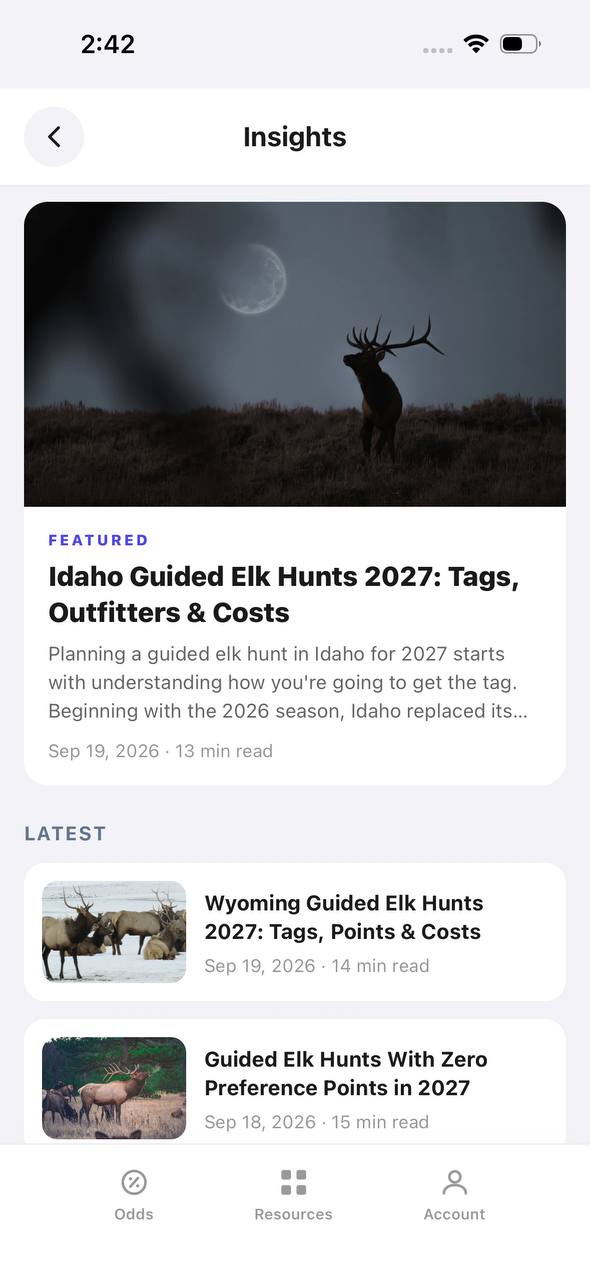
Insights screen with a featured article and a latest articles list

Insights

Hunting articles, built into the app itself.

Insights opens to a featured article with a hero image, then a Latest list of recent posts, each with a thumbnail, read time, and publish date.

  • The featured slot rotates to the newest deep-dive article.
  • Read time and publish date show on every card, not just the featured one.
  • This mirrors the blog content already published on the marketing site.
Download on the App StoreGet it on Google Play

Rope, Snares, and Securing Equipment

Beyond the harpoon line, you need additional heavy rope for controlling and securing gators. Bring at least 100 feet of extra 3/8-inch or 1/2-inch nylon or polyester rope. This is used for making temporary tie-offs, creating snare loops to control the mouth and legs, or securing the gator to the boat.

Some hunters use pre-made snare poles with cable loops for capturing the head and mouth. These give you a way to control the business end of the gator from a distance. Once snared, you can bring the gator alongside the boat and work toward dispatch. Snare poles should be 10–12 feet long with aircraft cable rated for at least 500 pounds.

Electrical tape is essential for taping the gator's mouth shut once it is dispatched and aboard. Wrap several layers around the snout behind the teeth. Even dead gators can snap shut reflexively, and a taped mouth prevents accidents during transport. Some hunters also tape the legs to the body to make handling easier.

Bring heavy-duty gloves—leather work gloves or rubber-coated commercial fishing gloves. They protect your hands from rope burns, hook points, and the gator's rough hide. Cheap cotton gloves will not cut it when you are hauling on wet rope with a 10-foot gator pulling back.

Boat and Navigation Essentials

You need a boat designed for shallow, vegetation-choked water. Airboats, shallow-draft aluminum jon boats, and flat-bottomed skiffs are the most common choices. The boat should be stable enough to handle the weight and movement of a large gator being brought aboard. Most Florida gator hunters work from boats in the 14–18 foot range.

A reliable trolling motor or push pole is critical for silent approaches. You want to close the distance without spooking the gator. Outboard motors are used for transit but not for stalking. Many hunters use an electric trolling motor for the final approach, then switch to a push pole for the last 50 feet.

GPS and a good navigation app are important for marking locations, finding your way back in the dark, and staying legal. Many Wildlife Management Areas have specific boundaries and zones where hunting is allowed. A handheld GPS unit or smartphone with offline maps prevents you from accidentally crossing into closed areas. The OnX Hunt app is popular among hunters for its property boundaries and public land layers.

Life jackets are required by law and common sense. Fighting a gator in the dark on the water is inherently dangerous. Falls and capsizes happen. Wear your PFD, and make sure everyone in the boat does the same.

Draw odds
Alaska moose draw odds by unit, colored by draw, OTC, or no data
AdultNonresident

Alaska · Moose

Draw, OTC, and no-data units across the whole state.

Adult, Nonresident, Moose, no additional filters. Every unit is colored by its best matching draw odds; if nothing draws, it shows OTC; if neither, no data.

  • Alaska mixes draw and OTC moose hunts within the same region.
  • Green units are worth an application; purple units are OTC.
  • Filters stay applied when a unit is opened for hunt detail.
Draw odds
California mule deer draw odds ranked by unit in a list
AdultNonresident

California · Mule deer

Nonresident odds ranked unit by unit.

Adult, Nonresident, Mule deer, no weapon or season chip, so every matching hunt in a zone is combined into one badge and sorted by best projected odds.

  • D6 leads the list; a range like 8%–14% means more than one hunt code exists in that zone.
  • The list and the map read the same filtered hunt set.
  • 46 units are shown for this species and state alone.

Free to join

Download mobile app

  • Detailed draw odds
  • Point tracking
  • Deadline reminders
  • 19 states covered
Download on the App StoreGet it on Google Play
Unit detail
Wyoming elk unit detail, hunts tab, showing hunt windows on a timeline

Wyoming · Elk, Unit 3

Every hunt window inside one unit, laid out on a timeline.

Unit 3 has two hunt codes for elk. Each one shows its weapon, animal type, and season as a bar on a shared Aug–Jan timeline, plus a day-by-day moon phase strip.

  • Archery, then a long Any Legal Weapon window, then a late season — three opportunities in one unit.
  • The 100% badge at top means no real draw competition for the selected filters right now.
  • Weather & conditions expands below the hunt list without leaving the unit.
Terrain data
Colorado pronghorn unit detail, terrain tab, showing unit outline and key metrics

Colorado · Pronghorn, Unit 3

Unit boundaries and a complexity score at a glance.

The Terrain tab draws the unit outline against its neighbors and scores it for complexity, then breaks out area, public land, access, topography, forest, and water.

  • 849 sq mi, 55% public land, and flat topography make this a fairly approachable unit.
  • Each metric carries a short rating word — Vast, Some, Fair, Flat, Sparse, Moderate — with a tooltip.
  • The outline map shows adjacent units 2, 4, 13, and 301 for context.
State profiles
State Profiles screen listing states with wildlife agency and public land percentage

State Profiles

Each state's wildlife agency and public land share, at a glance.

State Profiles lists every covered state as a photo card naming its wildlife agency and, where available, its public land percentage.

  • Public land percentage shows right in the list, before opening the state.
  • Each card names the exact agency the regulations come from.
  • States without a public land figure yet, like Alabama here, are still listed.
Points wallet
Points Wallet screen with Colorado expanded, showing a point stepper per species

Points Wallet · Colorado

Every state and species point balance in one wallet.

Points Wallet lists each state with a species count; expanding a state, like Colorado here, shows a stepper for every species so a balance can be entered or adjusted directly.

  • Colorado alone tracks points across 10 species independently.
  • Species with no points, like Pronghorn here, still show a zero to stay visible.
  • Desert Bighorn Sheep is flagged as a random draw with no points system.

Free to join

Download mobile app

  • Detailed draw odds
  • Point tracking
  • Deadline reminders
  • 19 states covered
Download on the App StoreGet it on Google Play
Draw odds
Montana white-tailed deer draw odds filtered to any legal weapon, either sex, regular season
AdultNonresidentAny Legal WeaponEitherRegular

Montana · White-tailed deer

Nearly the whole state is OTC for this filter combination.

Adult, Nonresident, White-tailed deer, filtered to Any Legal Weapon, Either, Regular. Under this combination almost every unit turns purple — over the counter.

  • Switching weapon, sex, or season changes the picture completely.
  • Purple means the tag can be bought directly, no draw.
  • This is the tag-and-go read of Montana whitetail, not the point-based one.
Terrain data
New Mexico mule deer unit 5A terrain tab with boundary description and land cover breakdown

New Mexico · Mule deer, Unit 5A

A written boundary description, not just a shape.

Unit 5A's terrain tab opens with a plain-language paragraph about surrounding land, access towns, and ownership mix, then a land cover breakdown by percentage.

  • 72% open plains and 25% forested plains describe the terrain at a glance.
  • The boundary text calls out the exact reservation and forest lines that define the unit.
  • Access & pressure continues below the fold with mileage detail.
Draw odds
New Mexico mule deer draw odds by unit
AdultNonresident

New Mexico · Mule deer

Mule deer draw odds for every unit in the state.

Adult, Nonresident, Mule deer, all weapons and seasons. Each unit is colored by the same odds calculation used in the dashboard.

  • Green and tan together separate units worth applying to from units that are not.
  • Numbered units follow New Mexico's own game management unit boundaries.
  • Opening a unit shows the exact hunt behind the color.
Favorites
Favorite Units screen grouped by state and species

Favorite Units

Starred units from any state, grouped by species.

Favorite Units collects every starred unit across states and species into one list, grouped by state and species pair, so a saved unit is one tap away.

  • Arizona mule deer and Colorado pronghorn favorites sit side by side here.
  • Each row opens straight into that unit's detail view.
  • Unstarring from this screen removes it from the group instantly.
Deadlines
Deadline Reminders screen listing application and purchase deadlines by date

Deadline Reminders

Every application and purchase deadline, sorted by date.

Deadline Reminders filters by state and sorts by date, showing the deadline type, a countdown, and the state and species it applies to, with a link out to the source.

  • Countdown badges shift as a deadline gets close — "in 5 days" here, for example.
  • Application opens and closes are tracked as separate reminder types.
  • Each card links out to confirm the rule at the source.
Interactive map
Arizona elk unit boundaries overlaid on an interactive street map

Arizona · Elk

Unit boundaries laid directly over a real map.

This view overlays Arizona elk unit boundaries and labels on top of a street map, with a search bar pinned to state and species and a layer toggle in the corner.

  • Real towns like Prescott and Sedona sit inside their unit boundaries for context.
  • A location button and layer switch float over the map, clear of the unit labels.
  • A Filter button at the bottom opens the same filters used elsewhere in the app.

Free to join

Download mobile app

  • Detailed draw odds
  • Point tracking
  • Deadline reminders
  • 19 states covered
Download on the App StoreGet it on Google Play
Insights
Insights screen with a featured article and a latest articles list

Insights

Hunting articles, built into the app itself.

Insights opens to a featured article with a hero image, then a Latest list of recent posts, each with a thumbnail, read time, and publish date.

  • The featured slot rotates to the newest deep-dive article.
  • Read time and publish date show on every card, not just the featured one.
  • This mirrors the blog content already published on the marketing site.
Download on the App StoreGet it on Google Play

Safety and Communication Gear

Alligator hunting is one of the more dangerous pursuits in the hunting world. You are working in the dark, in the water, with an animal that can injure or kill you. Proper safety equipment is not negotiable.

A marine VHF radio or a fully charged cell phone in a waterproof case ensures you can call for help if something goes wrong. Many Florida swamps and lakes have limited cell coverage, so a VHF radio is often more reliable. At minimum, make sure someone on shore knows your location and expected return time.

A well-stocked first aid kit is essential. Include trauma supplies like Israeli bandages, QuikClot, and a tourniquet. Gator bites, hook injuries, and lacerations from thrashing animals can cause serious bleeding. You may be 30 minutes or more from medical help, so your kit needs to handle major injuries.

Knives are needed for processing and tagging. Carry a fixed-blade hunting knife with a 4–5 inch blade for making the required tail notch and cape cuts. A folding lockback knife is useful as a backup and general utility tool. Keep blades sharp—dull knives are more dangerous because they require more force and are more likely to slip.

Bug spray is mandatory. Florida swamps in late summer are infested with mosquitoes and biting flies. Bring high-DEET spray and consider a Thermacell unit for the boat. You cannot focus on hunting if you are being eaten alive by insects.

Firearms and Backup Options

While the bang stick is the primary dispatch tool, Florida law allows the use of firearms to kill alligators once they are secured by a harpoon or other device. Some hunters prefer to use a firearm as a backup or primary method, especially on very large gators where precise shot placement is easier with a gun.

A .22 Magnum revolver or rifle is a popular choice for brain shots at close range. The relatively low recoil and noise make it manageable on a boat, and it has enough power for a well-placed shot behind the gator's eyes. Some hunters use larger calibers like 9mm or .45 ACP pistols for added insurance.

Shotguns loaded with slugs are effective but loud and produce significant muzzle blast in the dark. If you choose a shotgun, use a 12-gauge with rifled slugs and be prepared for recoil management on an unstable platform. Make sure your shooting position is secure and your muzzle is pointed in a safe direction at all times.

Bow fishing gear is legal for taking gators in Florida, though it is less common than harpoons because of the lower holding power and shorter effective range. If you use a bow, you need a heavy draw weight—at least 50 pounds—and arrows equipped with barbed points and heavy line.

Processing and Transport Equipment

Once the gator is dispatched, you need to get it back to the ramp and process it. Bring a heavy-duty cooler or fish box large enough to hold the meat. Gator meat spoils quickly in Florida heat, so pack ice and get it on ice as soon as possible after harvest.

A tape measure is required to verify that your gator meets the minimum legal length—4 feet in most areas. Measure from the tip of the snout to the end of the tail along the belly. Record this measurement and take photos for documentation.

Bring heavy-duty trash bags for transporting the hide and meat. If you plan to have the hide tanned, keep it cool and get it to a processor or into a freezer within 24 hours. Meat should be cleaned, packaged, and frozen promptly. Many hunters field dress gators at the ramp and bring home only the tail and body meat.

A sturdy fillet knife or electric knife makes processing easier. Gator meat is dense and somewhat tough to cut, especially the tail section. A good sharp fillet knife with a flexible blade helps you separate meat from the bone efficiently.

Draw odds
Alaska moose draw odds by unit, colored by draw, OTC, or no data
AdultNonresident

Alaska · Moose

Draw, OTC, and no-data units across the whole state.

Adult, Nonresident, Moose, no additional filters. Every unit is colored by its best matching draw odds; if nothing draws, it shows OTC; if neither, no data.

  • Alaska mixes draw and OTC moose hunts within the same region.
  • Green units are worth an application; purple units are OTC.
  • Filters stay applied when a unit is opened for hunt detail.
Draw odds
California mule deer draw odds ranked by unit in a list
AdultNonresident

California · Mule deer

Nonresident odds ranked unit by unit.

Adult, Nonresident, Mule deer, no weapon or season chip, so every matching hunt in a zone is combined into one badge and sorted by best projected odds.

  • D6 leads the list; a range like 8%–14% means more than one hunt code exists in that zone.
  • The list and the map read the same filtered hunt set.
  • 46 units are shown for this species and state alone.

Free to join

Download mobile app

  • Detailed draw odds
  • Point tracking
  • Deadline reminders
  • 19 states covered
Download on the App StoreGet it on Google Play
Unit detail
Wyoming elk unit detail, hunts tab, showing hunt windows on a timeline

Wyoming · Elk, Unit 3

Every hunt window inside one unit, laid out on a timeline.

Unit 3 has two hunt codes for elk. Each one shows its weapon, animal type, and season as a bar on a shared Aug–Jan timeline, plus a day-by-day moon phase strip.

  • Archery, then a long Any Legal Weapon window, then a late season — three opportunities in one unit.
  • The 100% badge at top means no real draw competition for the selected filters right now.
  • Weather & conditions expands below the hunt list without leaving the unit.
Terrain data
Colorado pronghorn unit detail, terrain tab, showing unit outline and key metrics

Colorado · Pronghorn, Unit 3

Unit boundaries and a complexity score at a glance.

The Terrain tab draws the unit outline against its neighbors and scores it for complexity, then breaks out area, public land, access, topography, forest, and water.

  • 849 sq mi, 55% public land, and flat topography make this a fairly approachable unit.
  • Each metric carries a short rating word — Vast, Some, Fair, Flat, Sparse, Moderate — with a tooltip.
  • The outline map shows adjacent units 2, 4, 13, and 301 for context.
State profiles
State Profiles screen listing states with wildlife agency and public land percentage

State Profiles

Each state's wildlife agency and public land share, at a glance.

State Profiles lists every covered state as a photo card naming its wildlife agency and, where available, its public land percentage.

  • Public land percentage shows right in the list, before opening the state.
  • Each card names the exact agency the regulations come from.
  • States without a public land figure yet, like Alabama here, are still listed.
Points wallet
Points Wallet screen with Colorado expanded, showing a point stepper per species

Points Wallet · Colorado

Every state and species point balance in one wallet.

Points Wallet lists each state with a species count; expanding a state, like Colorado here, shows a stepper for every species so a balance can be entered or adjusted directly.

  • Colorado alone tracks points across 10 species independently.
  • Species with no points, like Pronghorn here, still show a zero to stay visible.
  • Desert Bighorn Sheep is flagged as a random draw with no points system.

Free to join

Download mobile app

  • Detailed draw odds
  • Point tracking
  • Deadline reminders
  • 19 states covered
Download on the App StoreGet it on Google Play
Draw odds
Montana white-tailed deer draw odds filtered to any legal weapon, either sex, regular season
AdultNonresidentAny Legal WeaponEitherRegular

Montana · White-tailed deer

Nearly the whole state is OTC for this filter combination.

Adult, Nonresident, White-tailed deer, filtered to Any Legal Weapon, Either, Regular. Under this combination almost every unit turns purple — over the counter.

  • Switching weapon, sex, or season changes the picture completely.
  • Purple means the tag can be bought directly, no draw.
  • This is the tag-and-go read of Montana whitetail, not the point-based one.
Terrain data
New Mexico mule deer unit 5A terrain tab with boundary description and land cover breakdown

New Mexico · Mule deer, Unit 5A

A written boundary description, not just a shape.

Unit 5A's terrain tab opens with a plain-language paragraph about surrounding land, access towns, and ownership mix, then a land cover breakdown by percentage.

  • 72% open plains and 25% forested plains describe the terrain at a glance.
  • The boundary text calls out the exact reservation and forest lines that define the unit.
  • Access & pressure continues below the fold with mileage detail.
Draw odds
New Mexico mule deer draw odds by unit
AdultNonresident

New Mexico · Mule deer

Mule deer draw odds for every unit in the state.

Adult, Nonresident, Mule deer, all weapons and seasons. Each unit is colored by the same odds calculation used in the dashboard.

  • Green and tan together separate units worth applying to from units that are not.
  • Numbered units follow New Mexico's own game management unit boundaries.
  • Opening a unit shows the exact hunt behind the color.
Favorites
Favorite Units screen grouped by state and species

Favorite Units

Starred units from any state, grouped by species.

Favorite Units collects every starred unit across states and species into one list, grouped by state and species pair, so a saved unit is one tap away.

  • Arizona mule deer and Colorado pronghorn favorites sit side by side here.
  • Each row opens straight into that unit's detail view.
  • Unstarring from this screen removes it from the group instantly.
Deadlines
Deadline Reminders screen listing application and purchase deadlines by date

Deadline Reminders

Every application and purchase deadline, sorted by date.

Deadline Reminders filters by state and sorts by date, showing the deadline type, a countdown, and the state and species it applies to, with a link out to the source.

  • Countdown badges shift as a deadline gets close — "in 5 days" here, for example.
  • Application opens and closes are tracked as separate reminder types.
  • Each card links out to confirm the rule at the source.
Interactive map
Arizona elk unit boundaries overlaid on an interactive street map

Arizona · Elk

Unit boundaries laid directly over a real map.

This view overlays Arizona elk unit boundaries and labels on top of a street map, with a search bar pinned to state and species and a layer toggle in the corner.

  • Real towns like Prescott and Sedona sit inside their unit boundaries for context.
  • A location button and layer switch float over the map, clear of the unit labels.
  • A Filter button at the bottom opens the same filters used elsewhere in the app.

Free to join

Download mobile app

  • Detailed draw odds
  • Point tracking
  • Deadline reminders
  • 19 states covered
Download on the App StoreGet it on Google Play
Insights
Insights screen with a featured article and a latest articles list

Insights

Hunting articles, built into the app itself.

Insights opens to a featured article with a hero image, then a Latest list of recent posts, each with a thumbnail, read time, and publish date.

  • The featured slot rotates to the newest deep-dive article.
  • Read time and publish date show on every card, not just the featured one.
  • This mirrors the blog content already published on the marketing site.
Download on the App StoreGet it on Google Play

TAGZ: Planning Your Next Hunt

While Florida alligator hunting is a unique pursuit, many hunters also chase big game across the West. TAGZ helps you track preference points and bonus points across multiple states, compare unit maps and terrain, and stay on top of draw deadlines so you never miss an application window. Whether you are building points for a trophy elk tag or researching OTC deer units, TAGZ gives you the tools to make smarter draw decisions and confidently plan hunts from application season through the field.

FAQ — Florida Alligator Hunting Gear

What is the most important piece of equipment for alligator hunting?

The harpoon system is your most critical tool. It gives you control from a safe distance and keeps the gator secured while you prepare for dispatch. Without a solid harpoon setup, you cannot safely handle a large alligator.

Do I really need a bang stick or can I use a regular firearm?

A bang stick is strongly recommended because it delivers precise contact energy to the brain at point-blank range without the risk of a miss or ricochet. Firearms work but require perfect shot placement on a moving target in the dark from an unstable boat.

What size fishing rod and reel do I need for alligator hunting?

Use a heavy or extra-heavy 7–8 foot saltwater rod with a conventional reel that holds at least 300 yards of 80–130 pound braid. The setup needs to handle sustained runs and have enough drag power to tire a large gator without breaking.

How much does quality alligator hunting equipment cost?

Expect to spend $800–1500 to outfit yourself properly. A complete harpoon system runs $150–300, a quality bang stick costs $200–400, heavy rod and reel setup is $200–500, and lighting, rope, and safety gear add another $250–400.

Can I use the same boat I use for bass fishing?

Maybe. If your bass boat is stable, has a shallow draft, and can handle the weight of a large gator being brought aboard, it will work. Many hunters prefer flat-bottomed jon boats or skiffs because they are more stable and better suited for navigating shallow, weedy water.

What should I do if my bang stick misfires?

Always carry backup loads and ideally a second bang stick. If a misfire occurs, stay calm, keep the gator secured, and reload or switch to your backup. Never attempt to repair or troubleshoot a bang stick while actively fighting a gator.

Continue Planning Your Hunt

Florida alligator hunting is a specialized pursuit, but if you are serious about big-game hunting across multiple states, TAGZ simplifies the research and planning process. Compare draw odds side by side, track your preference points and bonus points, and explore unit maps with terrain overlays and public land boundaries. From OTC elk tags to limited-entry trophy hunts, TAGZ helps you make confident decisions before you ever apply. Check out the TAGZ product to see how it streamlines western hunt planning, or browse the TAGZ Insights blog for more hunting strategies and gear guides. Ready to start planning your next hunt? Visit the TAGZ homepage or explore pricing options to find the plan that fits your hunting goals.