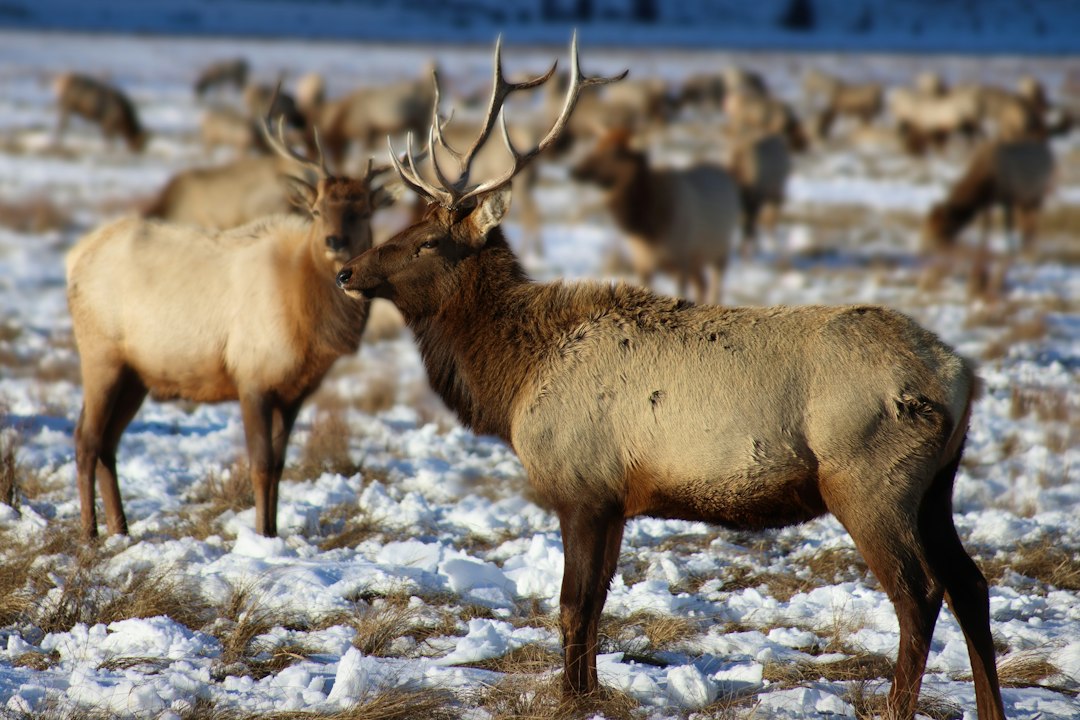
Wyoming Elk Draw Odds With 0 Points: 2027 Guide

16 min read·Sep 25, 2026·TAGZ
Wyoming Elk Draw Odds With 0 Points: 2027 Guide

How Does the Wyoming Elk Draw Work?

Wyoming treats resident and nonresident elk applicants differently.

For nonresidents, full-price elk licenses use:

Preference Points + Random Opportunity.

For residents, the elk drawing operates differently and doesn't use the nonresident elk preference-point system.

This article focuses primarily on:

Nonresident Wyoming Elk With Zero Points.

Wyoming Uses Preference Points for Nonresident Elk

Wyoming uses:

Preference Points

not bonus points for the applicable nonresident full-price elk drawing.

In the preference portion:

More Points = Higher Priority.

Applicants with the highest point totals are processed before applicants with fewer points.

However, that's only part of the system.

The 75/25 Wyoming Elk Draw

Wyoming currently splits applicable nonresident full-price elk quota into:

75% Preference

and:

25% Random.

That second portion is what keeps low-point and zero-point applicants in the game.

Can You Draw Wyoming Elk With Zero Points?

Yes.

A zero-point applicant participates in the preference portion.

But hunters with more preference points rank ahead of the zero-point applicant there.

If unsuccessful, the applicant can then participate in the applicable:

Random Portion.

So even if historical preference-point demand makes a license impossible to guarantee at zero points:

Random Opportunity May Still Exist.
Draw odds
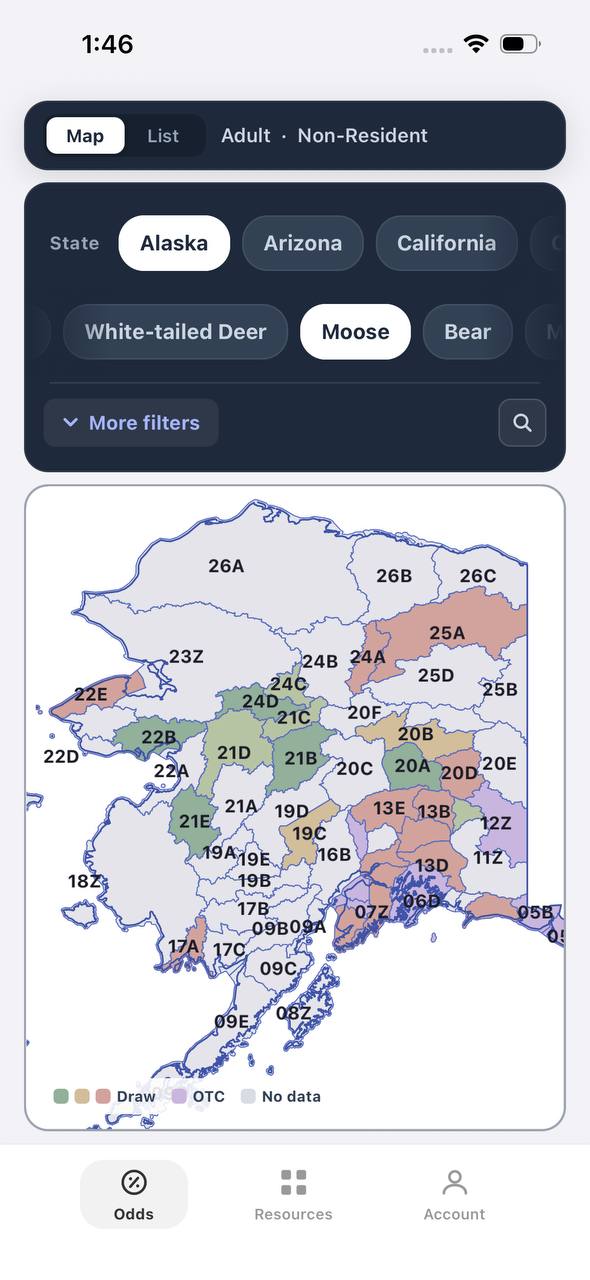
Alaska moose draw odds by unit, colored by draw, OTC, or no data
AdultNonresident

Alaska · Moose

Draw, OTC, and no-data units across the whole state.

Adult, Nonresident, Moose, no additional filters. Every unit is colored by its best matching draw odds; if nothing draws, it shows OTC; if neither, no data.

  • Alaska mixes draw and OTC moose hunts within the same region.
  • Green units are worth an application; purple units are OTC.
  • Filters stay applied when a unit is opened for hunt detail.
Draw odds
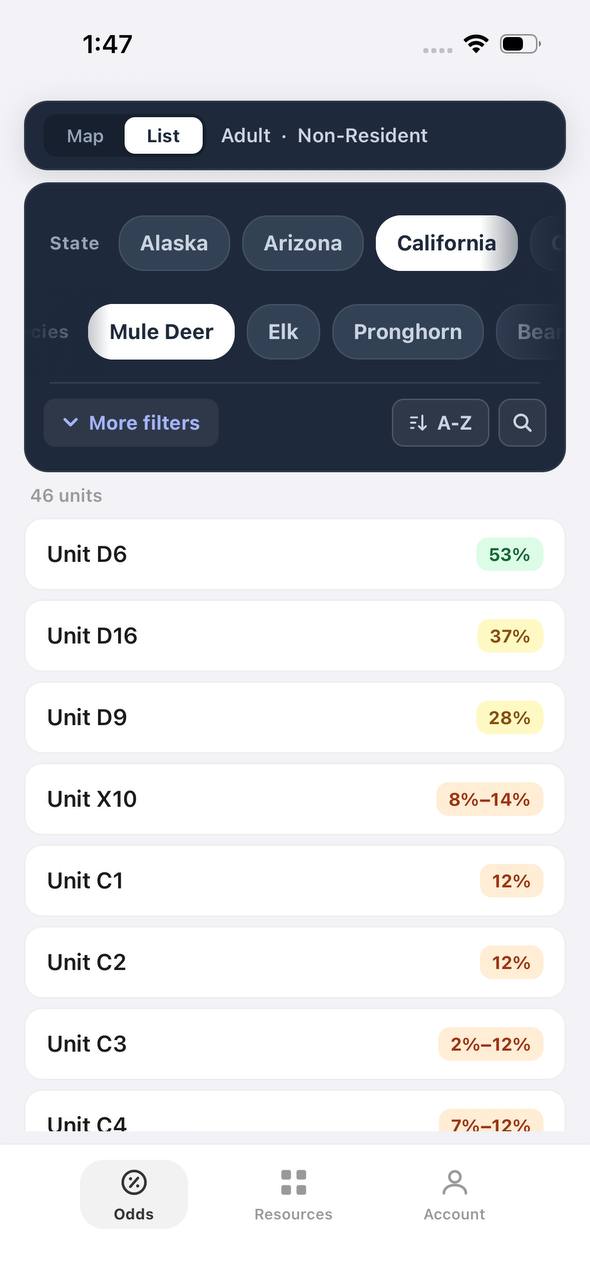
California mule deer draw odds ranked by unit in a list
AdultNonresident

California · Mule deer

Nonresident odds ranked unit by unit.

Adult, Nonresident, Mule deer, no weapon or season chip, so every matching hunt in a zone is combined into one badge and sorted by best projected odds.

  • D6 leads the list; a range like 8%–14% means more than one hunt code exists in that zone.
  • The list and the map read the same filtered hunt set.
  • 46 units are shown for this species and state alone.

Free to join

Download mobile app

  • Detailed draw odds
  • Point tracking
  • Deadline reminders
  • 18 states covered
Download on the App StoreGet it on Google Play
Unit detail
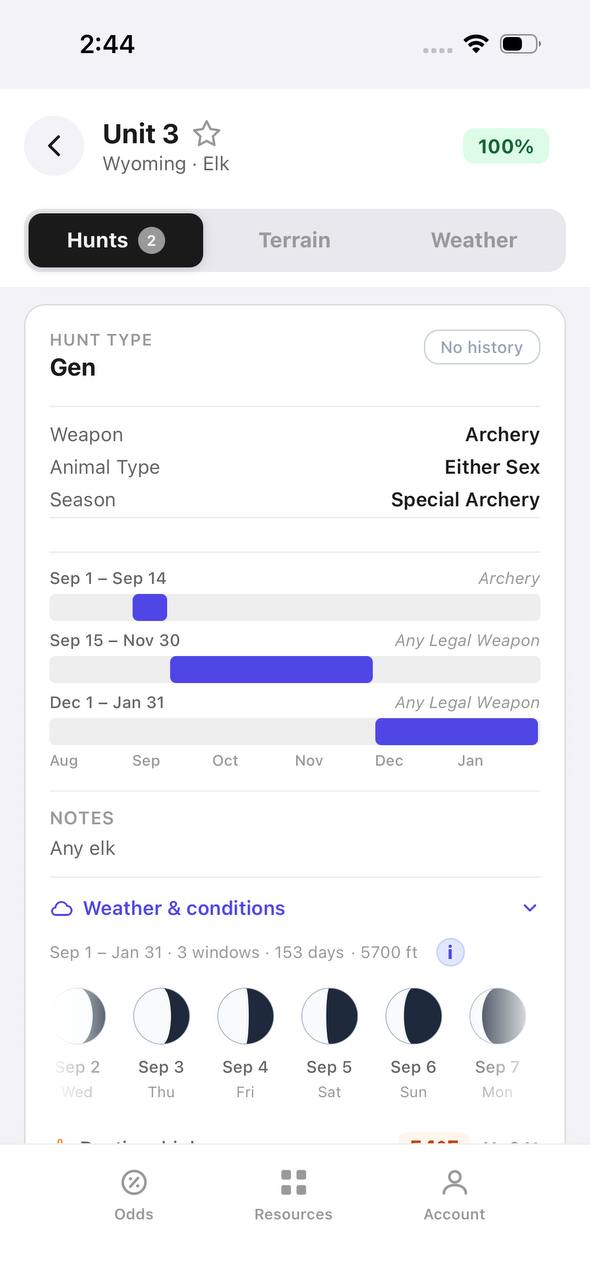
Wyoming elk unit detail, hunts tab, showing hunt windows on a timeline

Wyoming · Elk, Unit 3

Every hunt window inside one unit, laid out on a timeline.

Unit 3 has two hunt codes for elk. Each one shows its weapon, animal type, and season as a bar on a shared Aug–Jan timeline, plus a day-by-day moon phase strip.

  • Archery, then a long Any Legal Weapon window, then a late season — three opportunities in one unit.
  • The 100% badge at top means no real draw competition for the selected filters right now.
  • Weather & conditions expands below the hunt list without leaving the unit.
Terrain data
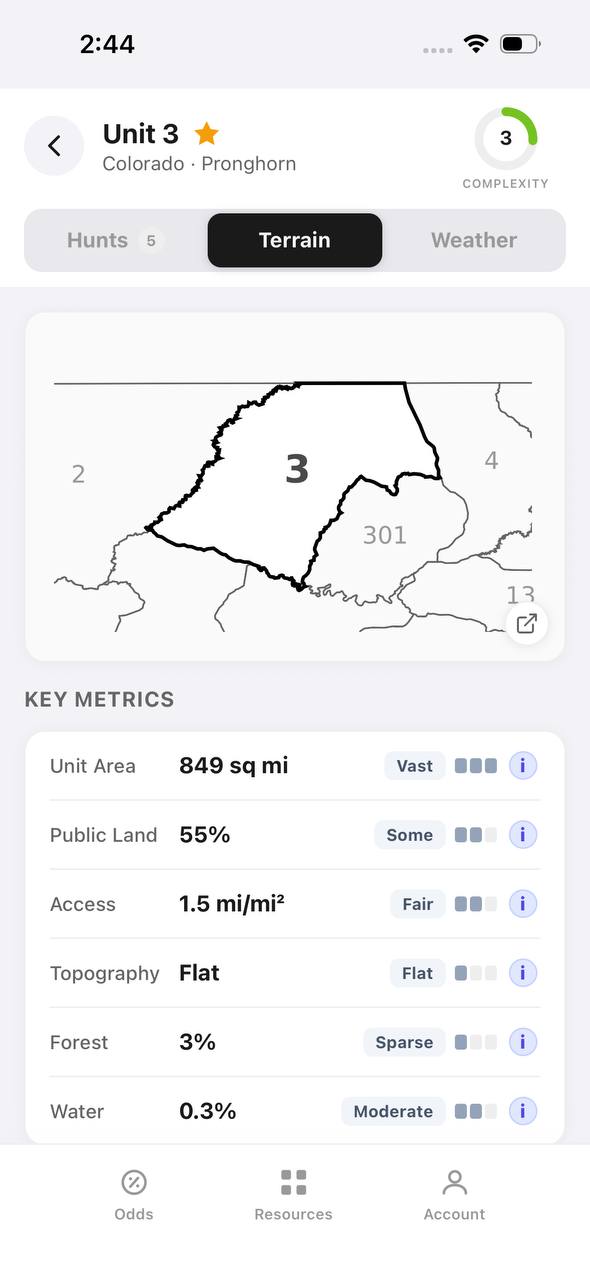
Colorado pronghorn unit detail, terrain tab, showing unit outline and key metrics

Colorado · Pronghorn, Unit 3

Unit boundaries and a complexity score at a glance.

The Terrain tab draws the unit outline against its neighbors and scores it for complexity, then breaks out area, public land, access, topography, forest, and water.

  • 849 sq mi, 55% public land, and flat topography make this a fairly approachable unit.
  • Each metric carries a short rating word — Vast, Some, Fair, Flat, Sparse, Moderate — with a tooltip.
  • The outline map shows adjacent units 2, 4, 13, and 301 for context.
State profiles
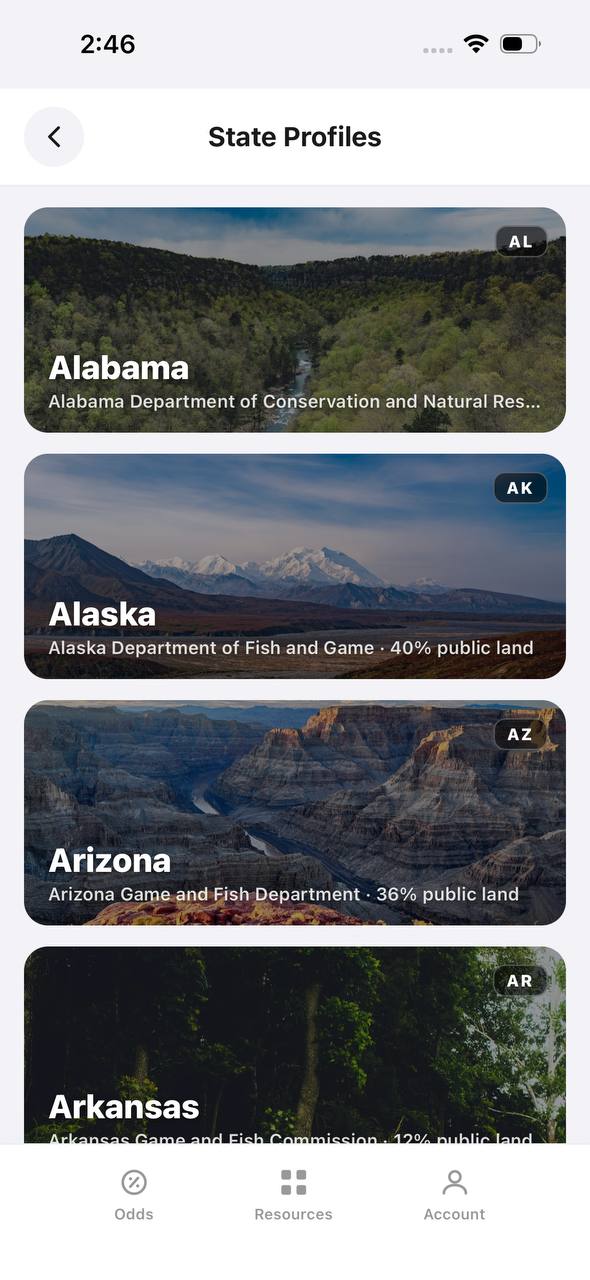
State Profiles screen listing states with wildlife agency and public land percentage

State Profiles

Each state's wildlife agency and public land share, at a glance.

State Profiles lists every covered state as a photo card naming its wildlife agency and, where available, its public land percentage.

  • Public land percentage shows right in the list, before opening the state.
  • Each card names the exact agency the regulations come from.
  • States without a public land figure yet, like Alabama here, are still listed.
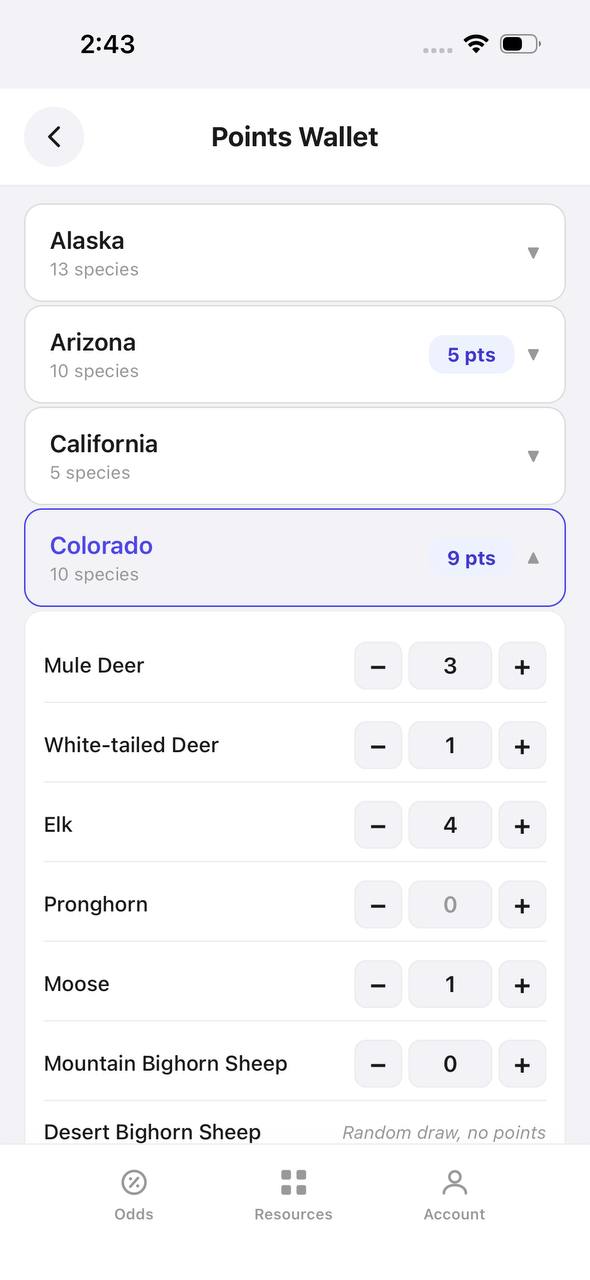
Points wallet
Points Wallet screen with Colorado expanded, showing a point stepper per species

Points Wallet · Colorado

Every state and species point balance in one wallet.

Points Wallet lists each state with a species count; expanding a state, like Colorado here, shows a stepper for every species so a balance can be entered or adjusted directly.

  • Colorado alone tracks points across 10 species independently.
  • Species with no points, like Pronghorn here, still show a zero to stay visible.
  • Desert Bighorn Sheep is flagged as a random draw with no points system.

Free to join

Download mobile app

  • Detailed draw odds
  • Point tracking
  • Deadline reminders
  • 18 states covered
Download on the App StoreGet it on Google Play
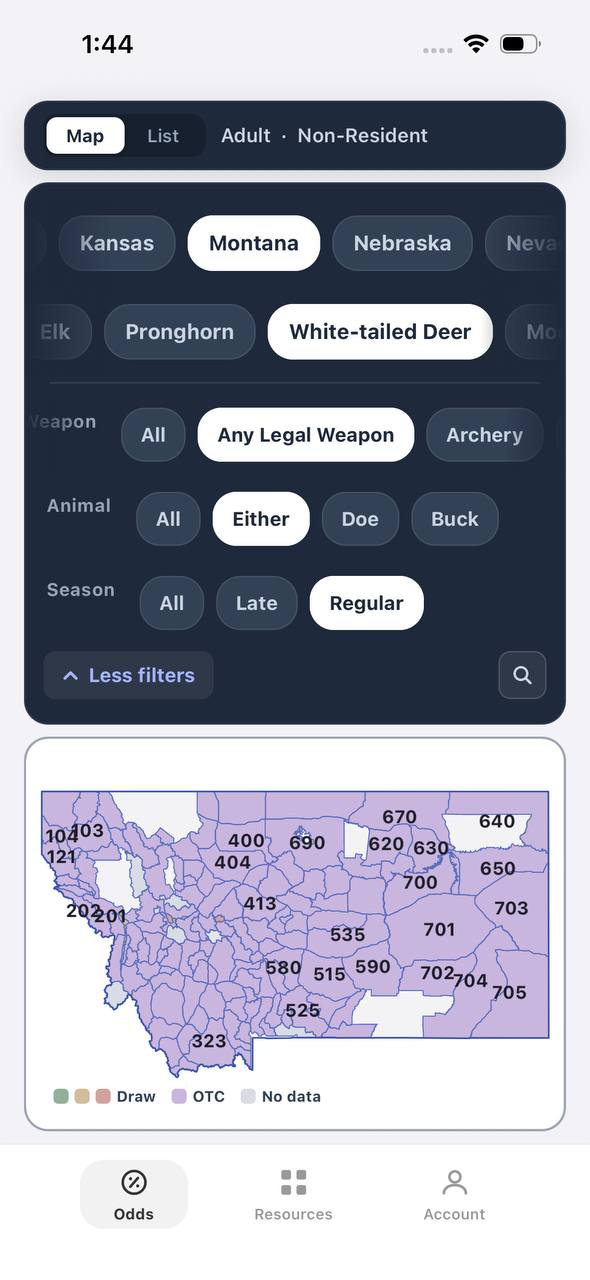
Draw odds
Montana white-tailed deer draw odds filtered to any legal weapon, either sex, regular season
AdultNonresidentAny Legal WeaponEitherRegular

Montana · White-tailed deer

Nearly the whole state is OTC for this filter combination.

Adult, Nonresident, White-tailed deer, filtered to Any Legal Weapon, Either, Regular. Under this combination almost every unit turns purple — over the counter.

  • Switching weapon, sex, or season changes the picture completely.
  • Purple means the tag can be bought directly, no draw.
  • This is the tag-and-go read of Montana whitetail, not the point-based one.
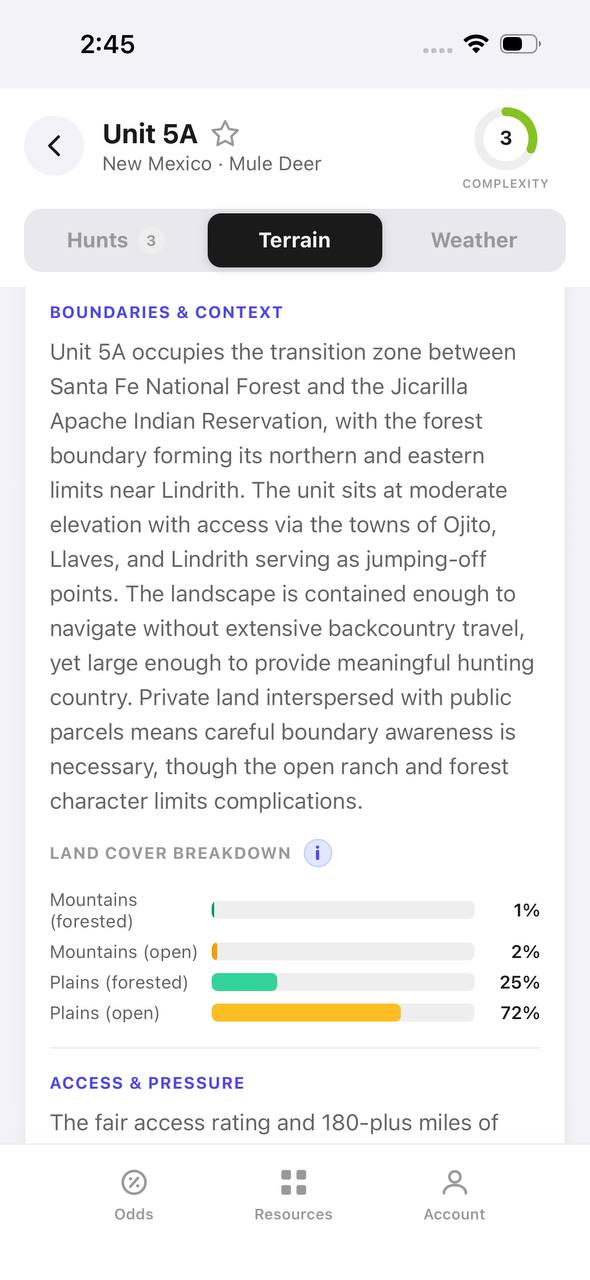
Terrain data
New Mexico mule deer unit 5A terrain tab with boundary description and land cover breakdown

New Mexico · Mule deer, Unit 5A

A written boundary description, not just a shape.

Unit 5A's terrain tab opens with a plain-language paragraph about surrounding land, access towns, and ownership mix, then a land cover breakdown by percentage.

  • 72% open plains and 25% forested plains describe the terrain at a glance.
  • The boundary text calls out the exact reservation and forest lines that define the unit.
  • Access & pressure continues below the fold with mileage detail.
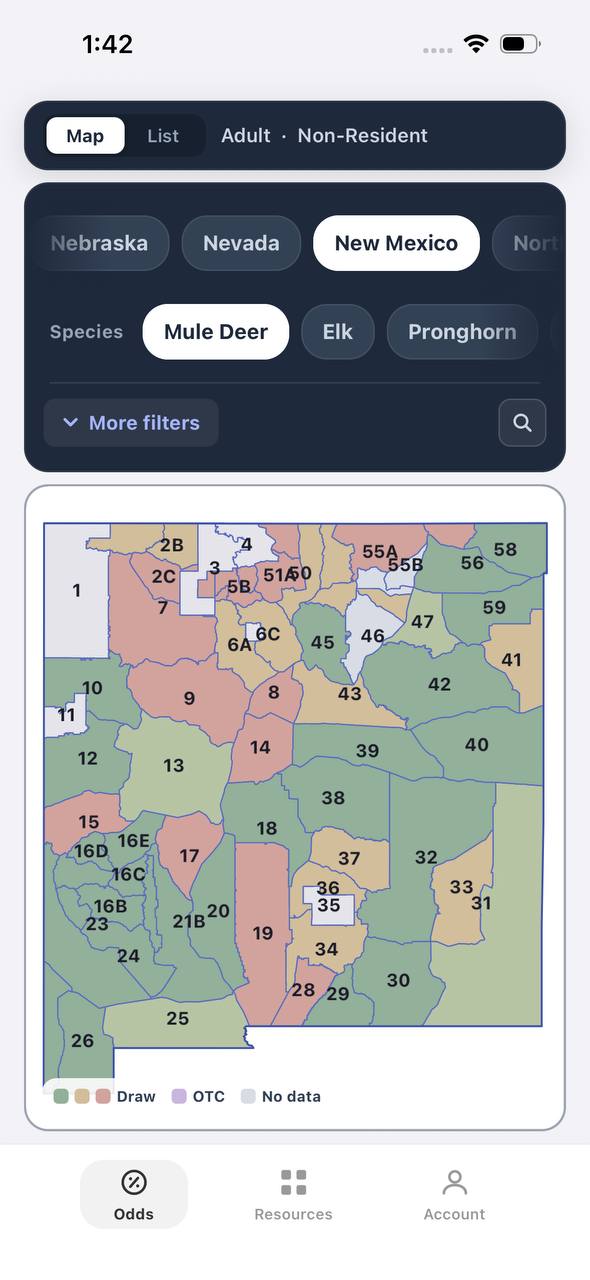
Draw odds
New Mexico mule deer draw odds by unit
AdultNonresident

New Mexico · Mule deer

Mule deer draw odds for every unit in the state.

Adult, Nonresident, Mule deer, all weapons and seasons. Each unit is colored by the same odds calculation used in the dashboard.

  • Green and tan together separate units worth applying to from units that are not.
  • Numbered units follow New Mexico's own game management unit boundaries.
  • Opening a unit shows the exact hunt behind the color.
Favorites
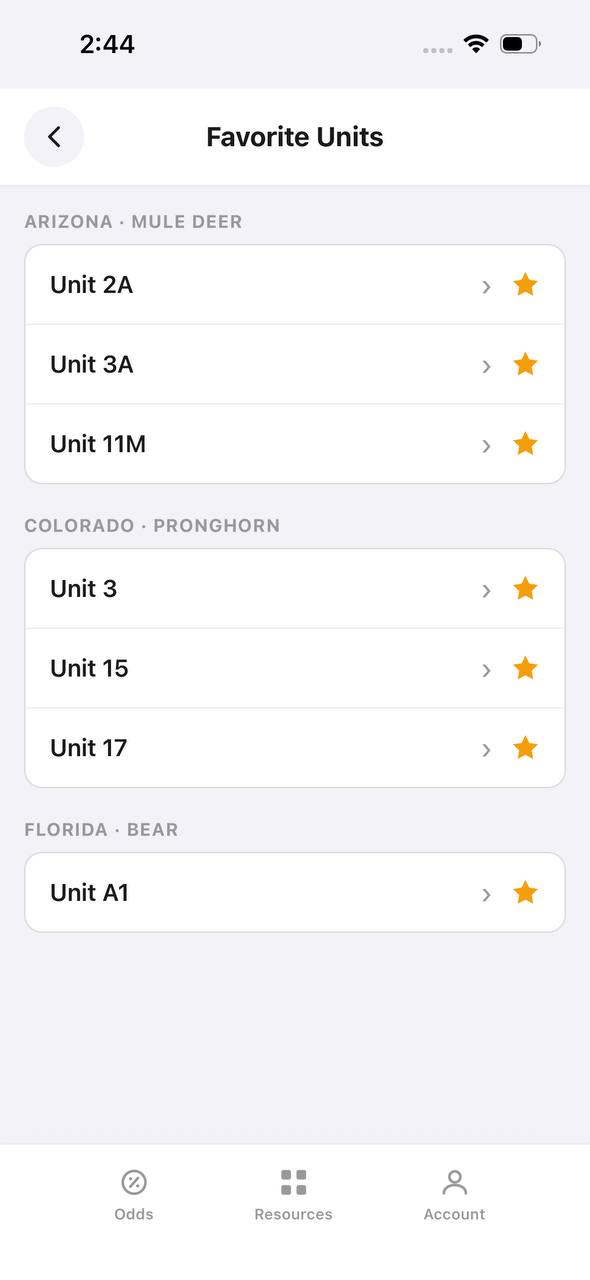
Favorite Units screen grouped by state and species

Favorite Units

Starred units from any state, grouped by species.

Favorite Units collects every starred unit across states and species into one list, grouped by state and species pair, so a saved unit is one tap away.

  • Arizona mule deer and Colorado pronghorn favorites sit side by side here.
  • Each row opens straight into that unit's detail view.
  • Unstarring from this screen removes it from the group instantly.
Deadlines
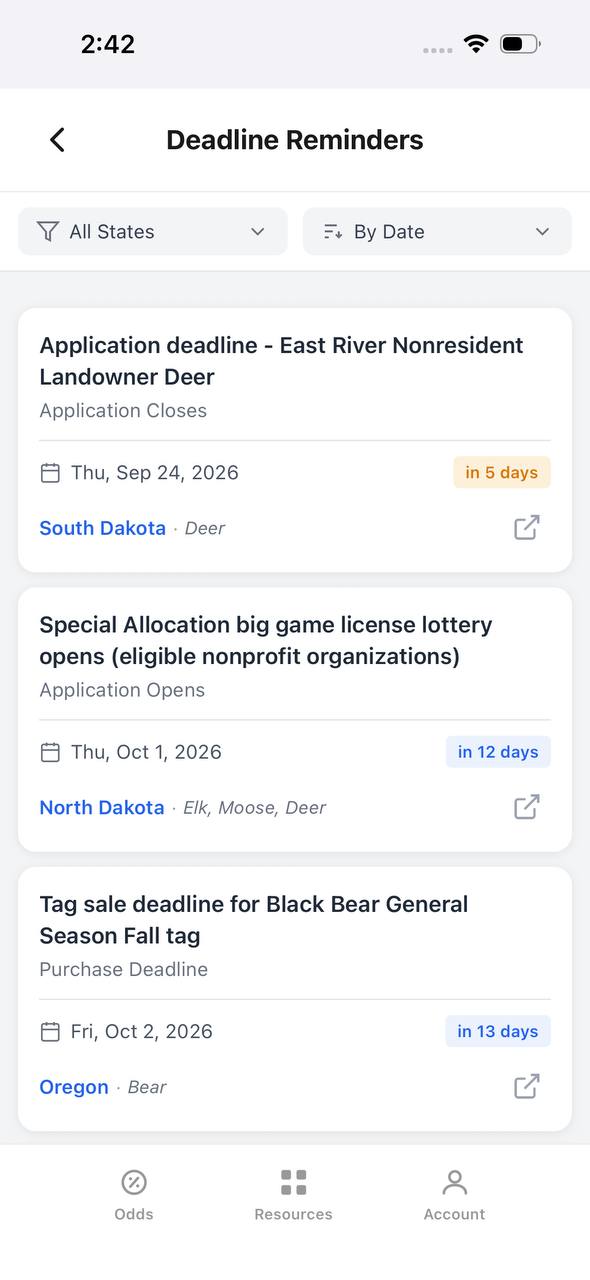
Deadline Reminders screen listing application and purchase deadlines by date

Deadline Reminders

Every application and purchase deadline, sorted by date.

Deadline Reminders filters by state and sorts by date, showing the deadline type, a countdown, and the state and species it applies to, with a link out to the source.

  • Countdown badges shift as a deadline gets close — "in 5 days" here, for example.
  • Application opens and closes are tracked as separate reminder types.
  • Each card links out to confirm the rule at the source.
Interactive map
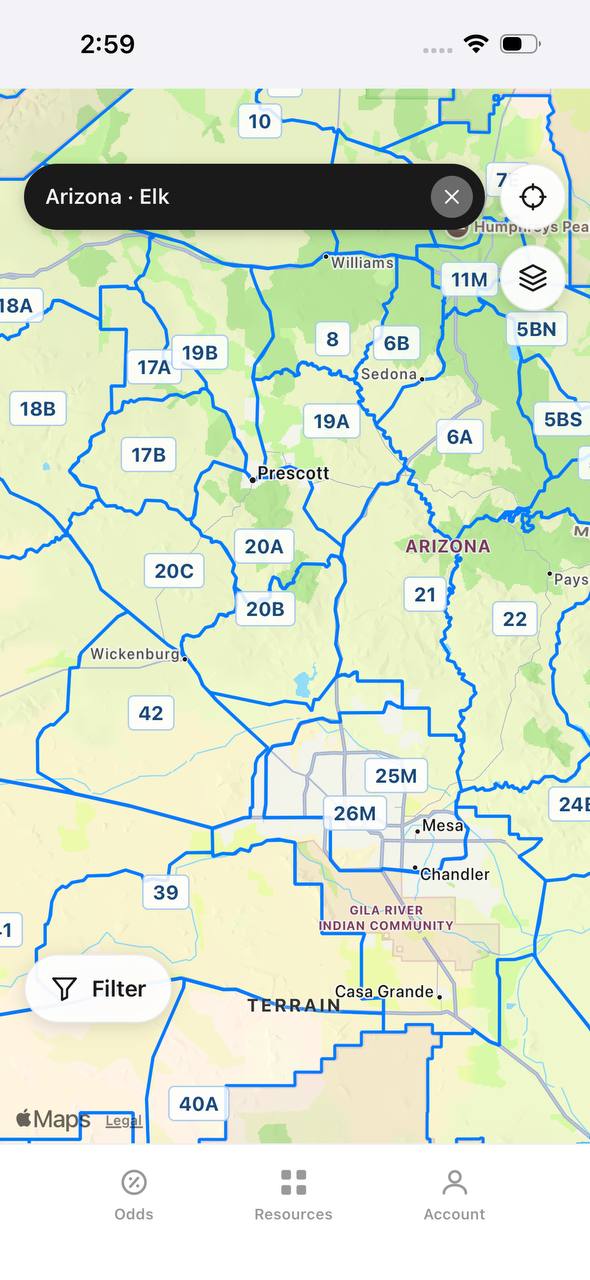
Arizona elk unit boundaries overlaid on an interactive street map

Arizona · Elk

Unit boundaries laid directly over a real map.

This view overlays Arizona elk unit boundaries and labels on top of a street map, with a search bar pinned to state and species and a layer toggle in the corner.

  • Real towns like Prescott and Sedona sit inside their unit boundaries for context.
  • A location button and layer switch float over the map, clear of the unit labels.
  • A Filter button at the bottom opens the same filters used elsewhere in the app.

Free to join

Download mobile app

  • Detailed draw odds
  • Point tracking
  • Deadline reminders
  • 18 states covered
Download on the App StoreGet it on Google Play
Insights
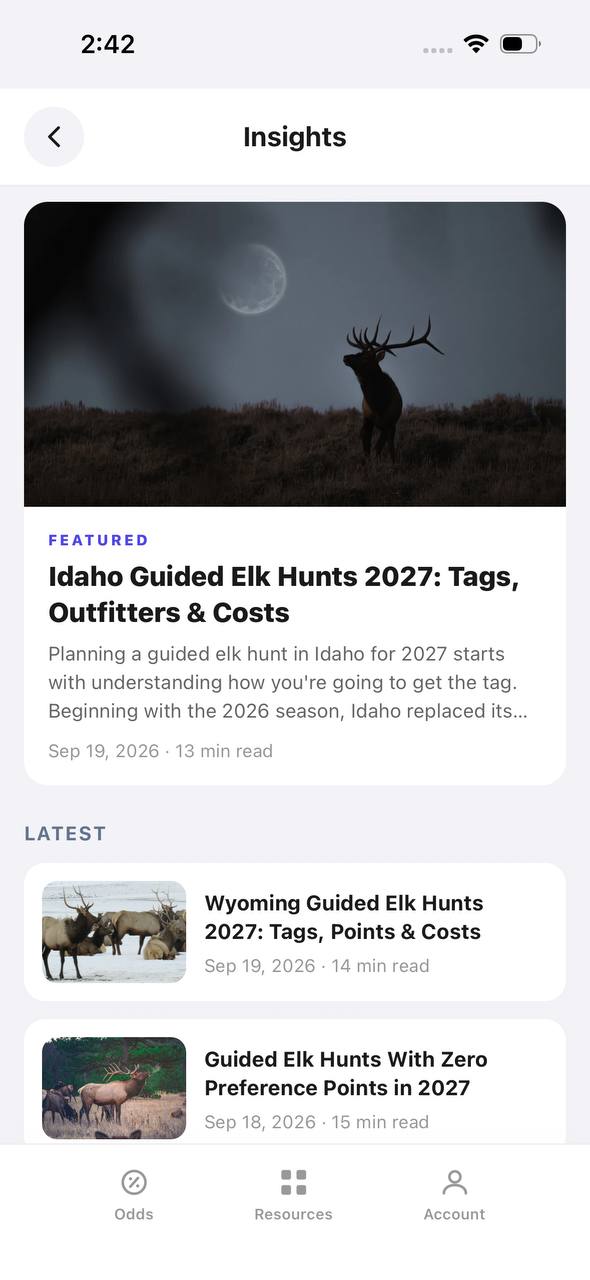
Insights screen with a featured article and a latest articles list

Insights

Hunting articles, built into the app itself.

Insights opens to a featured article with a hero image, then a Latest list of recent posts, each with a thumbnail, read time, and publish date.

  • The featured slot rotates to the newest deep-dive article.
  • Read time and publish date show on every card, not just the featured one.
  • This mirrors the blog content already published on the marketing site.
Download on the App StoreGet it on Google Play

Can a Zero-Point Hunter Draw a High-Demand Elk License?

Potentially.

That's one of the most important characteristics of Wyoming's system.

A high-demand license might historically require many points to guarantee through the:

Preference Draw

while a zero-point hunter could still potentially draw through the:

Random Draw.

The probability may be extremely low.

But:

Preference Threshold ≠ Minimum Points Required to Have Any Chance.

What Does "Takes 10 Points" Actually Mean?

Hunters frequently say:

"That Wyoming elk hunt takes 10 points."

Usually, what they mean is something closer to:

"Applicants historically needed around 10 points to guarantee that license in the preference portion of that particular draw."

That doesn't necessarily mean:

Applicants below 10 points had zero chance.

The random portion can still provide opportunity.

Zero Points Doesn't Mean First-Time Applicants Get Priority

The original article implied some Wyoming hunts:

Favor First-Time Applicants.

They don't.

Zero-point hunters don't receive special priority simply because they're new.

Their opportunity comes from:

  • Licenses surviving to their point level in the preference portion

  • Random licenses

  • Applicable later-choice opportunities

  • Leftover licenses

  • Other available license pathways

General Wyoming Elk Changed for Nonresidents

This is especially important for 2027 planning.

Wyoming distinguishes between:

Resident General Elk Licenses

and:

Nonresident Region General Elk Licenses.

Residents can obtain applicable General elk licenses over the counter.

Nonresidents wishing to hunt General elk must:

Apply for a Region General Elk License.

Nonresident General Elk Is Not Simply OTC

Don't publish:

"Wyoming has OTC General Elk tags for nonresidents."

That's misleading.

For nonresidents:

General Elk Is a Drawn License.

A nonresident Region General Elk License allows the holder to hunt applicable General elk seasons within the region for which the license is valid.

Wyoming Nonresident General Elk Regions

Under the current structure, nonresident General elk opportunity is organized into:

Regions.

A Region General License can be valid across multiple elk hunt areas within that region that are open to General license hunting.

However:

Region General License ≠ Every Elk Area Inside the Region.

Limited-quota elk areas aren't automatically open simply because they geographically fall inside a General region.

General vs Limited-Quota Elk

These are fundamentally different Wyoming opportunities.

General Elk

General licenses can be used in hunt areas designated as open to General license hunting, subject to each area's season dates and restrictions.

For nonresidents, these are obtained through the applicable:

Region General License Drawing.

Limited-Quota Elk

A limited-quota license is issued for a particular:

Hunt Area + License Type

and is subject to the restrictions of that license.

Don't combine General and limited-quota odds.

Hunt Area Isn't Enough

If you're researching a limited-quota elk hunt, don't search only:

"Wyoming Elk Area 100 Odds."

Research:

Hunt Area + License Type + Residency + Regular/Special + Preference/Random.

Different license types within the same hunt area can have completely different:

  • Quotas

  • Seasons

  • Legal elk

  • Geographic restrictions

  • Draw odds

Wyoming Elk License Types Matter

Depending on the hunt, Wyoming uses different license types for elk opportunities.

These can distinguish:

  • Any elk or antlered elk opportunities

  • Antlerless opportunities

  • Specific seasons

  • Portions of hunt areas

  • Archery-specific opportunity

  • Other hunt restrictions

Always research the exact license type before applying.

Full-Price vs Reduced-Price Elk

Wyoming also distinguishes between:

Full-Price Elk Licenses

and:

Reduced-Price Cow/Calf Licenses.

Preference points apply to applicable:

Nonresident Full-Price Elk Licenses.

Reduced-price cow/calf licenses operate through a different drawing structure and don't use nonresident elk preference points in the same way.

Don't combine those odds.

Regular vs Special Draw

Nonresidents also choose between:

Regular

and:

Special

drawing pools for applicable full-price elk licenses.

The Special Draw has a higher license cost.

It doesn't mean:

Better Elk.

It doesn't mean:

Better Hunt.

And it doesn't guarantee:

Better Odds.

Does Special Always Have Better Odds?

No.

Special and Regular have different applicant pools.

Historical probability can differ between them.

Always compare:

Regular Preference

Regular Random

Special Preference

and:

Special Random

before deciding.

Draw odds
Alaska moose draw odds by unit, colored by draw, OTC, or no data
AdultNonresident

Alaska · Moose

Draw, OTC, and no-data units across the whole state.

Adult, Nonresident, Moose, no additional filters. Every unit is colored by its best matching draw odds; if nothing draws, it shows OTC; if neither, no data.

  • Alaska mixes draw and OTC moose hunts within the same region.
  • Green units are worth an application; purple units are OTC.
  • Filters stay applied when a unit is opened for hunt detail.
Draw odds
California mule deer draw odds ranked by unit in a list
AdultNonresident

California · Mule deer

Nonresident odds ranked unit by unit.

Adult, Nonresident, Mule deer, no weapon or season chip, so every matching hunt in a zone is combined into one badge and sorted by best projected odds.

  • D6 leads the list; a range like 8%–14% means more than one hunt code exists in that zone.
  • The list and the map read the same filtered hunt set.
  • 46 units are shown for this species and state alone.

Free to join

Download mobile app

  • Detailed draw odds
  • Point tracking
  • Deadline reminders
  • 18 states covered
Download on the App StoreGet it on Google Play
Unit detail
Wyoming elk unit detail, hunts tab, showing hunt windows on a timeline

Wyoming · Elk, Unit 3

Every hunt window inside one unit, laid out on a timeline.

Unit 3 has two hunt codes for elk. Each one shows its weapon, animal type, and season as a bar on a shared Aug–Jan timeline, plus a day-by-day moon phase strip.

  • Archery, then a long Any Legal Weapon window, then a late season — three opportunities in one unit.
  • The 100% badge at top means no real draw competition for the selected filters right now.
  • Weather & conditions expands below the hunt list without leaving the unit.
Terrain data
Colorado pronghorn unit detail, terrain tab, showing unit outline and key metrics

Colorado · Pronghorn, Unit 3

Unit boundaries and a complexity score at a glance.

The Terrain tab draws the unit outline against its neighbors and scores it for complexity, then breaks out area, public land, access, topography, forest, and water.

  • 849 sq mi, 55% public land, and flat topography make this a fairly approachable unit.
  • Each metric carries a short rating word — Vast, Some, Fair, Flat, Sparse, Moderate — with a tooltip.
  • The outline map shows adjacent units 2, 4, 13, and 301 for context.
State profiles
State Profiles screen listing states with wildlife agency and public land percentage

State Profiles

Each state's wildlife agency and public land share, at a glance.

State Profiles lists every covered state as a photo card naming its wildlife agency and, where available, its public land percentage.

  • Public land percentage shows right in the list, before opening the state.
  • Each card names the exact agency the regulations come from.
  • States without a public land figure yet, like Alabama here, are still listed.
Points wallet
Points Wallet screen with Colorado expanded, showing a point stepper per species

Points Wallet · Colorado

Every state and species point balance in one wallet.

Points Wallet lists each state with a species count; expanding a state, like Colorado here, shows a stepper for every species so a balance can be entered or adjusted directly.

  • Colorado alone tracks points across 10 species independently.
  • Species with no points, like Pronghorn here, still show a zero to stay visible.
  • Desert Bighorn Sheep is flagged as a random draw with no points system.

Free to join

Download mobile app

  • Detailed draw odds
  • Point tracking
  • Deadline reminders
  • 18 states covered
Download on the App StoreGet it on Google Play
Draw odds
Montana white-tailed deer draw odds filtered to any legal weapon, either sex, regular season
AdultNonresidentAny Legal WeaponEitherRegular

Montana · White-tailed deer

Nearly the whole state is OTC for this filter combination.

Adult, Nonresident, White-tailed deer, filtered to Any Legal Weapon, Either, Regular. Under this combination almost every unit turns purple — over the counter.

  • Switching weapon, sex, or season changes the picture completely.
  • Purple means the tag can be bought directly, no draw.
  • This is the tag-and-go read of Montana whitetail, not the point-based one.
Terrain data
New Mexico mule deer unit 5A terrain tab with boundary description and land cover breakdown

New Mexico · Mule deer, Unit 5A

A written boundary description, not just a shape.

Unit 5A's terrain tab opens with a plain-language paragraph about surrounding land, access towns, and ownership mix, then a land cover breakdown by percentage.

  • 72% open plains and 25% forested plains describe the terrain at a glance.
  • The boundary text calls out the exact reservation and forest lines that define the unit.
  • Access & pressure continues below the fold with mileage detail.
Draw odds
New Mexico mule deer draw odds by unit
AdultNonresident

New Mexico · Mule deer

Mule deer draw odds for every unit in the state.

Adult, Nonresident, Mule deer, all weapons and seasons. Each unit is colored by the same odds calculation used in the dashboard.

  • Green and tan together separate units worth applying to from units that are not.
  • Numbered units follow New Mexico's own game management unit boundaries.
  • Opening a unit shows the exact hunt behind the color.
Favorites
Favorite Units screen grouped by state and species

Favorite Units

Starred units from any state, grouped by species.

Favorite Units collects every starred unit across states and species into one list, grouped by state and species pair, so a saved unit is one tap away.

  • Arizona mule deer and Colorado pronghorn favorites sit side by side here.
  • Each row opens straight into that unit's detail view.
  • Unstarring from this screen removes it from the group instantly.
Deadlines
Deadline Reminders screen listing application and purchase deadlines by date

Deadline Reminders

Every application and purchase deadline, sorted by date.

Deadline Reminders filters by state and sorts by date, showing the deadline type, a countdown, and the state and species it applies to, with a link out to the source.

  • Countdown badges shift as a deadline gets close — "in 5 days" here, for example.
  • Application opens and closes are tracked as separate reminder types.
  • Each card links out to confirm the rule at the source.
Interactive map
Arizona elk unit boundaries overlaid on an interactive street map

Arizona · Elk

Unit boundaries laid directly over a real map.

This view overlays Arizona elk unit boundaries and labels on top of a street map, with a search bar pinned to state and species and a layer toggle in the corner.

  • Real towns like Prescott and Sedona sit inside their unit boundaries for context.
  • A location button and layer switch float over the map, clear of the unit labels.
  • A Filter button at the bottom opens the same filters used elsewhere in the app.

Free to join

Download mobile app

  • Detailed draw odds
  • Point tracking
  • Deadline reminders
  • 18 states covered
Download on the App StoreGet it on Google Play
Insights
Insights screen with a featured article and a latest articles list

Insights

Hunting articles, built into the app itself.

Insights opens to a featured article with a hero image, then a Latest list of recent posts, each with a thumbnail, read time, and publish date.

  • The featured slot rotates to the newest deep-dive article.
  • Read time and publish date show on every card, not just the featured one.
  • This mirrors the blog content already published on the marketing site.
Download on the App StoreGet it on Google Play

How Regular and Special Quota Is Allocated

Under Wyoming's current nonresident draw structure, after applicable landowner allocation, remaining nonresident quota is divided between:

Special Draw — 40%

and:

Regular Draw — 60%.

Each applicable pool then uses the:

75% Preference / 25% Random

structure.

This creates several different historical statistics for the same elk opportunity.

First Choice Matters

Wyoming preference points apply to:

First-Choice Full-Price License Applications.

Your first choice should therefore be deliberate.

If you successfully draw your first-choice license:

Your preference points are no longer available for future draws.

That includes a first-choice license obtained through the:

Random Portion.

Drawing Random Still Uses Your Points

This surprises some hunters.

Suppose you have:

8 Preference Points

but fail to draw your first choice in the preference portion.

You then draw the same first-choice license through:

Random.

Your points are still used.

The key is:

First-Choice Success

not whether the license came from preference or random.

Later Choices Work Differently

Wyoming processes applicable:

First Choice

before later choices.

If licenses remain after first-choice demand, they may potentially be available to:

Second

or:

Third

choice applicants.

Preference points aren't used on those later choices in the same manner.

This can create a strategy where a hunter:

Preserves Points + Hunts on a Later Choice

when historical demand leaves applicable licenses available.

But you need to verify that the hunt actually survives first-choice demand.

Three Choices Aren't Three Independent Draws

Don't describe Wyoming as:

"Apply to three units to increase your chances."

That's misleading.

Ranked hunt choices are processed within the applicable application.

They're not three independent first-choice applications.

Don't Waste a Second Choice

If a license historically receives enough first-choice applicants to consume the quota:

Putting It Second Doesn't Create Another Realistic Chance.

Use Wyoming's historical draw reports to determine whether licenses actually survived first-choice demand.

How Do You Earn Wyoming Elk Preference Points?

This is another major correction to the original article.

An unsuccessful nonresident elk application doesn't automatically mean:

You Earn a Preference Point.

Wyoming provides a separate:

Preference Point Purchase Period.

Eligible hunters can purchase:

One Elk Preference Point Per Year.

Current Preference Point Period

Under Wyoming's current calendar, the preference-point purchase period runs:

July 1 through November 2.

Verify the final 2027 dates before purchasing.

Current Nonresident Elk Preference Point Price

Wyoming has scheduled the adult nonresident elk preference-point fee to increase to:

$75 beginning January 1, 2027.

That makes long-term point building a real budget consideration.

Don't evaluate only the eventual license cost.

Calculate:

Years of Points + Point Fees + Application Costs + License Cost + Travel.

Nonresident Elk Application Deadline

Under Wyoming's current published calendar, the nonresident elk application period is:

January 2 through February 2.

Current draw results are scheduled for:

May 21.

That's much earlier than Wyoming's deer and antelope deadlines.

Verify the final 2027 calendar before applying.

Applying Early Doesn't Improve Odds

Submitting your application on:

January 2

doesn't provide better drawing priority than submitting a correct application before the deadline.

Apply early to:

  • Review your application

  • Confirm hunt choices

  • Check point totals

  • Avoid technical issues

  • Make corrections

  • Avoid missing the deadline

But:

Early Application ≠ Better Draw Odds.

What Are the Best Wyoming Elk Areas With Zero Points?

There isn't a permanent list.

That's why the original claims about:

Areas 17, 19, 54 and 55

shouldn't be published without current hunt-specific data.

The correct answer changes based on:

  • License type

  • General vs limited quota

  • Region

  • Regular vs Special

  • Quota

  • Applicants

  • Random licenses

  • Access

  • Season structure

Instead of permanently calling several areas:

"Best Zero-Point Units,"

update the analysis annually.

Draw odds
Alaska moose draw odds by unit, colored by draw, OTC, or no data
AdultNonresident

Alaska · Moose

Draw, OTC, and no-data units across the whole state.

Adult, Nonresident, Moose, no additional filters. Every unit is colored by its best matching draw odds; if nothing draws, it shows OTC; if neither, no data.

  • Alaska mixes draw and OTC moose hunts within the same region.
  • Green units are worth an application; purple units are OTC.
  • Filters stay applied when a unit is opened for hunt detail.
Draw odds
California mule deer draw odds ranked by unit in a list
AdultNonresident

California · Mule deer

Nonresident odds ranked unit by unit.

Adult, Nonresident, Mule deer, no weapon or season chip, so every matching hunt in a zone is combined into one badge and sorted by best projected odds.

  • D6 leads the list; a range like 8%–14% means more than one hunt code exists in that zone.
  • The list and the map read the same filtered hunt set.
  • 46 units are shown for this species and state alone.

Free to join

Download mobile app

  • Detailed draw odds
  • Point tracking
  • Deadline reminders
  • 18 states covered
Download on the App StoreGet it on Google Play
Unit detail
Wyoming elk unit detail, hunts tab, showing hunt windows on a timeline

Wyoming · Elk, Unit 3

Every hunt window inside one unit, laid out on a timeline.

Unit 3 has two hunt codes for elk. Each one shows its weapon, animal type, and season as a bar on a shared Aug–Jan timeline, plus a day-by-day moon phase strip.

  • Archery, then a long Any Legal Weapon window, then a late season — three opportunities in one unit.
  • The 100% badge at top means no real draw competition for the selected filters right now.
  • Weather & conditions expands below the hunt list without leaving the unit.
Terrain data
Colorado pronghorn unit detail, terrain tab, showing unit outline and key metrics

Colorado · Pronghorn, Unit 3

Unit boundaries and a complexity score at a glance.

The Terrain tab draws the unit outline against its neighbors and scores it for complexity, then breaks out area, public land, access, topography, forest, and water.

  • 849 sq mi, 55% public land, and flat topography make this a fairly approachable unit.
  • Each metric carries a short rating word — Vast, Some, Fair, Flat, Sparse, Moderate — with a tooltip.
  • The outline map shows adjacent units 2, 4, 13, and 301 for context.
State profiles
State Profiles screen listing states with wildlife agency and public land percentage

State Profiles

Each state's wildlife agency and public land share, at a glance.

State Profiles lists every covered state as a photo card naming its wildlife agency and, where available, its public land percentage.

  • Public land percentage shows right in the list, before opening the state.
  • Each card names the exact agency the regulations come from.
  • States without a public land figure yet, like Alabama here, are still listed.
Points wallet
Points Wallet screen with Colorado expanded, showing a point stepper per species

Points Wallet · Colorado

Every state and species point balance in one wallet.

Points Wallet lists each state with a species count; expanding a state, like Colorado here, shows a stepper for every species so a balance can be entered or adjusted directly.

  • Colorado alone tracks points across 10 species independently.
  • Species with no points, like Pronghorn here, still show a zero to stay visible.
  • Desert Bighorn Sheep is flagged as a random draw with no points system.

Free to join

Download mobile app

  • Detailed draw odds
  • Point tracking
  • Deadline reminders
  • 18 states covered
Download on the App StoreGet it on Google Play
Draw odds
Montana white-tailed deer draw odds filtered to any legal weapon, either sex, regular season
AdultNonresidentAny Legal WeaponEitherRegular

Montana · White-tailed deer

Nearly the whole state is OTC for this filter combination.

Adult, Nonresident, White-tailed deer, filtered to Any Legal Weapon, Either, Regular. Under this combination almost every unit turns purple — over the counter.

  • Switching weapon, sex, or season changes the picture completely.
  • Purple means the tag can be bought directly, no draw.
  • This is the tag-and-go read of Montana whitetail, not the point-based one.
Terrain data
New Mexico mule deer unit 5A terrain tab with boundary description and land cover breakdown

New Mexico · Mule deer, Unit 5A

A written boundary description, not just a shape.

Unit 5A's terrain tab opens with a plain-language paragraph about surrounding land, access towns, and ownership mix, then a land cover breakdown by percentage.

  • 72% open plains and 25% forested plains describe the terrain at a glance.
  • The boundary text calls out the exact reservation and forest lines that define the unit.
  • Access & pressure continues below the fold with mileage detail.
Draw odds
New Mexico mule deer draw odds by unit
AdultNonresident

New Mexico · Mule deer

Mule deer draw odds for every unit in the state.

Adult, Nonresident, Mule deer, all weapons and seasons. Each unit is colored by the same odds calculation used in the dashboard.

  • Green and tan together separate units worth applying to from units that are not.
  • Numbered units follow New Mexico's own game management unit boundaries.
  • Opening a unit shows the exact hunt behind the color.
Favorites
Favorite Units screen grouped by state and species

Favorite Units

Starred units from any state, grouped by species.

Favorite Units collects every starred unit across states and species into one list, grouped by state and species pair, so a saved unit is one tap away.

  • Arizona mule deer and Colorado pronghorn favorites sit side by side here.
  • Each row opens straight into that unit's detail view.
  • Unstarring from this screen removes it from the group instantly.
Deadlines
Deadline Reminders screen listing application and purchase deadlines by date

Deadline Reminders

Every application and purchase deadline, sorted by date.

Deadline Reminders filters by state and sorts by date, showing the deadline type, a countdown, and the state and species it applies to, with a link out to the source.

  • Countdown badges shift as a deadline gets close — "in 5 days" here, for example.
  • Application opens and closes are tracked as separate reminder types.
  • Each card links out to confirm the rule at the source.
Interactive map
Arizona elk unit boundaries overlaid on an interactive street map

Arizona · Elk

Unit boundaries laid directly over a real map.

This view overlays Arizona elk unit boundaries and labels on top of a street map, with a search bar pinned to state and species and a layer toggle in the corner.

  • Real towns like Prescott and Sedona sit inside their unit boundaries for context.
  • A location button and layer switch float over the map, clear of the unit labels.
  • A Filter button at the bottom opens the same filters used elsewhere in the app.

Free to join

Download mobile app

  • Detailed draw odds
  • Point tracking
  • Deadline reminders
  • 18 states covered
Download on the App StoreGet it on Google Play
Insights
Insights screen with a featured article and a latest articles list

Insights

Hunting articles, built into the app itself.

Insights opens to a featured article with a hero image, then a Latest list of recent posts, each with a thumbnail, read time, and publish date.

  • The featured slot rotates to the newest deep-dive article.
  • Read time and publish date show on every card, not just the featured one.
  • This mirrors the blog content already published on the marketing site.
Download on the App StoreGet it on Google Play

Don't Invent 2027 Odds

Actual:

2027 Wyoming Elk Draw Odds

don't exist until the 2027 drawing occurs.

Before then, use:

Historical Draw Results

to estimate relative draw difficulty.

Label them clearly.

For example:

2026 Historical Random Draw Odds

not:

2027 Draw Odds.

How to Analyze a Zero-Point Elk Hunt

For each opportunity, research:

1. General Region or Limited-Quota Hunt Area

2. License Type

3. Regular vs Special

4. Preference-Point Results

5. Random Results

6. First-Choice Demand

7. Quota

8. Later-Choice Availability

9. Season Dates

10. Public-Land Access

11. Historical Harvest

That's far more useful than a generic:

"Top Five Zero-Point Units."

Zero-Point Strategy #1: Target the Random Draw

If you have zero points and want a difficult limited-quota license:

Random Is Your Opportunity.

Research:

Random Licenses vs Random Applicants

for the exact license.

Then compare several years.

A single year's random probability can be volatile.

Zero-Point Strategy #2: Compare General Region Licenses

For nonresidents interested in General elk hunting, compare the available:

Region General Licenses.

Don't evaluate only historical draw probability.

Also research:

  • Which General hunt areas are included

  • Season dates

  • Weapon opportunities

  • Wilderness

  • Access

  • Terrain

  • Public land

  • Hunter pressure

The easiest Region General License to draw isn't automatically the best elk hunt for you.

Zero-Point Strategy #3: Compare Regular vs Special

For the exact opportunity you're considering, compare:

Regular

against:

Special.

Ask:

How many licenses went random?

How many applicants entered the random pool?

What did the preference portion require?

How much more does Special cost?

Then decide whether the historical difference justifies the price.

Zero-Point Strategy #4: Study Later Choices

Look for applicable elk licenses that historically:

Survived First-Choice Demand.

Those can create a potential pathway to hunt without using your first-choice preference points.

But don't assume last year's second-choice opportunity will repeat.

Zero-Point Strategy #5: Watch Leftovers

After the initial drawings, licenses that remain can enter Wyoming's:

Leftover Draw.

The leftover drawing is random.

Residents and nonresidents can participate under the applicable rules.

Any licenses remaining after that process may become available first-come, first-served.

Leftover Doesn't Mean Good Public-Land Access

Wyoming Game and Fish specifically notes that leftover licenses can often involve:

Private Lands With Difficult Access.

So don't see:

Leftover Elk License

and automatically assume you've found an easy hunt.

Research permission first.

Zero-Point Strategy #6: Consider Cow/Calf Opportunity Separately

If your primary goal is:

Hunting Elk

rather than specifically harvesting a bull, reduced-price cow/calf licenses can provide another pathway.

Research them separately because:

Cow/Calf Draw ≠ Full-Price Preference Point Draw.

They use different rules and odds.

Zero-Point Strategy #7: Research Access Before Applying

Before choosing an elk hunt, evaluate:

  • Public land

  • Private land

  • Wilderness

  • Roads

  • Trailheads

  • Hunter Management Areas

  • Walk-In Hunting Areas

  • Seasonal closures

  • Motorized restrictions

  • Private access

  • Terrain

Draw probability is only useful if you can realistically hunt the license.

Wyoming Wilderness Rule for Nonresidents

This is particularly important for nonresident elk hunters.

Wyoming has special requirements affecting nonresident big-game hunting in designated:

Wilderness Areas.

A nonresident hunting big game in applicable wilderness generally needs to be accompanied by:

A Licensed Wyoming Professional Guide

or:

A Qualified Resident Guide

under Wyoming law.

So a hunt with excellent public wilderness habitat may not function as a normal DIY opportunity for a nonresident.

Verify the current wilderness requirements before applying.

Draw odds
Alaska moose draw odds by unit, colored by draw, OTC, or no data
AdultNonresident

Alaska · Moose

Draw, OTC, and no-data units across the whole state.

Adult, Nonresident, Moose, no additional filters. Every unit is colored by its best matching draw odds; if nothing draws, it shows OTC; if neither, no data.

  • Alaska mixes draw and OTC moose hunts within the same region.
  • Green units are worth an application; purple units are OTC.
  • Filters stay applied when a unit is opened for hunt detail.
Draw odds
California mule deer draw odds ranked by unit in a list
AdultNonresident

California · Mule deer

Nonresident odds ranked unit by unit.

Adult, Nonresident, Mule deer, no weapon or season chip, so every matching hunt in a zone is combined into one badge and sorted by best projected odds.

  • D6 leads the list; a range like 8%–14% means more than one hunt code exists in that zone.
  • The list and the map read the same filtered hunt set.
  • 46 units are shown for this species and state alone.

Free to join

Download mobile app

  • Detailed draw odds
  • Point tracking
  • Deadline reminders
  • 18 states covered
Download on the App StoreGet it on Google Play
Unit detail
Wyoming elk unit detail, hunts tab, showing hunt windows on a timeline

Wyoming · Elk, Unit 3

Every hunt window inside one unit, laid out on a timeline.

Unit 3 has two hunt codes for elk. Each one shows its weapon, animal type, and season as a bar on a shared Aug–Jan timeline, plus a day-by-day moon phase strip.

  • Archery, then a long Any Legal Weapon window, then a late season — three opportunities in one unit.
  • The 100% badge at top means no real draw competition for the selected filters right now.
  • Weather & conditions expands below the hunt list without leaving the unit.
Terrain data
Colorado pronghorn unit detail, terrain tab, showing unit outline and key metrics

Colorado · Pronghorn, Unit 3

Unit boundaries and a complexity score at a glance.

The Terrain tab draws the unit outline against its neighbors and scores it for complexity, then breaks out area, public land, access, topography, forest, and water.

  • 849 sq mi, 55% public land, and flat topography make this a fairly approachable unit.
  • Each metric carries a short rating word — Vast, Some, Fair, Flat, Sparse, Moderate — with a tooltip.
  • The outline map shows adjacent units 2, 4, 13, and 301 for context.
State profiles
State Profiles screen listing states with wildlife agency and public land percentage

State Profiles

Each state's wildlife agency and public land share, at a glance.

State Profiles lists every covered state as a photo card naming its wildlife agency and, where available, its public land percentage.

  • Public land percentage shows right in the list, before opening the state.
  • Each card names the exact agency the regulations come from.
  • States without a public land figure yet, like Alabama here, are still listed.
Points wallet
Points Wallet screen with Colorado expanded, showing a point stepper per species

Points Wallet · Colorado

Every state and species point balance in one wallet.

Points Wallet lists each state with a species count; expanding a state, like Colorado here, shows a stepper for every species so a balance can be entered or adjusted directly.

  • Colorado alone tracks points across 10 species independently.
  • Species with no points, like Pronghorn here, still show a zero to stay visible.
  • Desert Bighorn Sheep is flagged as a random draw with no points system.

Free to join

Download mobile app

  • Detailed draw odds
  • Point tracking
  • Deadline reminders
  • 18 states covered
Download on the App StoreGet it on Google Play
Draw odds
Montana white-tailed deer draw odds filtered to any legal weapon, either sex, regular season
AdultNonresidentAny Legal WeaponEitherRegular

Montana · White-tailed deer

Nearly the whole state is OTC for this filter combination.

Adult, Nonresident, White-tailed deer, filtered to Any Legal Weapon, Either, Regular. Under this combination almost every unit turns purple — over the counter.

  • Switching weapon, sex, or season changes the picture completely.
  • Purple means the tag can be bought directly, no draw.
  • This is the tag-and-go read of Montana whitetail, not the point-based one.
Terrain data
New Mexico mule deer unit 5A terrain tab with boundary description and land cover breakdown

New Mexico · Mule deer, Unit 5A

A written boundary description, not just a shape.

Unit 5A's terrain tab opens with a plain-language paragraph about surrounding land, access towns, and ownership mix, then a land cover breakdown by percentage.

  • 72% open plains and 25% forested plains describe the terrain at a glance.
  • The boundary text calls out the exact reservation and forest lines that define the unit.
  • Access & pressure continues below the fold with mileage detail.
Draw odds
New Mexico mule deer draw odds by unit
AdultNonresident

New Mexico · Mule deer

Mule deer draw odds for every unit in the state.

Adult, Nonresident, Mule deer, all weapons and seasons. Each unit is colored by the same odds calculation used in the dashboard.

  • Green and tan together separate units worth applying to from units that are not.
  • Numbered units follow New Mexico's own game management unit boundaries.
  • Opening a unit shows the exact hunt behind the color.
Favorites
Favorite Units screen grouped by state and species

Favorite Units

Starred units from any state, grouped by species.

Favorite Units collects every starred unit across states and species into one list, grouped by state and species pair, so a saved unit is one tap away.

  • Arizona mule deer and Colorado pronghorn favorites sit side by side here.
  • Each row opens straight into that unit's detail view.
  • Unstarring from this screen removes it from the group instantly.
Deadlines
Deadline Reminders screen listing application and purchase deadlines by date

Deadline Reminders

Every application and purchase deadline, sorted by date.

Deadline Reminders filters by state and sorts by date, showing the deadline type, a countdown, and the state and species it applies to, with a link out to the source.

  • Countdown badges shift as a deadline gets close — "in 5 days" here, for example.
  • Application opens and closes are tracked as separate reminder types.
  • Each card links out to confirm the rule at the source.
Interactive map
Arizona elk unit boundaries overlaid on an interactive street map

Arizona · Elk

Unit boundaries laid directly over a real map.

This view overlays Arizona elk unit boundaries and labels on top of a street map, with a search bar pinned to state and species and a layer toggle in the corner.

  • Real towns like Prescott and Sedona sit inside their unit boundaries for context.
  • A location button and layer switch float over the map, clear of the unit labels.
  • A Filter button at the bottom opens the same filters used elsewhere in the app.

Free to join

Download mobile app

  • Detailed draw odds
  • Point tracking
  • Deadline reminders
  • 18 states covered
Download on the App StoreGet it on Google Play
Insights
Insights screen with a featured article and a latest articles list

Insights

Hunting articles, built into the app itself.

Insights opens to a featured article with a hero image, then a Latest list of recent posts, each with a thumbnail, read time, and publish date.

  • The featured slot rotates to the newest deep-dive article.
  • Read time and publish date show on every card, not just the featured one.
  • This mirrors the blog content already published on the marketing site.
Download on the App StoreGet it on Google Play

Public Land Doesn't Always Mean Easy Access

Wyoming contains extensive federal and state land.

But:

Statewide Public Land Percentage

doesn't tell you whether your elk hunt has good access.

A hunt area may contain:

  • Landlocked public parcels

  • Large wilderness blocks

  • Private inholdings

  • Seasonal road closures

  • Limited trail access

Research the exact area.

Hunter Management Areas

Wyoming Game and Fish operates:

Hunter Management Areas

that can provide public hunting access on participating properties.

These can have:

  • Permission-slip requirements

  • Application periods

  • Species restrictions

  • License-type restrictions

  • Specific ranch rules

Don't assume holding an elk license automatically gives you access.

Draw Odds vs Harvest Success

These statistics measure different things.

Draw Odds

How difficult was obtaining the license?

Harvest Success

How frequently did hunters report harvesting?

A hunt can have:

Easy Draw + Difficult Hunting

or:

Hard Draw + Lower Harvest Than Expected.

Don't use draw difficulty as a substitute for hunt quality.

Hard Draw Doesn't Mean Bigger Bulls

A hunt requiring many preference points isn't automatically:

A Trophy Elk Hunt.

High demand can come from:

  • Reputation

  • Season timing

  • Limited quota

  • Access

  • Publicity

  • Historic expectations

Draw difficulty primarily tells you about:

Applicant Demand Relative to License Supply.

Easier Draw Doesn't Mean Worse Elk Hunting

Likewise:

Better Draw Odds ≠ Bad Elk Hunting.

An opportunity may receive less demand because of:

  • Access challenges

  • Difficult terrain

  • Private land

  • Season timing

  • Travel

  • Lower publicity

Research the hunt rather than ranking it solely by odds.

Group Applications

Wyoming allows applicable hunters to submit:

Party Applications.

For nonresident preference-point drawings, party members' points are averaged according to Wyoming's current rules.

A party isn't automatically a better draw strategy.

Its primary purpose is:

Hunting Together.

Don't Add a Zero-Point Hunter Without Checking the Math

If several hunters have high preference-point totals and add someone with:

0 Points

the party average changes.

That can materially affect its position in the preference drawing.

Calculate the average before applying.

How TAGZ Helps With Wyoming Elk

TAGZ helps hunters organize Wyoming elk research around the variables that actually matter.

For Wyoming, compare:

  • Residency

  • Preference points

  • General Region

  • Hunt area

  • License type

  • Regular Draw

  • Special Draw

  • Preference results

  • Random results

  • Historical applicants

  • Quota

  • Season

  • Weapon

  • Historical harvest where available

  • Terrain

  • Public/private land

  • Access

That gives a zero-point hunter a better framework than:

"Which Wyoming unit is easiest?"

Build a Zero-Point Wyoming Elk Strategy

Classify potential opportunities into:

Hunt Now

Build Points

and:

Long-Shot Random.

Hunt Now

Opportunities where historical data suggests a realistic current pathway.

Build Points

Hunts where you'd rather accumulate preference points toward a future preference-draw position.

Long-Shot Random

Highly demanded licenses you're willing to pursue despite a low random probability.

Because Wyoming retains a random portion:

Long Shot Doesn't Mean Impossible.

Historical Odds Are Planning Tools

TAGZ can help compare historical Wyoming draw information.

But historical results don't guarantee:

  • 2027 applicant totals

  • 2027 quota

  • 2027 preference thresholds

  • 2027 random probability

  • 2027 access

  • Harvest success

Use the data to improve decisions—not promise a result.

Built by Hunters, Guides and Outfitters

TAGZ was started by hunters, guides and outfitters with firsthand Western hunting experience.

Wyoming demonstrates why hunters need to look beyond a generic:

"Best Zero-Point Units"

list.

Instead ask:

General Region or Limited Quota?

Which License Type?

Regular or Special?

Preference or Random?

First Choice or Later Choice?

Can I access it?

Does wilderness affect my DIY plan?

Would I actually want the license if I drew it?

Those questions create a much better application strategy.

Learn more through About TAGZ.

Can you draw Wyoming elk with zero points?

Yes. Applicable nonresident full-price elk licenses include a random portion, allowing zero-point applicants a chance to draw.

Does Wyoming use preference points for elk?

Yes, for applicable nonresident full-price elk licenses. Resident elk drawings operate differently.

What percentage of Wyoming nonresident elk licenses go random?

Under the current structure, applicable nonresident full-price quota is split 75% preference and 25% random within the relevant draw pools.

Can zero-point hunters enter the preference draw?

Yes. All eligible applicants participate, but hunters with more preference points rank ahead of zero-point applicants.

Can zero-point hunters draw a high-demand elk hunt?

Potentially through the random portion. Historical random probability may be very low for highly demanded licenses.

Are Wyoming General elk licenses OTC for nonresidents?

No. Wyoming residents can obtain applicable General elk licenses OTC, while nonresidents must draw the applicable Region General Elk License.

Does Wyoming automatically give me an elk point if I don't draw?

No. Eligible nonresidents purchase preference points separately during Wyoming's designated preference-point period.

When can I buy a Wyoming elk preference point?

The current preference-point period is July 1 through November 2. Verify the final 2027 dates.

How much will a Wyoming nonresident elk preference point cost in 2027?

Wyoming has scheduled the adult nonresident elk preference-point fee at $75 beginning January 1, 2027.

Does the Special Draw always have better odds?

No. Compare the actual historical Regular and Special results.

If I draw my first choice randomly, do I lose my preference points?

Yes. First-choice success makes the applicant's preference points unavailable for future drawings, even when the license is awarded through the random portion.

Can I preserve points and draw a second-choice elk license?

Potentially, if an applicable license remains after first-choice demand. Historical second-choice availability isn't guaranteed to repeat.

Are leftover elk licenses available in Wyoming?

Sometimes. Availability changes annually, and many leftovers can involve difficult private-land access.

Are 2027 Wyoming elk draw odds available yet?

No. Actual 2027 draw results don't exist before the 2027 drawing. Use historical results for planning.

FAQ — Wyoming Elk Draw Odds With Zero Points 2027

Is it worth applying for Wyoming elk with zero points?

That depends on the exact license and your goals. Zero-point applicants can participate in applicable random drawings, so having no points doesn't automatically eliminate your chance.

What are the best Wyoming elk units with zero points?

There isn't a permanent list. Compare current General Region and limited-quota opportunities using exact license types, Regular/Special pools, random odds and access.

Are Wyoming elk points preference or bonus points?

They are preference points for applicable nonresident full-price elk licenses.

Does one point guarantee better odds than zero?

It gives you a higher position than zero-point applicants in the preference portion, but the practical improvement depends on the exact license and applicant distribution.

Do I earn a point every year I'm unsuccessful?

No. Nonresident elk preference points are purchased separately during the point-purchase period.

Can I buy a General elk license OTC?

Wyoming residents can purchase applicable General elk licenses OTC. Nonresidents must obtain the applicable Region General Elk License through the draw.

Can I apply for multiple elk units?

Wyoming applications allow ranked hunt choices where applicable, but these aren't separate independent first-choice applications.

Should I apply Special with zero points?

Only after comparing the historical Special and Regular drawing statistics and considering the additional license cost.

Does applying early help?

No. Apply early to avoid mistakes, not to improve drawing probability.

Can I hunt elk while building preference points?

Potentially. Later-choice, leftover, reduced-price cow/calf and other opportunities may provide hunting pathways that interact differently with full-price preference points. Research the exact license before applying.

Does a hard-to-draw hunt mean better elk?

No. Drawing difficulty measures demand relative to available licenses, not guaranteed elk numbers, antler size or harvest success.

When is the Wyoming nonresident elk application deadline?

The current Wyoming Game and Fish calendar lists nonresident elk applications from January 2 through February 2, with results May 21. Verify the final 2027 dates before applying.

Continue Planning Your 2027 Wyoming Elk Application

If you're entering 2027 with:

0 Wyoming Elk Preference Points

you still have options.

Start by deciding between:

Nonresident Region General Elk

and:

Limited-Quota Elk.

Then research:

License + Region/Hunt Area + License Type + Regular/Special + Preference Results + Random Results + First-Choice Demand + Access.

From there, choose a strategy:

Hunt Now

Target opportunities where historical results show a realistic zero-point pathway.

Build Points

Purchase your annual preference point and work toward opportunities where preference-point position matters.

Long-Shot Random

Apply for a highly demanded first-choice hunt while accepting that your realistic pathway may be the random portion.

And always research:

Access + Wilderness + Terrain + Season

before chasing better odds.

Use TAGZ to research Wyoming elk opportunities, draw information and hunt-planning data.

Explore additional hunting research through TAGZ Insights.

See how TAGZ works through TAGZ Product.

Learn about the hunters, guides and outfitters behind TAGZ through About TAGZ.

For official historical drawing statistics, use Wyoming Game and Fish Draw Results & Odds.

For current application dates, use Wyoming Game and Fish Application Dates & Deadlines.

For official elk seasons, areas and licensing information, use the Wyoming Game and Fish Elk Hunt Planner.

Historical draw odds and preference-point levels are planning tools—not guarantees. Quotas, applicants, Region General structure, access, seasons and drawing probabilities can change annually.

Share

Was this article helpful?

Previous

Alaska Dall Sheep Draw Odds 2027: Permits & Strategy

Alaska does not use preference points or bonus points for Dall sheep drawing permits. Drawing permits are awarded through a: Random Lottery That means an applicant who has been unsuccessful for 15 years doesn't receive additional point-based priority over a first-time applicant. For applicable drawing hunts, Alaska currently allows hunters to submit: Up to six applications per species across individual and party applications combined, subject to hunt-specific restrictions. Hunters can generally apply for: Multiple different Dall sheep drawing hunts or: The same hunt more than once provided they stay within the six-application limit and follow the current hunt-specific rules. For nonresidents, another rule is critical: A nonresident hunting Dall sheep must be accompanied by an Alaska-licensed guide or a qualifying Alaska resident relative within second degree of kindred. Some nonresident drawing hunts also require a guide-client contract when applying. For 2027 planning, research: Hunt Number + Residency + Permits Available + Historical Applications + Hunt Restrictions + Guide Requirements rather than looking for a nonexistent preference-point threshold.
Alaska Dall Sheep Draw Odds 2027: Permits & Strategy

Related

New Mexico Elk Draw Odds 2027: Units & Strategy

New Mexico is one of the most important Western states for hunters to understand because: New Mexico does not use preference points or bonus points for its public elk draw. You don't need to build points for years before having a chance at an elk tag. Instead, eligible applications are randomly assigned sequence numbers. When an application is processed, New Mexico attempts to award the applicant's: First Choice → Second Choice → Third Choice based on available licenses and the applicable quota pool. Under current law, New Mexico's draw attempts to allocate at least: 84% — New Mexico Residents 10% — Residents or Nonresidents Applying With a Registered New Mexico Outfitter 6% — Nonresidents Applying Without a Registered Outfitter That makes residency and outfitter status critical to understanding historical odds. For 2027 planning, research: Hunt Code + Residency/Draw Pool + Weapon + Season + Applicants + Licenses rather than simply searching for the "best New Mexico elk unit."
New Mexico Elk Draw Odds 2027: Units & Strategy

Next

California Guided Elk Hunts 2027: Tags, Draw & Costs

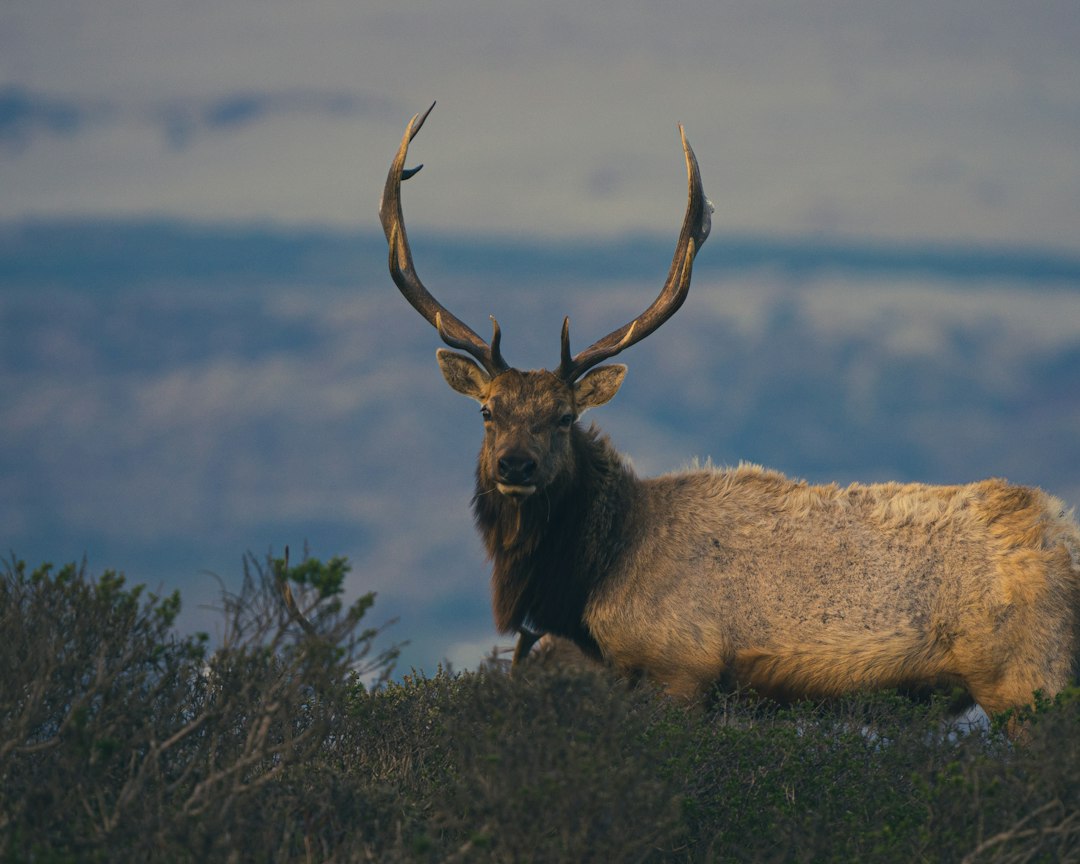
California offers guided hunting opportunities for Tule elk, Roosevelt elk and Rocky Mountain elk, but hunters need to understand the tag pathway before booking an outfitter. California does not have a broad general over-the-counter elk season. Depending on the hunt, your elk opportunity may come through: California's Big Game Drawing A Private Lands Management (PLM) property A SHARE Access Permit Another authorized special elk opportunity These pathways work differently. For the standard Big Game Drawing, California uses a modified preference-point system, and a guide doesn't automatically improve your drawing probability. For private-land opportunities, especially PLM properties, the tag structure can be substantially different. Before sending an outfitter a deposit, ask: "Exactly how will I legally obtain the elk tag for this hunt?" That should be the starting point for every California guided elk hunt. California Guided Elk Hunting in 2027
California Guided Elk Hunts 2027: Tags, Draw & Costs