Does New Mexico Use Preference Points for Elk?
No.
New Mexico doesn't use preference points for its public elk draw.
It also doesn't use bonus points.
This is the biggest correction to the original article.
A hunter who has applied unsuccessfully for:
20 years
doesn't receive point-based priority over a hunter applying for:
the first time.
Each year's draw starts with random application sequencing.
Can a First-Time Applicant Draw New Mexico Elk?
Yes.
Because New Mexico doesn't use preference points, a first-time applicant can potentially draw a highly sought-after elk license.
That doesn't mean the odds are good.
Some New Mexico elk hunts receive substantial applicant demand relative to their limited quotas.
But:
Zero points aren't a disadvantage because there are no points.
Do You Need to Build Points for New Mexico Elk?
No.
There are no elk preference points to build.
There are no elk bonus points to purchase.
There is no:
Point creep
in the traditional Western draw sense.
If you're unsuccessful this year, you don't receive additional drawing priority next year simply because you previously applied.
How Does the New Mexico Elk Draw Work?
New Mexico randomly assigns each application a:
Sequence Number.
The drawing system then processes applications according to those numbers.
When your application is reached, the system attempts to fulfill your choices in order:
First Choice
then:
Second Choice
then:
Third Choice.
If an available license exists for one of those choices within the applicable quota rules, the application can be successful.
If none is available, the system advances.
Free to join
Download mobile app
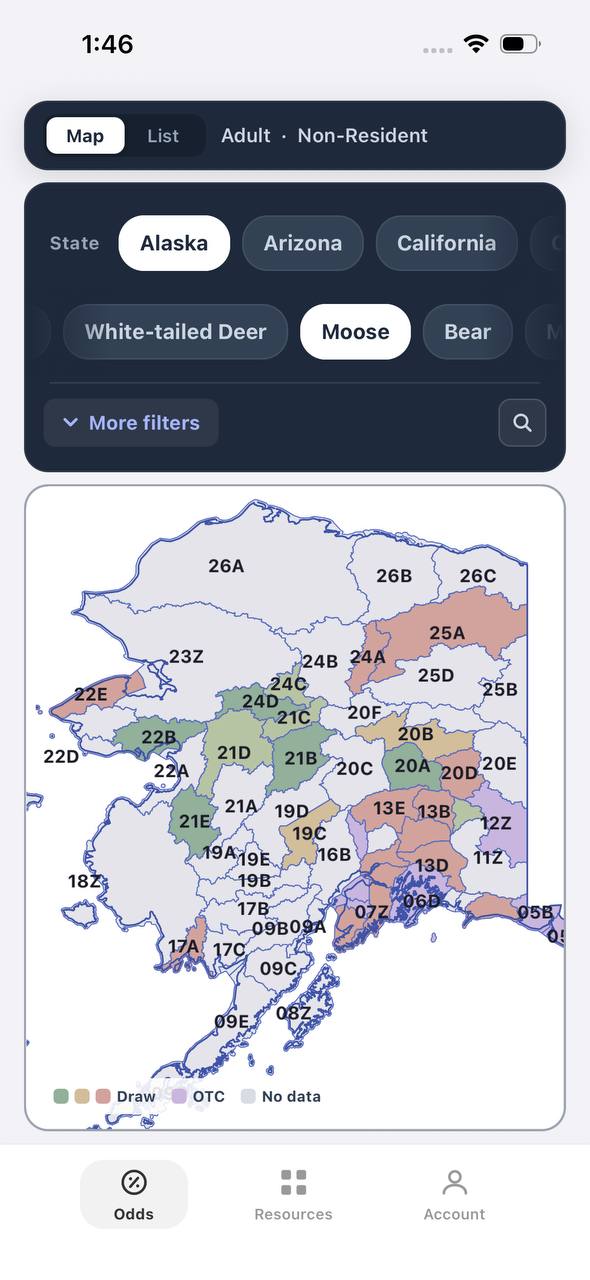
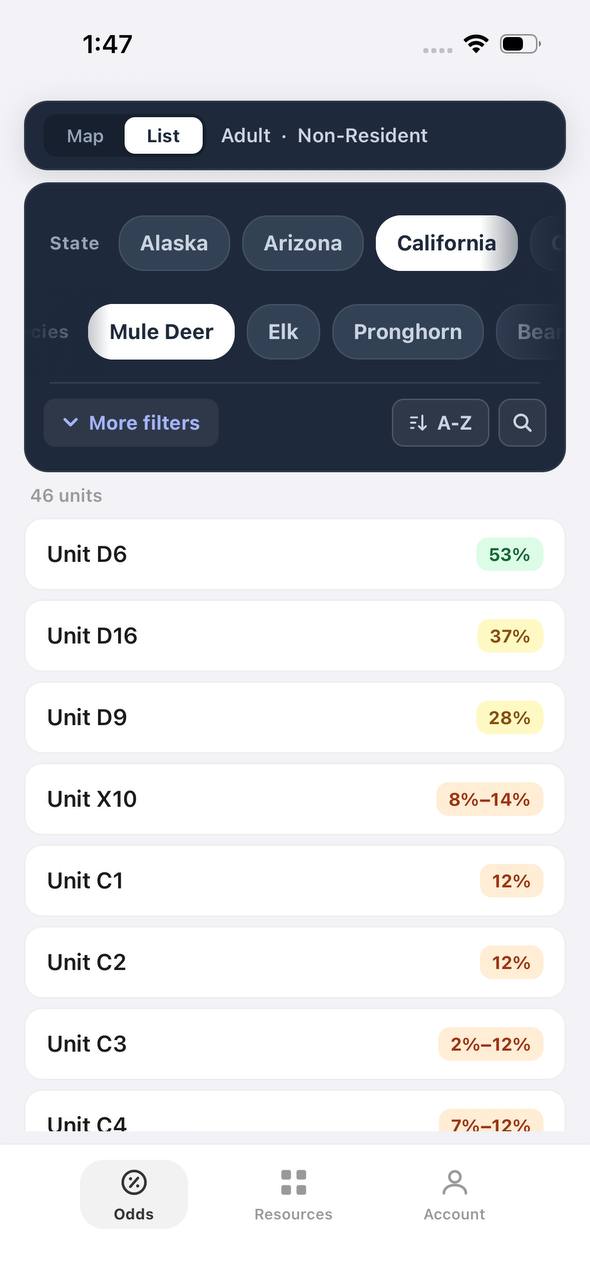
- Detailed draw odds
- Point tracking
- Deadline reminders
- 18 states covered

Free to join
Download mobile app
- Detailed draw odds
- Point tracking
- Deadline reminders
- 18 states covered
Free to join
Download mobile app
- Detailed draw odds
- Point tracking
- Deadline reminders
- 18 states covered
New Mexico's 84/10/6 Draw Explained
New Mexico's public draw uses three major quota pools.
Under current law:
84% Resident Pool
A minimum of:
84%
of draw licenses for each hunt are allocated to New Mexico residents.
10% Outfitter Pool
10%
are allocated to residents or nonresidents applying with a registered New Mexico outfitter.
6% Nonresident Pool
6%
are allocated to nonresidents who aren't applying through the outfitter pool.
A nonresident who draws through the 6% pool can still hire a guide afterward.
The 6% pool doesn't prohibit guided hunting.
Does an Outfitter Improve New Mexico Draw Odds?
Potentially—but only through a specific legal pathway.
New Mexico has a designated:
10% Outfitter Pool.
To qualify, the hunter must meet New Mexico's requirements for applying with a registered outfitter.
This is different from simply hiring a guide after drawing.
Hiring a Guide Isn't the Same as Applying in the Outfitter Pool
A nonresident can:
Apply in the 6% nonresident pool
draw a license
and:
Hire an outfitter or guide afterward.
That doesn't retroactively move the application into the 10% outfitter pool.
If you want to participate in the outfitter pool, you need to follow the applicable New Mexico requirements when submitting the application.
Is the 10% Outfitter Pool Always Better?
No.
Don't automatically assume:
10% > 6%, therefore outfitter odds are always better.
The applicant pools can contain different numbers of hunters.
What matters is:
Applicants competing in that pool relative to licenses available to that pool.
For some hunts, historical outfitter-pool odds can be more attractive.
For others, the difference may be smaller.
Research the exact hunt.
Small Quotas Matter for Nonresidents
New Mexico specifically warns applicants that it is extremely unlikely for:
Outfitted applicants to draw hunt codes with six or fewer licenses
or:
Nonresidents to draw hunt codes with 12 or fewer licenses.
That's a crucial consideration when a nonresident sees an appealing hunt with a tiny quota.
Don't evaluate only the overall number of applicants.
Look at the number of licenses available and how the quota system affects your pool.
Antlerless Elk Has Additional Nonresident Restrictions
Under current rules:
Nonresidents are ineligible for antlerless elk draw licenses.
Likewise, nonresidents are ineligible for hunts held exclusively on:
Wildlife Management Areas.
That means not every elk hunt shown in New Mexico's regulations is an option for a nonresident.
Actual 2027 New Mexico Elk Odds Don't Exist Yet
Be careful with articles claiming:
"2027 New Mexico elk draw odds."
Actual 2027 drawing results won't exist until the 2027 draw occurs.
Before then, hunters can analyze:
Historical Draw Odds
to understand previous applicant demand.
Historical results can inform your strategy.
They can't guarantee 2027 results.
Don't Call Unit 16A a "High-Odds Unit"
The original article describes:
Unit 16A
as a favorable-odds opportunity.
That's too broad.
New Mexico draw probability isn't determined simply by:
Unit 16A.
There can be different hunts involving:
Weapon
Season dates
Legal animal
Hunt code
Quota
Applicant pool
Some highly regarded Unit 16 opportunities can receive substantial applicant demand.
Research the exact hunt code.
Don't Call Unit 34 a "First-Time Applicant Unit"
Because New Mexico has no preference-point system:
First-time applicant
isn't a special odds category.
A first-time applicant and a longtime unsuccessful applicant are treated without point-based preference.
Unit 34 can have multiple elk hunt codes with different drawing statistics.
Don't assign one generic draw probability to the entire unit.
Don't Call Unit 13 a "High-Odds Unit" Without the Hunt Code
The same applies to:
Unit 13.
Research:
Exact Hunt Code + Weapon + Season + Quota + Residency/Outfitter Pool
before describing historical odds.
A GMU number alone isn't enough.
Hunt Code Matters More Than Unit Name
This is one of the most important New Mexico SEO concepts.
Don't optimize only for:
"New Mexico Unit 16A elk odds."
Also answer:
Which hunt code?
A hunt code identifies the specific opportunity.
Two hunts in the same GMU can have completely different:
Applicant demand
Quotas
Seasons
Weapons
Draw odds
Harvest outcomes
Free to join
Download mobile app
- Detailed draw odds
- Point tracking
- Deadline reminders
- 18 states covered
Free to join
Download mobile app
- Detailed draw odds
- Point tracking
- Deadline reminders
- 18 states covered
Free to join
Download mobile app
- Detailed draw odds
- Point tracking
- Deadline reminders
- 18 states covered
Weapon Choice Can Change Your Odds
New Mexico offers elk opportunities involving different sporting arms.
Depending on the hunt, that can include:
Bow
Muzzleloader
and:
Any Legal Sporting Arm
among applicable classifications.
Demand can vary substantially.
Don't combine archery, muzzleloader and rifle-type historical results into one generic unit percentage.
Season Timing Matters
Two elk hunts in the same unit can have different applicant demand because of:
Rut timing
Weapon
Season dates
Hunt length
Expected weather
Access
Perceived hunt quality
That's another reason hunt-code-level research matters.
Quality and High-Demand Hunts
New Mexico classifies applicable elk hunts using fee types such as:
S — Standard
Q — Quality
HD — High Demand
and:
Q/HD — Quality and High Demand.
These classifications matter for fees and hunt research.
Don't treat every elk license within a unit as interchangeable.
Quality Doesn't Mean Guaranteed Trophy
New Mexico's quality-hunt designation relates to management factors such as desirable season structure, lower hunter density and hunting opportunity.
It doesn't mean:
Guaranteed Trophy Bull.
Likewise:
High Demand
describes demand.
It doesn't guarantee bigger elk.
How Many Elk Choices Can You Make?
New Mexico's application system evaluates your first three specific hunt choices in sequence.
Think:
Choice 1 → Choice 2 → Choice 3
when your application is processed.
This creates a meaningful application strategy.
Your Choices Aren't Three Independent Draws
Don't think:
"I get three separate lottery tickets."
Your application receives a sequence number.
When the system reaches your application, it evaluates your choices according to the drawing rules and remaining licenses.
That's different from submitting three completely separate applications.
How Should You Structure Your Choices?
There's no universal perfect strategy.
One possible framework is:
Choice 1 — Highest-Priority Hunt
The hunt you'd most like to receive.
Choice 2 — Strong Alternative
Another hunt you'd genuinely be willing to hunt.
Choice 3 — Opportunity-Oriented Hunt
An acceptable hunt with historically different applicant pressure.
But don't blindly use this structure.
Research how each hunt historically performs as a first, second or third choice.
First Choice Can Matter
A highly competitive hunt may allocate all available licenses before second-choice applicants have meaningful access to it.
That means:
Choice order matters.
Don't assume putting a premium hunt second gives you the same practical opportunity as putting it first.
New Mexico Fourth Choice
New Mexico also offers an optional:
Fourth Choice
for deer and elk.
Fourth choice works very differently.
Instead of selecting another exact hunt code, applicants indicate willingness to accept an available hunt within a specified quadrant of the state.
Fourth Choice Can Result in a Very Different Hunt
Hunters should understand the tradeoff.
Under current rules, a fourth-choice elk assignment uses the same sporting-arm type as your first choice.
But you can potentially receive:
An antlerless license
even if your first three choices were for mature bull hunts.
New Mexico also warns that success rates on fourth-choice hunts can be low because elk populations may be small or localized.
Don't select fourth choice unless you're genuinely willing to accept that uncertainty.
Does Applying for More Choices Improve Your Opportunity?
Listing multiple acceptable choices gives the system more options when processing your application.
But don't describe that as:
"Spreading multiple applications across units."
You submit an application with ranked hunt choices.
That's a more accurate description.
Free to join
Download mobile app
- Detailed draw odds
- Point tracking
- Deadline reminders
- 18 states covered
Free to join
Download mobile app
- Detailed draw odds
- Point tracking
- Deadline reminders
- 18 states covered
Free to join
Download mobile app
- Detailed draw odds
- Point tracking
- Deadline reminders
- 18 states covered
Does Applying Early Improve New Mexico Elk Odds?
No.
Submitting your application earlier doesn't give you a better sequence number.
Applying early is still smart because it gives you time to:
Check hunt codes
Verify residency
Review outfitter information
Confirm license requirements
Correct mistakes
Complete harvest reporting
Avoid missing the deadline
But:
Early Application ≠ Better Draw Odds.
When Is the New Mexico Elk Application Deadline?
The original article's suggestion that hunters should begin applying in:
Fall 2026
is incorrect.
New Mexico's main elk drawing occurs through a spring application process.
For reference, the 2026 deadline was:
March 18, 2026 at 5 p.m. Mountain Daylight Time.
Don't automatically publish March 18 as the final 2027 deadline until New Mexico releases its 2027 application calendar.
Harvest Reporting Can Affect Draw Eligibility
New Mexico requires applicable previous-year license holders to complete mandatory harvest reporting.
Under the current system, failure to complete required reporting by the applicable deadline can make a hunter:
Ineligible for the following big-game drawing.
That makes harvest reporting part of your application preparation.
Do You Need Preference Points to Apply?
Again:
No.
There is no point requirement.
A hunter can decide in 2027:
"I want to apply for New Mexico elk for the first time."
and enter the same random system without a point-based disadvantage.
That's one of New Mexico's biggest attractions for Western elk applicants.
Is New Mexico Good for New Applicants?
New Mexico can be attractive for hunters entering a new state because:
There is no preference-point barrier.
But don't confuse:
No points required
with:
Easy to draw.
Highly desirable elk hunts can still have extremely low historical odds.
What Are the Best New Mexico Elk Odds?
There's no responsible statewide answer.
Instead, search by:
Residency/Pool + Hunt Code + Weapon + Season + Applicants + Quota
Then compare historical results.
For nonresidents, compare:
6% Nonresident Pool
against:
10% Outfitter Pool
where applicable.
Easier Draw Doesn't Mean Smaller Bulls
Don't assume:
Better Draw Odds = Worse Elk
or:
Lower Draw Odds = Bigger Bulls.
Drawing difficulty is primarily a function of:
Applicant Demand vs Available Licenses
within the applicable quota structure.
Demand can be affected by:
Reputation
Season
Weapon
Access
Media exposure
Quota
Hunter expectations
It's not an antler-size measurement.
Harder-to-Draw Units Don't Guarantee Trophy Bulls
The opposite is equally important.
Drawing an extremely difficult New Mexico elk tag doesn't guarantee:
A giant bull
High harvest success
Easy hunting
Good weather
Low pressure
A successful hunt
Research the hunt itself.
Draw Odds vs Harvest Success
These answer different questions.
Draw Odds
How difficult was obtaining the license?
Harvest Success
How often did hunters report harvesting?
Don't use harvest success as a substitute for draw odds.
And don't use draw difficulty as a substitute for expected hunting success.
Public Draw vs Private-Land Elk
New Mexico also has significant:
Private-Land Elk
opportunities.
These operate differently from the public draw.
New Mexico's:
EPLUS — Elk Private Lands Use System
provides private-land elk authorizations through participating properties.
Free to join
Download mobile app
- Detailed draw odds
- Point tracking
- Deadline reminders
- 18 states covered
Free to join
Download mobile app
- Detailed draw odds
- Point tracking
- Deadline reminders
- 18 states covered
Free to join
Download mobile app
- Detailed draw odds
- Point tracking
- Deadline reminders
- 18 states covered
What Is EPLUS?
EPLUS is New Mexico's:
Elk Private Lands Use System.
Participating properties can receive elk authorizations under applicable program rules.
Those authorizations are separate from winning a standard public elk draw license.
This creates another pathway for hunters considering New Mexico.
EPLUS Authorization Isn't the Same as an Elk License
A private-land elk authorization is used to obtain the applicable elk license.
Don't describe the authorization itself as though it's automatically the final hunting license.
Hunters still need to follow New Mexico's licensing process.
Can You Buy a Private-Land Elk Opportunity?
Depending on the authorization and property, EPLUS opportunities can enter the private market.
That can create:
No-Public-Draw
elk hunting pathways.
But costs and access can vary substantially.
Always verify:
Authorization type
Ranch
Unit
Season
Legal animal
Access
License requirements
before purchasing.
Public Draw vs EPLUS
Think of them separately.
Public Elk Draw
Random application system with the:
84/10/6 quota structure.
EPLUS
Private-land authorization system operating under separate rules.
A hunter doesn't need to assume:
"If I don't draw, I can't hunt New Mexico elk."
But private-land opportunities can have very different costs.
Guided Hunts and the 10% Outfitter Pool
New Mexico's outfitter pool deserves special attention.
To qualify for the 10% pool, hunters must follow the applicable contracted-outfitter requirements.
Under current rules, qualifying hunters need to be accompanied by the contracted outfitter or registered guide for at least the required portion of the hunt.
Don't enter the outfitter pool simply because you think:
"10% is automatically better."
Research the actual historical pool-specific results and understand the contract.
Can You Apply as a Group?
New Mexico allows:
Up to four hunters per elk draw application
under current rules.
Group applications should be evaluated carefully.
The entire application is processed together according to New Mexico's draw mechanics.
Group Applications Don't Create Preference
Because New Mexico has no points:
Group applications don't combine or average preference points.
The primary reason to apply together is to try to hunt together.
Not to increase point-based priority.
How TAGZ Helps Research New Mexico Elk
TAGZ helps hunters research draw opportunities around the variables that actually matter.
For New Mexico elk, that means:
Residency
Outfitter status
Hunt code
Unit
Weapon
Season
Historical applicants
Quota
Choice order
Historical harvest where available
Terrain
Public/private land
Instead of asking:
"How many points do I need for Unit 16A?"
the better question is:
"What were the historical odds for this exact Unit 16A hunt code in my applicable draw pool?"
Because:
New Mexico has no preference points.
Historical Odds Are Not 2027 Guarantees
TAGZ can help organize and compare historical draw information.
But previous results can't guarantee:
2027 applicant totals
2027 quota
2027 draw results
Future hunt quality
Harvest success
Historical data should help hunters make:
Better-informed applications
not promise a tag.
Built by Hunters, Guides and Outfitters
TAGZ was started by hunters, guides and outfitters with firsthand Western hunting experience.
New Mexico is a perfect example of why state-specific draw knowledge matters.
A hunter coming from Colorado, Wyoming or Oregon might assume:
"How many points do I need?"
But in New Mexico, that's the wrong question.
There are:
No preference points.
The questions that matter are:
Which hunt code?
Which draw pool?
How many licenses?
How many applicants?
Which weapon?
Which season?
Which choice position?
That's where a useful New Mexico elk strategy begins.
Learn more through About TAGZ.
Does New Mexico have preference points for elk?
No. New Mexico doesn't use preference points for its public elk draw.
Does New Mexico have bonus points?
No. New Mexico's public big-game draw randomly assigns sequence numbers to applications.
Can a first-time applicant draw New Mexico elk?
Yes. A first-time applicant has no point-based disadvantage compared with a hunter who has applied unsuccessfully for many years.
What is the New Mexico 84/10/6 rule?
Under current law, at least 84% of draw licenses are allocated to New Mexico residents, 10% to residents or nonresidents applying through the registered-outfitter pool and 6% to nonresidents outside that pool.
Does using an outfitter improve New Mexico elk odds?
Applying through the qualified outfitter pool places an eligible applicant in the 10% allocation rather than the standard 6% nonresident allocation. Actual historical odds still depend on applicants and licenses in each pool.
Can a nonresident apply without an outfitter?
Yes. Nonresidents can apply through the applicable 6% nonresident pool and hire a guide after drawing if desired.
Can nonresidents draw antlerless elk?
Under current rules, nonresidents aren't eligible for antlerless elk draw licenses.
How many elk choices can I list?
New Mexico evaluates the first three specific hunt choices in sequence. An optional fourth choice operates differently and can assign an available hunt within a selected quadrant.
Does applying early improve my odds?
No.
When is the New Mexico elk application deadline?
The 2026 deadline was March 18 at 5 p.m. MDT. Verify the official 2027 deadline when New Mexico publishes the new regulations.
What is EPLUS?
EPLUS is New Mexico's Elk Private Lands Use System, which provides a separate pathway for private-land elk authorizations.
Can I hunt New Mexico elk without winning the public draw?
Potentially. Private-land EPLUS opportunities provide a separate pathway subject to applicable authorization, licensing and access requirements.
FAQ — New Mexico Elk Draw Odds 2027
What are the best New Mexico elk draw odds for 2027?
Actual 2027 results don't exist before the draw. Use historical hunt-code-specific data to compare previous applicant demand and quotas.
How many points do I need to draw New Mexico elk?
None. New Mexico doesn't have preference or bonus points for its public elk draw.
Is Unit 16A easy to draw?
Don't evaluate Unit 16A as one draw. Research the exact hunt code, weapon, season and applicable applicant pool.
Is Unit 34 good for first-time applicants?
First-time status doesn't affect draw priority because New Mexico doesn't use points. Research the exact Unit 34 hunt code and historical odds.
Are premium New Mexico elk hunts impossible for new applicants?
No. A first-time applicant can draw because the system is random, although some hunts can have extremely low historical odds.
Should I apply with an outfitter?
That depends on the exact hunt and historical applicant pools. The outfitter pool receives a 10% allocation under current law, but applicant competition also matters.
Can I apply for several units?
You can list multiple hunt choices on your elk application under the applicable rules. They're ranked choices, not independent applications.
Does my second choice have the same chance as my first?
Not necessarily. Applications are processed sequentially, and licenses for highly competitive hunts may be gone before later choices are considered.
Is fourth choice a good backup?
It can provide another opportunity, but you can receive a hunt very different from your first three choices, including an antlerless elk license. Only select it if you're willing to accept that outcome.
Does New Mexico have OTC public bull elk tags?
Don't treat New Mexico like a broad OTC public-land elk state. Most standard public elk opportunities are managed through the draw, while private-land EPLUS provides a separate pathway.
Can I buy a New Mexico private-land elk hunt?
Private-land EPLUS opportunities can provide alternatives to the public draw. Verify the authorization, license, property access and hunt conditions before purchasing.
When should I start preparing for the 2027 application?
Begin researching well before the spring draw period so you have time to compare hunt codes, verify licensing and reporting requirements, and decide whether you're applying through the resident, nonresident or outfitter pool.
Continue Planning Your New Mexico Elk Application
The most important correction is simple:
New Mexico has no preference points.
You don't need to spend years building points before having a chance.
Instead, build your 2027 strategy around:
Residency/Draw Pool + Hunt Code + Unit + Weapon + Season + Choice Position + Applicants + Quota
For nonresidents, compare:
6% Nonresident Pool
with:
10% Outfitter Pool
where applicable.
Then separately consider:
EPLUS Private-Land Opportunities
if you want alternatives to the public drawing.
Use TAGZ to research New Mexico elk opportunities and historical draw information.
Explore additional draw and hunting research through TAGZ Insights.
See how TAGZ works through TAGZ Product.
Learn about the hunters, guides and outfitters behind TAGZ through About TAGZ.
For final 2027 deadlines, hunt codes, quotas, license fees and regulations, verify current information through the New Mexico Department of Wildlife Big Game Draw.
Historical draw odds are planning tools—not guarantees. Applicant demand, quotas, hunt codes and regulations can change from year to year.
Was this article helpful?
Previous
Alaska Dall Sheep Draw Odds 2027: Permits & Strategy
Alaska does not use preference points or bonus points for Dall sheep drawing permits. Drawing permits are awarded through a: Random Lottery That means an applicant who has been unsuccessful for 15 years doesn't receive additional point-based priority over a first-time applicant. For applicable drawing hunts, Alaska currently allows hunters to submit: Up to six applications per species across individual and party applications combined, subject to hunt-specific restrictions. Hunters can generally apply for: Multiple different Dall sheep drawing hunts or: The same hunt more than once provided they stay within the six-application limit and follow the current hunt-specific rules. For nonresidents, another rule is critical: A nonresident hunting Dall sheep must be accompanied by an Alaska-licensed guide or a qualifying Alaska resident relative within second degree of kindred. Some nonresident drawing hunts also require a guide-client contract when applying. For 2027 planning, research: Hunt Number + Residency + Permits Available + Historical Applications + Hunt Restrictions + Guide Requirements rather than looking for a nonexistent preference-point threshold.
Related
California Guided Elk Hunts 2027: Tags, Draw & Costs
California offers guided hunting opportunities for Tule elk, Roosevelt elk and Rocky Mountain elk, but hunters need to understand the tag pathway before booking an outfitter. California does not have a broad general over-the-counter elk season. Depending on the hunt, your elk opportunity may come through: California's Big Game Drawing A Private Lands Management (PLM) property A SHARE Access Permit Another authorized special elk opportunity These pathways work differently. For the standard Big Game Drawing, California uses a modified preference-point system, and a guide doesn't automatically improve your drawing probability. For private-land opportunities, especially PLM properties, the tag structure can be substantially different. Before sending an outfitter a deposit, ask: "Exactly how will I legally obtain the elk tag for this hunt?" That should be the starting point for every California guided elk hunt. California Guided Elk Hunting in 2027
Next
DIY vs Guided Bighorn Sheep Hunts: Which Fits You?
Should you hunt Rocky Mountain bighorn sheep DIY or hire an outfitter? It depends primarily on: The tag you draw + State Rules + Hunt Area + Access + Your Sheep-Hunting Experience + Available Scouting Time + Physical Ability + Budget. A DIY hunt can provide greater independence and reduce outfitter costs, but it puts scouting, access research, logistics, field judging and hunt execution entirely on you. A guided hunt can provide local experience, pre-hunt scouting and logistical support, but it adds substantial cost and does not guarantee a successful harvest. Most importantly: Decide how the tag works before deciding how you'll hunt it. Rocky Mountain bighorn sheep licensing systems differ significantly between states. Drawing a sheep tag in Colorado isn't the same process as drawing one in Wyoming, Idaho, Montana or Utah. Research the exact license first. Then decide whether that hunt makes sense: DIY or: Guided.