Washington Elk Bonus Points 2027: Draw Strategy Guide
ElkWashingtonDraw OddsUnit Strategy
18 min read·Sep 25, 2026·TAGZ
Washington Elk Bonus Points 2027: Draw Strategy Guide

Does Washington Use Preference Points for Elk?

Not in the traditional preference-point sense.

Washington uses a:

Weighted-Point Permit Drawing System.

This distinction matters.

In a pure preference system, applicants with more points generally receive priority before lower-point applicants.

Washington doesn't work that way.

Instead, accumulated points provide additional weight in a random drawing.

A lower-point applicant can potentially draw ahead of someone with substantially more points.

Are Washington Elk Points Bonus Points?

Hunters commonly describe Washington's system as a:

Bonus Point System

because points increase your chances without guaranteeing priority.

WDFW's official application instructions describe it as a:

Weighted-Point Permit Drawing System.

For SEO, hunters may search:

Washington elk bonus points

or:

Washington elk preference points.

But the article should explain the distinction clearly:

Washington points increase drawing probability—they don't create guaranteed preference.

Can a Low-Point Hunter Draw a Washington Elk Permit?

Yes.

Because Washington's drawing remains random, a hunter with relatively few points can potentially draw.

That is one of the biggest differences between Washington and a strict preference-point system.

More points improve your position.

They don't guarantee the permit.

Can a High-Point Hunter Still Be Unsuccessful?

Yes.

A hunter can accumulate a substantial number of points and remain unsuccessful.

That's why statements such as:

"This Washington elk hunt takes 15 points"

can be misleading.

A better description is:

"This hunt had these applicants, these permits and this point distribution in the historical drawing."
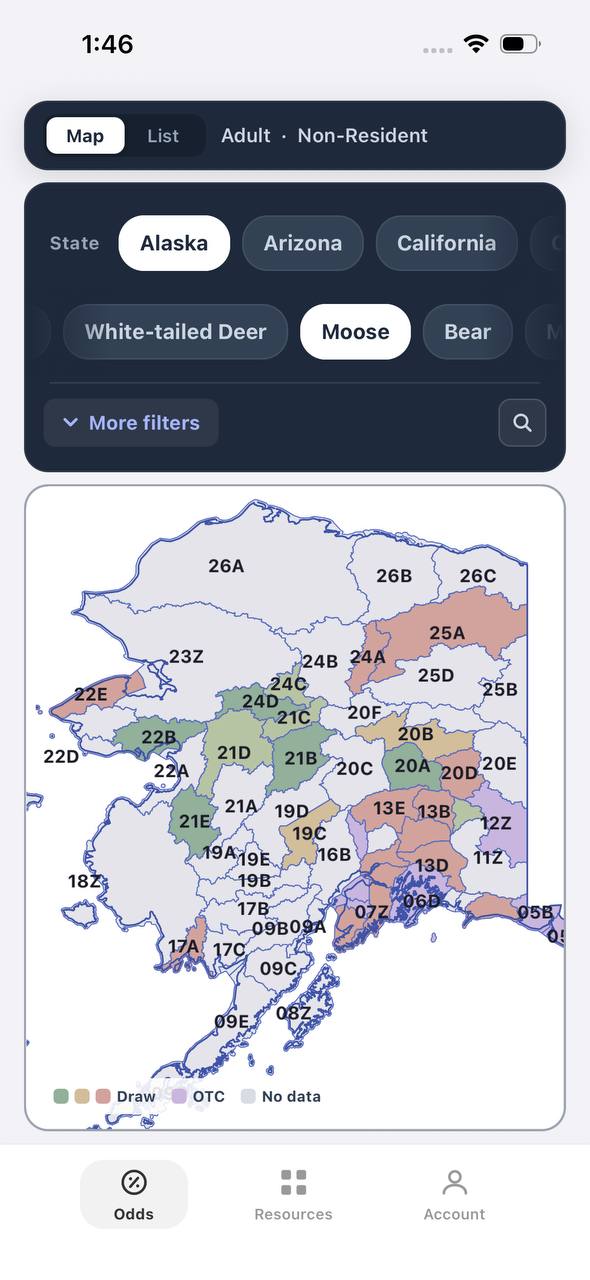
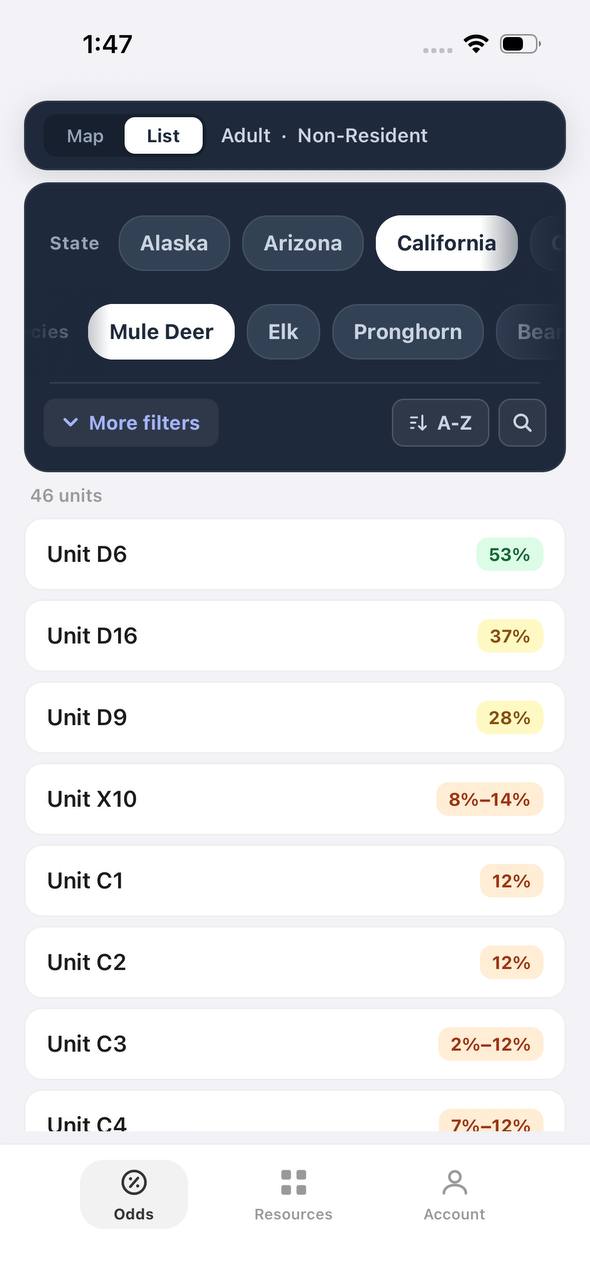
Draw odds
Alaska moose draw odds by unit, colored by draw, OTC, or no data
AdultNonresident

Alaska · Moose

Draw, OTC, and no-data units across the whole state.

Adult, Nonresident, Moose, no additional filters. Every unit is colored by its best matching draw odds; if nothing draws, it shows OTC; if neither, no data.

  • Alaska mixes draw and OTC moose hunts within the same region.
  • Green units are worth an application; purple units are OTC.
  • Filters stay applied when a unit is opened for hunt detail.
Draw odds
California mule deer draw odds ranked by unit in a list
AdultNonresident

California · Mule deer

Nonresident odds ranked unit by unit.

Adult, Nonresident, Mule deer, no weapon or season chip, so every matching hunt in a zone is combined into one badge and sorted by best projected odds.

  • D6 leads the list; a range like 8%–14% means more than one hunt code exists in that zone.
  • The list and the map read the same filtered hunt set.
  • 46 units are shown for this species and state alone.

Free to join

Download mobile app

  • Detailed draw odds
  • Point tracking
  • Deadline reminders
  • 18 states covered
Download on the App StoreGet it on Google Play
Unit detail
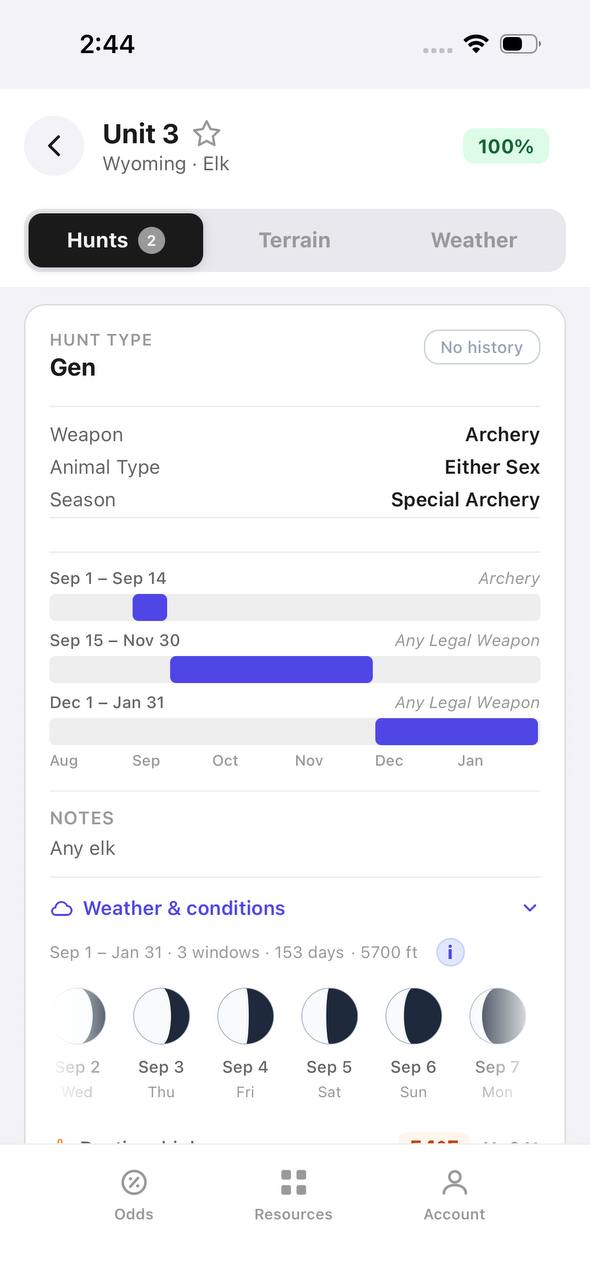
Wyoming elk unit detail, hunts tab, showing hunt windows on a timeline

Wyoming · Elk, Unit 3

Every hunt window inside one unit, laid out on a timeline.

Unit 3 has two hunt codes for elk. Each one shows its weapon, animal type, and season as a bar on a shared Aug–Jan timeline, plus a day-by-day moon phase strip.

  • Archery, then a long Any Legal Weapon window, then a late season — three opportunities in one unit.
  • The 100% badge at top means no real draw competition for the selected filters right now.
  • Weather & conditions expands below the hunt list without leaving the unit.
Terrain data
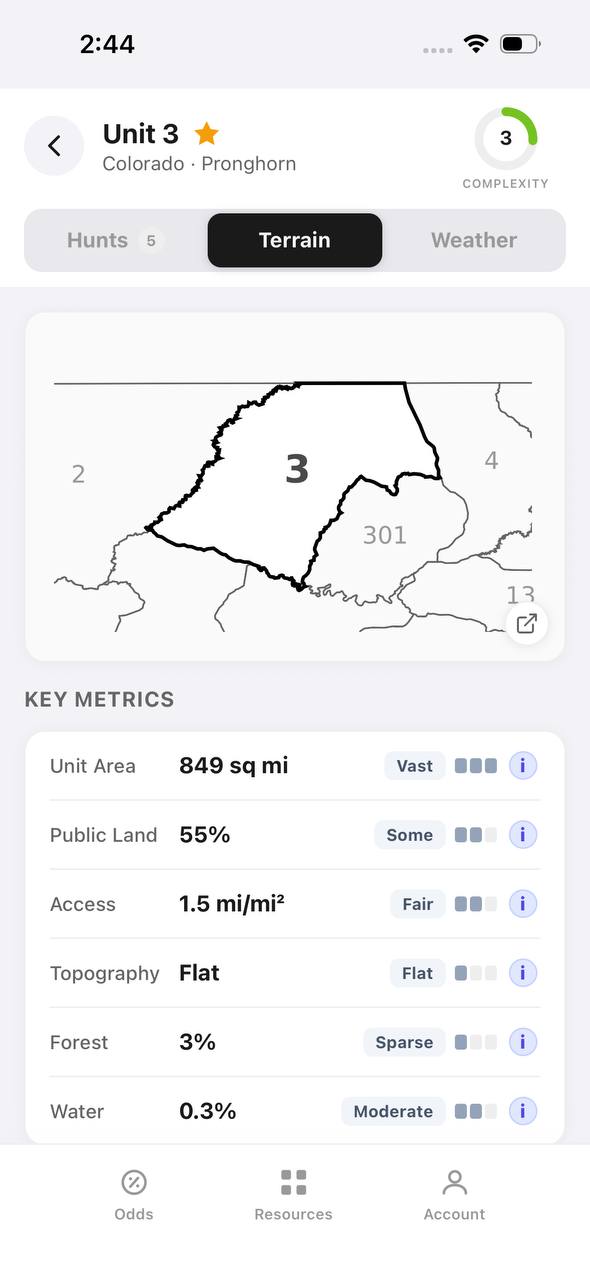
Colorado pronghorn unit detail, terrain tab, showing unit outline and key metrics

Colorado · Pronghorn, Unit 3

Unit boundaries and a complexity score at a glance.

The Terrain tab draws the unit outline against its neighbors and scores it for complexity, then breaks out area, public land, access, topography, forest, and water.

  • 849 sq mi, 55% public land, and flat topography make this a fairly approachable unit.
  • Each metric carries a short rating word — Vast, Some, Fair, Flat, Sparse, Moderate — with a tooltip.
  • The outline map shows adjacent units 2, 4, 13, and 301 for context.
State profiles
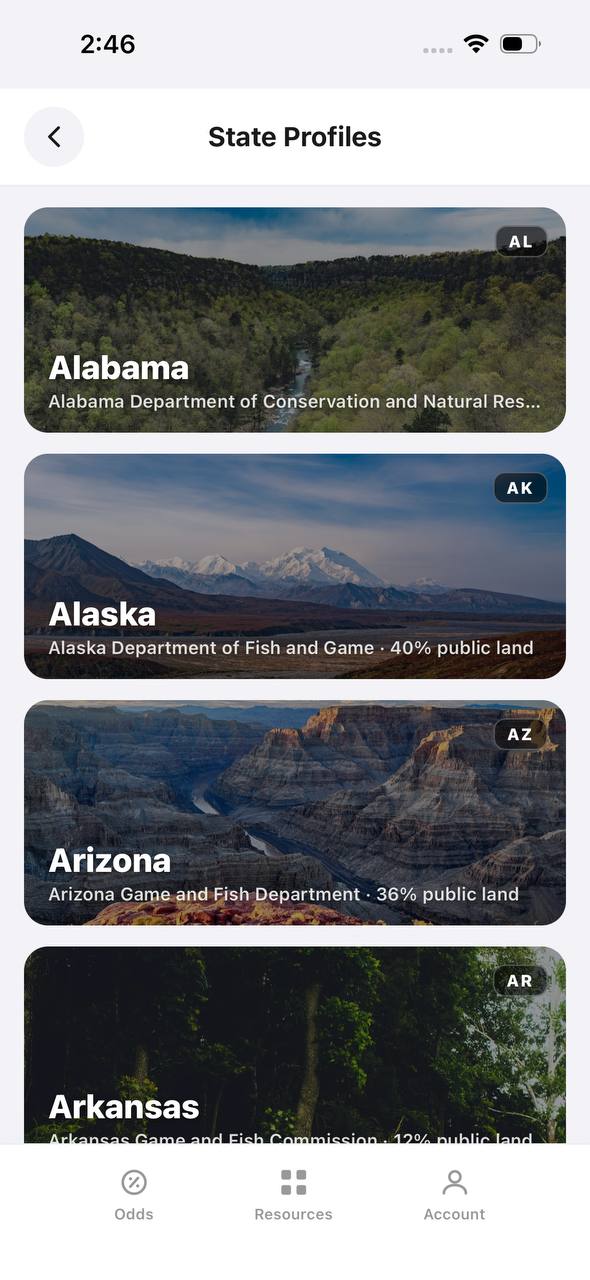
State Profiles screen listing states with wildlife agency and public land percentage

State Profiles

Each state's wildlife agency and public land share, at a glance.

State Profiles lists every covered state as a photo card naming its wildlife agency and, where available, its public land percentage.

  • Public land percentage shows right in the list, before opening the state.
  • Each card names the exact agency the regulations come from.
  • States without a public land figure yet, like Alabama here, are still listed.
Points wallet
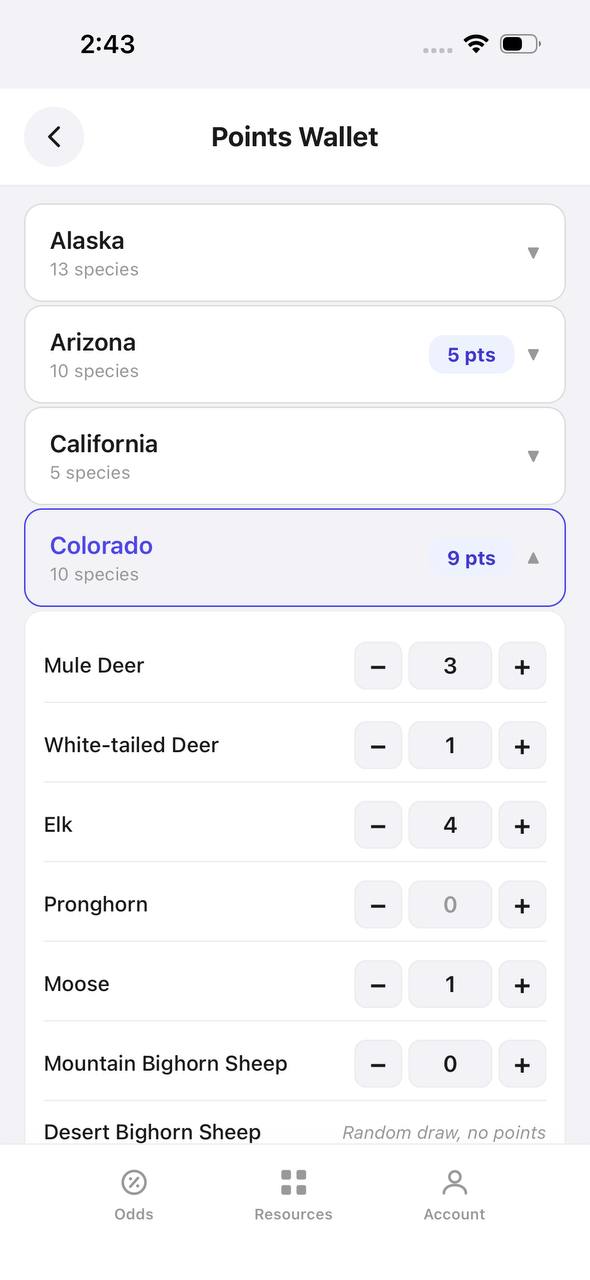
Points Wallet screen with Colorado expanded, showing a point stepper per species

Points Wallet · Colorado

Every state and species point balance in one wallet.

Points Wallet lists each state with a species count; expanding a state, like Colorado here, shows a stepper for every species so a balance can be entered or adjusted directly.

  • Colorado alone tracks points across 10 species independently.
  • Species with no points, like Pronghorn here, still show a zero to stay visible.
  • Desert Bighorn Sheep is flagged as a random draw with no points system.

Free to join

Download mobile app

  • Detailed draw odds
  • Point tracking
  • Deadline reminders
  • 18 states covered
Download on the App StoreGet it on Google Play
Draw odds
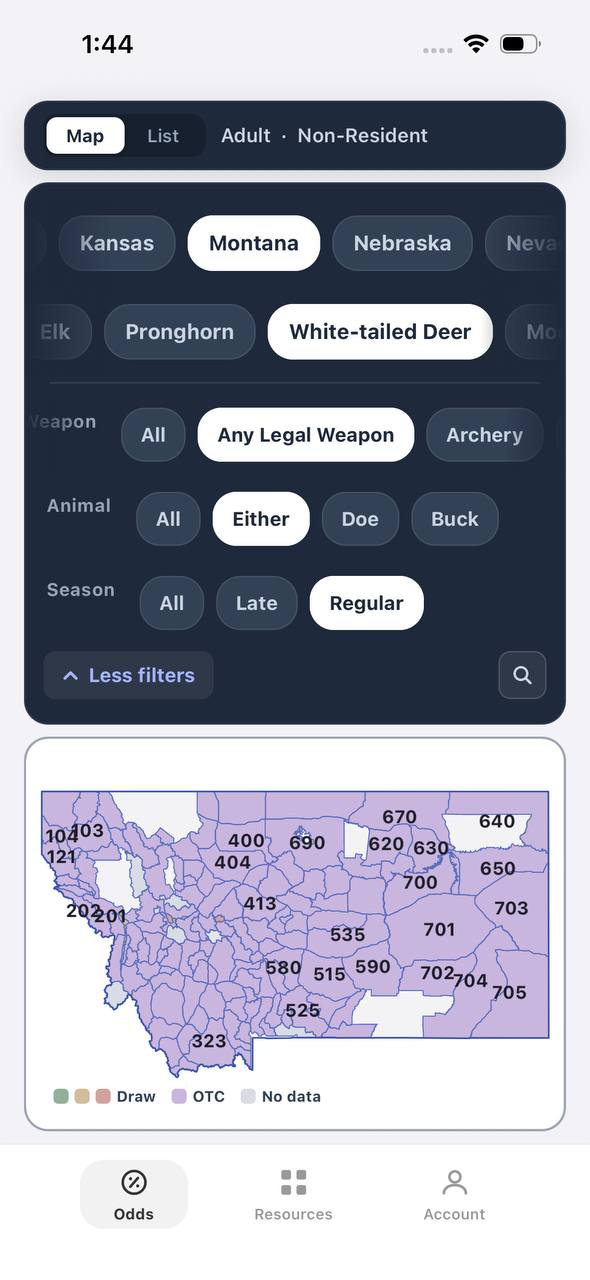
Montana white-tailed deer draw odds filtered to any legal weapon, either sex, regular season
AdultNonresidentAny Legal WeaponEitherRegular

Montana · White-tailed deer

Nearly the whole state is OTC for this filter combination.

Adult, Nonresident, White-tailed deer, filtered to Any Legal Weapon, Either, Regular. Under this combination almost every unit turns purple — over the counter.

  • Switching weapon, sex, or season changes the picture completely.
  • Purple means the tag can be bought directly, no draw.
  • This is the tag-and-go read of Montana whitetail, not the point-based one.
Terrain data
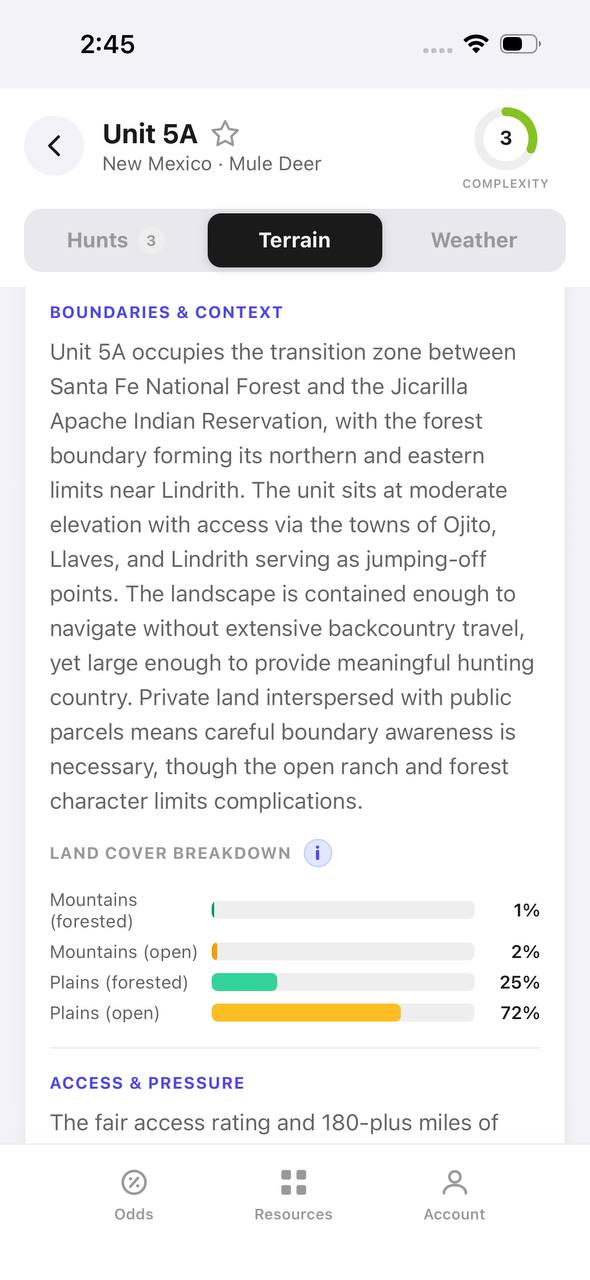
New Mexico mule deer unit 5A terrain tab with boundary description and land cover breakdown

New Mexico · Mule deer, Unit 5A

A written boundary description, not just a shape.

Unit 5A's terrain tab opens with a plain-language paragraph about surrounding land, access towns, and ownership mix, then a land cover breakdown by percentage.

  • 72% open plains and 25% forested plains describe the terrain at a glance.
  • The boundary text calls out the exact reservation and forest lines that define the unit.
  • Access & pressure continues below the fold with mileage detail.
Draw odds
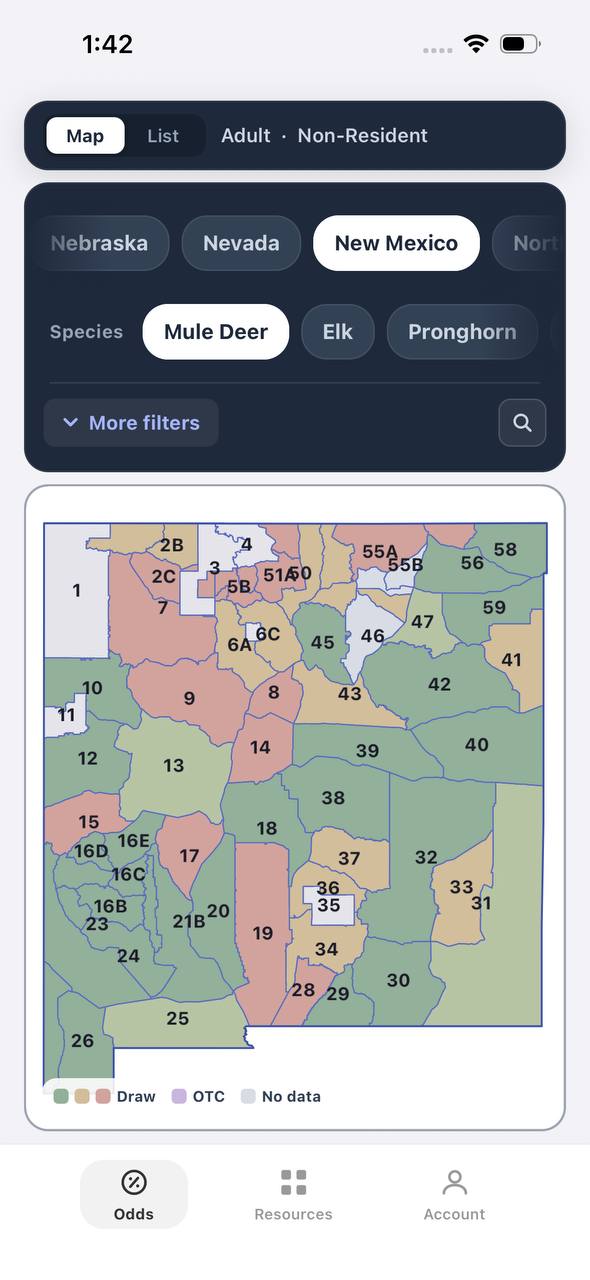
New Mexico mule deer draw odds by unit
AdultNonresident

New Mexico · Mule deer

Mule deer draw odds for every unit in the state.

Adult, Nonresident, Mule deer, all weapons and seasons. Each unit is colored by the same odds calculation used in the dashboard.

  • Green and tan together separate units worth applying to from units that are not.
  • Numbered units follow New Mexico's own game management unit boundaries.
  • Opening a unit shows the exact hunt behind the color.
Favorites
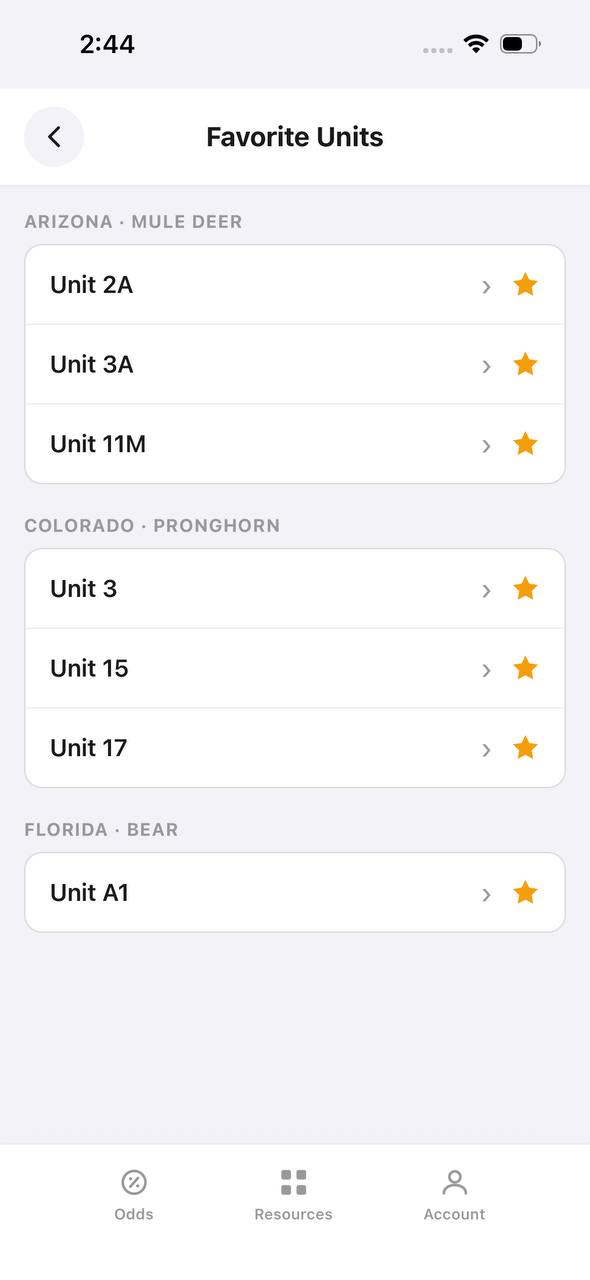
Favorite Units screen grouped by state and species

Favorite Units

Starred units from any state, grouped by species.

Favorite Units collects every starred unit across states and species into one list, grouped by state and species pair, so a saved unit is one tap away.

  • Arizona mule deer and Colorado pronghorn favorites sit side by side here.
  • Each row opens straight into that unit's detail view.
  • Unstarring from this screen removes it from the group instantly.
Deadlines
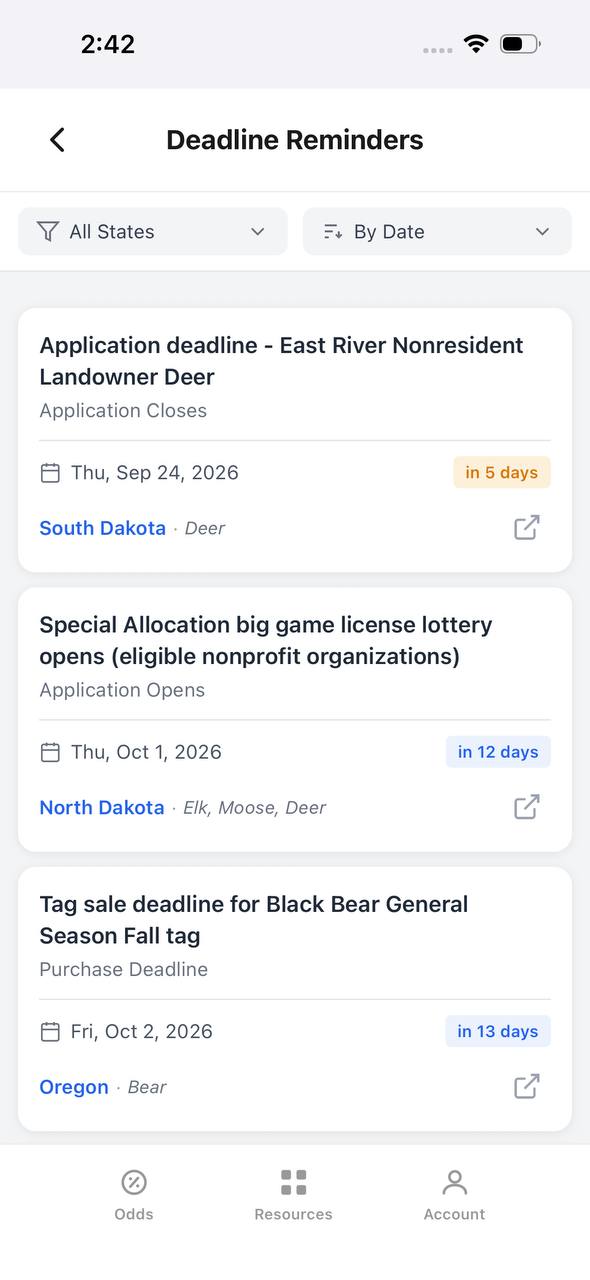
Deadline Reminders screen listing application and purchase deadlines by date

Deadline Reminders

Every application and purchase deadline, sorted by date.

Deadline Reminders filters by state and sorts by date, showing the deadline type, a countdown, and the state and species it applies to, with a link out to the source.

  • Countdown badges shift as a deadline gets close — "in 5 days" here, for example.
  • Application opens and closes are tracked as separate reminder types.
  • Each card links out to confirm the rule at the source.
Interactive map
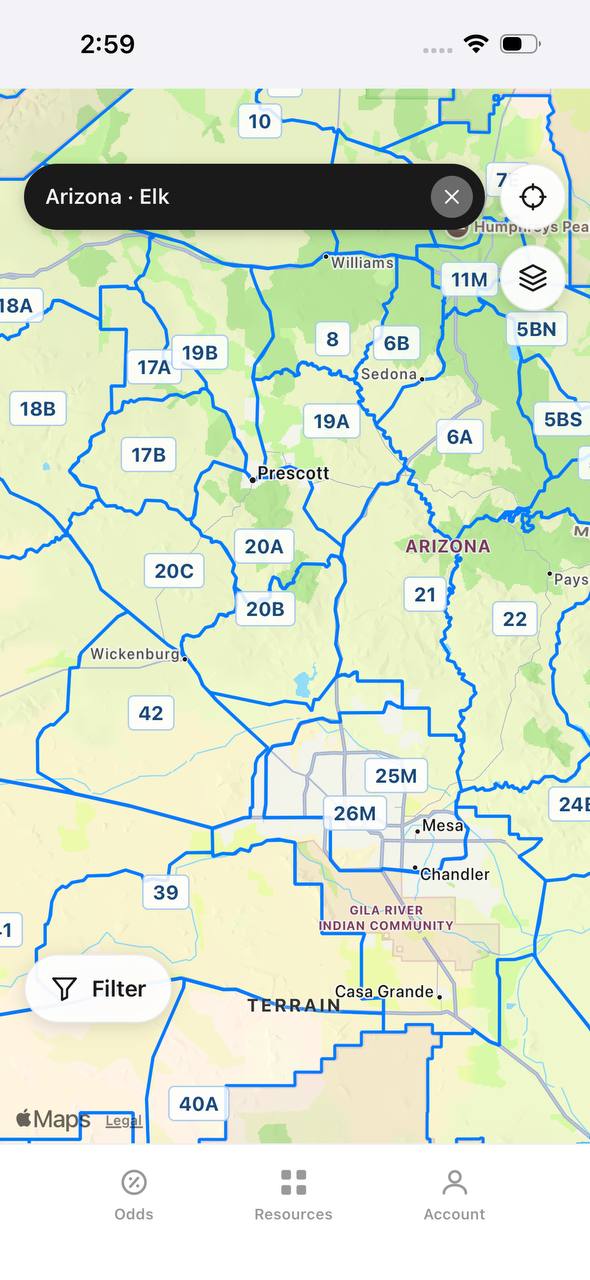
Arizona elk unit boundaries overlaid on an interactive street map

Arizona · Elk

Unit boundaries laid directly over a real map.

This view overlays Arizona elk unit boundaries and labels on top of a street map, with a search bar pinned to state and species and a layer toggle in the corner.

  • Real towns like Prescott and Sedona sit inside their unit boundaries for context.
  • A location button and layer switch float over the map, clear of the unit labels.
  • A Filter button at the bottom opens the same filters used elsewhere in the app.

Free to join

Download mobile app

  • Detailed draw odds
  • Point tracking
  • Deadline reminders
  • 18 states covered
Download on the App StoreGet it on Google Play
Insights
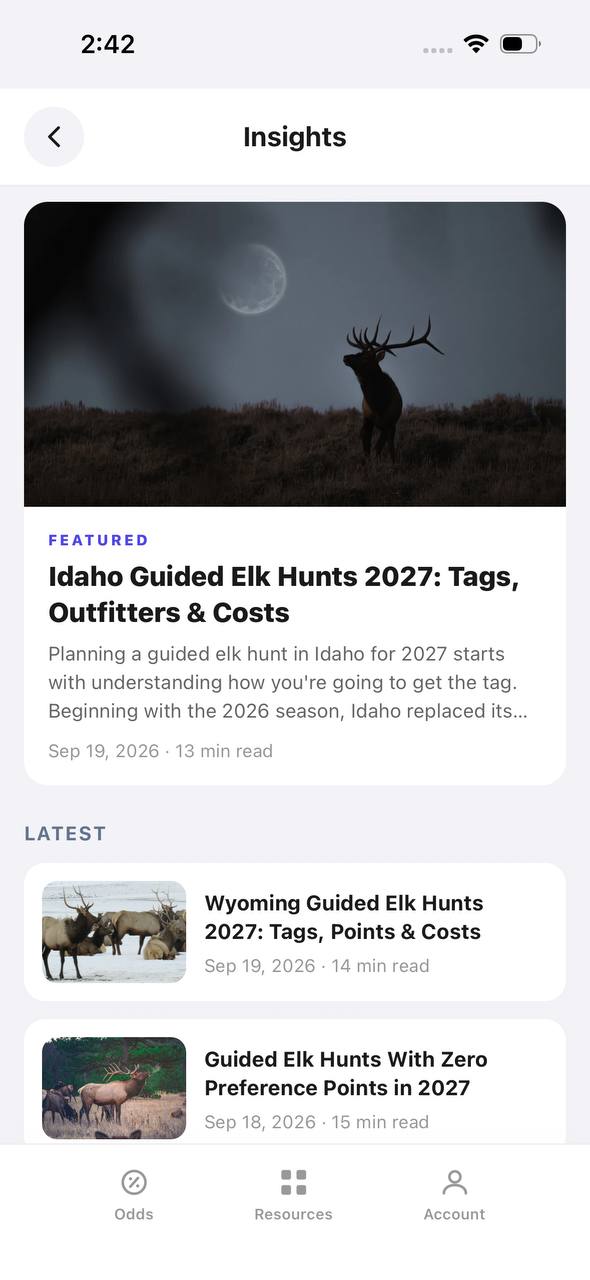
Insights screen with a featured article and a latest articles list

Insights

Hunting articles, built into the app itself.

Insights opens to a featured article with a hero image, then a Latest list of recent posts, each with a thumbnail, read time, and publish date.

  • The featured slot rotates to the newest deep-dive article.
  • Read time and publish date show on every card, not just the featured one.
  • This mirrors the blog content already published on the marketing site.
Download on the App StoreGet it on Google Play

How Do You Earn Washington Elk Points?

Under the current system, applicants accumulate points within the applicable special-permit category through the application process.

If you want to build a point without trying to draw a permit, Washington provides a:

Point Saver

option.

That allows a hunter to build within the applicable category without risking selection for a special permit.

Washington Elk Points Are Category-Specific

This is one of the most important parts of the system.

Washington doesn't treat every elk point as one universal pool.

Points accumulate separately within:

Permit Categories.

For example, a hunter's:

Quality Elk

points are separate from:

Bull Elk

points.

Likewise, applicable:

Antlerless Elk

points are maintained separately.

Drawing One Category Doesn't Necessarily Reset Another

Suppose you have points in:

Quality Elk

and:

Bull Elk.

If you draw a permit in one category, the points associated with that successful category reset according to the current rules.

Your separate category history isn't automatically treated as the same point pool.

This makes Washington strategy more complicated than simply saying:

"I have 10 elk points."

The better question is:

"I have 10 points in which elk permit category?"

Washington Elk Special Permit Categories

Current Washington elk special-permit categories include:

Quality Elk

These hunts are designed to provide conditions such as:

  • Lower-than-average hunter density

  • Greater potential for success

  • Favorable hunt timing

These can be highly desirable permits.

Bull Elk

Antlered elk opportunities available under applicable weapon and tag requirements.

Antlerless Elk

Antlerless opportunities managed under separate permit rules.

Youth Elk

Opportunities restricted to eligible youth hunters.

65+ Elk

Applicable special opportunities for eligible older hunters.

Disabled Elk

Special permits for hunters meeting Washington's disability requirements.

Master Hunter Elk

Applicable hunts available to eligible Master Hunter participants.

Each category should be researched separately.

Quality Elk vs Bull Elk Points

Don't combine:

Quality Elk Points

with:

Bull Elk Points

when researching historical draw odds.

They represent different permit categories.

A hunter could have very different point totals and drawing histories between them.

That's important when using historical data.

Washington Point Saver

Washington provides a:

Point Saver

option for hunters who want to accumulate a point without attempting to draw a special permit in that category.

This can be useful when:

  • You can't hunt that season

  • You're waiting for a future year

  • Your preferred hunt isn't available

  • Your schedule is uncertain

  • You're not prepared for the hunt

  • You're deliberately building points

Can You Hunt General Elk While Building Special Permit Points?

Potentially, yes.

This is a major distinction between:

General Elk Hunting

and:

Special Permit Elk Hunting.

Washington hunters generally purchase the appropriate elk license and transport tag before applying for applicable special elk permits.

If unsuccessful in the special permit drawing—or if using an applicable Point Saver strategy—the hunter can still have general-season opportunity consistent with the license, transport tag and current regulations.

That means Washington can offer:

Hunt General Elk + Build Special Permit Points

as part of a long-term strategy.

General Elk Tags and Special Permits Are Different

Don't call Washington's entire elk system:

OTC Elk

without explaining the structure.

A hunter may obtain an applicable general elk license/tag without winning a special permit drawing.

But a:

Special Hunt Permit

authorizes a particular special hunting opportunity.

Think of them as different layers:

General License/Transport Tag

plus, if successful:

Special Hunt Permit.

Special Permits Usually Don't Mean an Extra Elk

Drawing a special permit generally doesn't mean you automatically receive an additional elk.

Under current Washington rules, hunters are generally limited to:

One elk

during the hunting season unless a specific second-tag opportunity applies.

So:

Special Permit ≠ Automatically Second Elk.

Your Transport Tag Matters

For deer and elk special-permit applications, Washington requires hunters to have the appropriate hunting license and select the corresponding:

Transport Tag

before purchasing the special permit application.

The transport tag needs to match the requirements associated with the hunt.

That can involve:

  • Hunting method

  • Eastern or Western Washington

  • Applicable hunt restrictions

Don't build your special-permit strategy without first checking tag compatibility.

Archery, Muzzleloader and Modern Firearm Matter

Washington elk opportunity is closely tied to the hunter's selected transport tag and hunting method.

Applicable options can involve:

Archery

Muzzleloader

and:

Modern Firearm.

Special hunts can have their own weapon/tag requirements.

Always verify the exact hunt.

Multi-Season Elk Changes the Equation

Washington also offers a:

Multi-Season Elk Tag

through a separate application process.

Under the current program, successful Multi-Season Elk applicants can hunt eligible:

Archery + Muzzleloader + Modern Firearm

seasons until the elk tag is filled.

Multi-Season Elk tag holders can also apply for applicable special hunts across the available weapon types and on both sides of Washington.

That's a separate opportunity from the standard special-permit point system and should be researched independently.

Draw odds
Alaska moose draw odds by unit, colored by draw, OTC, or no data
AdultNonresident

Alaska · Moose

Draw, OTC, and no-data units across the whole state.

Adult, Nonresident, Moose, no additional filters. Every unit is colored by its best matching draw odds; if nothing draws, it shows OTC; if neither, no data.

  • Alaska mixes draw and OTC moose hunts within the same region.
  • Green units are worth an application; purple units are OTC.
  • Filters stay applied when a unit is opened for hunt detail.
Draw odds
California mule deer draw odds ranked by unit in a list
AdultNonresident

California · Mule deer

Nonresident odds ranked unit by unit.

Adult, Nonresident, Mule deer, no weapon or season chip, so every matching hunt in a zone is combined into one badge and sorted by best projected odds.

  • D6 leads the list; a range like 8%–14% means more than one hunt code exists in that zone.
  • The list and the map read the same filtered hunt set.
  • 46 units are shown for this species and state alone.

Free to join

Download mobile app

  • Detailed draw odds
  • Point tracking
  • Deadline reminders
  • 18 states covered
Download on the App StoreGet it on Google Play
Unit detail
Wyoming elk unit detail, hunts tab, showing hunt windows on a timeline

Wyoming · Elk, Unit 3

Every hunt window inside one unit, laid out on a timeline.

Unit 3 has two hunt codes for elk. Each one shows its weapon, animal type, and season as a bar on a shared Aug–Jan timeline, plus a day-by-day moon phase strip.

  • Archery, then a long Any Legal Weapon window, then a late season — three opportunities in one unit.
  • The 100% badge at top means no real draw competition for the selected filters right now.
  • Weather & conditions expands below the hunt list without leaving the unit.
Terrain data
Colorado pronghorn unit detail, terrain tab, showing unit outline and key metrics

Colorado · Pronghorn, Unit 3

Unit boundaries and a complexity score at a glance.

The Terrain tab draws the unit outline against its neighbors and scores it for complexity, then breaks out area, public land, access, topography, forest, and water.

  • 849 sq mi, 55% public land, and flat topography make this a fairly approachable unit.
  • Each metric carries a short rating word — Vast, Some, Fair, Flat, Sparse, Moderate — with a tooltip.
  • The outline map shows adjacent units 2, 4, 13, and 301 for context.
State profiles
State Profiles screen listing states with wildlife agency and public land percentage

State Profiles

Each state's wildlife agency and public land share, at a glance.

State Profiles lists every covered state as a photo card naming its wildlife agency and, where available, its public land percentage.

  • Public land percentage shows right in the list, before opening the state.
  • Each card names the exact agency the regulations come from.
  • States without a public land figure yet, like Alabama here, are still listed.
Points wallet
Points Wallet screen with Colorado expanded, showing a point stepper per species

Points Wallet · Colorado

Every state and species point balance in one wallet.

Points Wallet lists each state with a species count; expanding a state, like Colorado here, shows a stepper for every species so a balance can be entered or adjusted directly.

  • Colorado alone tracks points across 10 species independently.
  • Species with no points, like Pronghorn here, still show a zero to stay visible.
  • Desert Bighorn Sheep is flagged as a random draw with no points system.

Free to join

Download mobile app

  • Detailed draw odds
  • Point tracking
  • Deadline reminders
  • 18 states covered
Download on the App StoreGet it on Google Play
Draw odds
Montana white-tailed deer draw odds filtered to any legal weapon, either sex, regular season
AdultNonresidentAny Legal WeaponEitherRegular

Montana · White-tailed deer

Nearly the whole state is OTC for this filter combination.

Adult, Nonresident, White-tailed deer, filtered to Any Legal Weapon, Either, Regular. Under this combination almost every unit turns purple — over the counter.

  • Switching weapon, sex, or season changes the picture completely.
  • Purple means the tag can be bought directly, no draw.
  • This is the tag-and-go read of Montana whitetail, not the point-based one.
Terrain data
New Mexico mule deer unit 5A terrain tab with boundary description and land cover breakdown

New Mexico · Mule deer, Unit 5A

A written boundary description, not just a shape.

Unit 5A's terrain tab opens with a plain-language paragraph about surrounding land, access towns, and ownership mix, then a land cover breakdown by percentage.

  • 72% open plains and 25% forested plains describe the terrain at a glance.
  • The boundary text calls out the exact reservation and forest lines that define the unit.
  • Access & pressure continues below the fold with mileage detail.
Draw odds
New Mexico mule deer draw odds by unit
AdultNonresident

New Mexico · Mule deer

Mule deer draw odds for every unit in the state.

Adult, Nonresident, Mule deer, all weapons and seasons. Each unit is colored by the same odds calculation used in the dashboard.

  • Green and tan together separate units worth applying to from units that are not.
  • Numbered units follow New Mexico's own game management unit boundaries.
  • Opening a unit shows the exact hunt behind the color.
Favorites
Favorite Units screen grouped by state and species

Favorite Units

Starred units from any state, grouped by species.

Favorite Units collects every starred unit across states and species into one list, grouped by state and species pair, so a saved unit is one tap away.

  • Arizona mule deer and Colorado pronghorn favorites sit side by side here.
  • Each row opens straight into that unit's detail view.
  • Unstarring from this screen removes it from the group instantly.
Deadlines
Deadline Reminders screen listing application and purchase deadlines by date

Deadline Reminders

Every application and purchase deadline, sorted by date.

Deadline Reminders filters by state and sorts by date, showing the deadline type, a countdown, and the state and species it applies to, with a link out to the source.

  • Countdown badges shift as a deadline gets close — "in 5 days" here, for example.
  • Application opens and closes are tracked as separate reminder types.
  • Each card links out to confirm the rule at the source.
Interactive map
Arizona elk unit boundaries overlaid on an interactive street map

Arizona · Elk

Unit boundaries laid directly over a real map.

This view overlays Arizona elk unit boundaries and labels on top of a street map, with a search bar pinned to state and species and a layer toggle in the corner.

  • Real towns like Prescott and Sedona sit inside their unit boundaries for context.
  • A location button and layer switch float over the map, clear of the unit labels.
  • A Filter button at the bottom opens the same filters used elsewhere in the app.

Free to join

Download mobile app

  • Detailed draw odds
  • Point tracking
  • Deadline reminders
  • 18 states covered
Download on the App StoreGet it on Google Play
Insights
Insights screen with a featured article and a latest articles list

Insights

Hunting articles, built into the app itself.

Insights opens to a featured article with a hero image, then a Latest list of recent posts, each with a thumbnail, read time, and publish date.

  • The featured slot rotates to the newest deep-dive article.
  • Read time and publish date show on every card, not just the featured one.
  • This mirrors the blog content already published on the marketing site.
Download on the App StoreGet it on Google Play

Does Drawing a Multi-Season Elk Tag Use My Special Hunt Points?

Don't confuse:

Multi-Season Tag Drawing

with:

Special Hunt Permit Drawing.

They are separate systems.

Research each independently.

Can You Apply for Multiple Washington Elk Special Permit Categories?

Under current regulations, hunters can purchase and submit:

Up to six elk special permit applications

with:

One permit application per hunt category for which they qualify.

That doesn't mean six applications for the same category.

It means hunters may participate across multiple eligible elk permit categories.

How Many Hunt Choices Can You List?

Washington currently allows:

Up to four hunt choices per application

for applicable categories.

However:

Quality Elk

currently allows:

Two Hunt Choices.

Your choices are ranked.

WDFW considers the hunts in the priority order you select.

Hunt Choices Aren't Independent Applications

Don't describe four choices as:

Four independent chances at four elk tags.

They're ranked hunt choices within the applicable category application.

The system evaluates them according to the drawing process.

Put Hunts in the Order You Actually Want Them

Because Washington considers your hunt choices in priority order, rank them based on the hunts you'd actually prefer.

Don't blindly put the:

"Best Odds Hunt"

first unless it's truly your preferred opportunity.

Understand:

  • Hunt dates

  • Weapon

  • Unit

  • Access

  • Permit quota

  • Historical applicants

  • Point category

before ranking choices.

Don't Draw a Permit Just to "Keep Building Points"

The original article suggested applying for less-competitive units to:

Draw a tag and build points simultaneously.

That is misleading for the same permit category.

If you're selected for a special permit:

Your points in that category reset to zero.

If your goal is specifically to preserve/build points in a category, use the applicable:

Point Saver

rather than intentionally drawing a permit in that category.

Point Strategy: Hunt Now vs Build

A better strategy is to classify each category as:

Hunt Now

or:

Build.

Hunt Now

Apply for actual special hunts you're willing and prepared to hunt.

Accept that drawing resets the points for that category.

Build

Use the Point Saver if you're deliberately accumulating a point and don't want to risk drawing that category.

That's a much clearer Washington strategy.

More Points Don't Mean You Should Automatically Apply

Suppose you have:

15 Quality Elk Points.

That doesn't mean:

"I need to burn them this year."

Ask:

  • Is the hunt actually desirable to me?

  • Can I hunt the dates?

  • Is access good?

  • Can I scout?

  • Does my transport tag match?

  • Has the hunt changed?

  • Have permit numbers changed?

  • How many applicants are entering?

Don't chase a permit solely because you've accumulated points.

Don't Chase "Maximum Points"

Because Washington is weighted rather than pure preference:

There isn't a guaranteed maximum-point threshold.

A high-point applicant can remain unsuccessful.

A lower-point applicant can draw.

That makes historical probability more important than:

"What was the minimum point level?"

How to Analyze Washington Elk Draw Odds

Start with:

Permit Category.

Then evaluate:

Hunt Choice + Current Points + Applicants + Permits + Weapon/Tag + Unit + Season

For example, don't simply search:

"Washington Entiat elk odds."

Instead determine the specific special hunt you're considering within Washington's Entiat unit on TAGZ, then compare the exact hunt category, weapon, applicants and permit quota.

The unit is only one part of the drawing equation.

Unit Pages Should Support Hunt-Level Research

A unit page helps you understand:

  • Terrain

  • Access

  • Hunt opportunities

  • Species

  • Seasons

  • Unit geography

But draw odds should still be evaluated at the:

Exact Hunt Level.

That's particularly important in Washington because the same unit can contain several elk special-permit opportunities.

Historical Odds Aren't 2027 Odds

Actual:

2027 Washington Elk Draw Results

don't exist before the 2027 drawing.

Historical data can help hunters understand:

  • Previous applicant demand

  • Previous permit quota

  • Historical draw difficulty

  • Point trends

But it can't guarantee future probability.

Washington Is Setting New 2027 Hunting Regulations

Another important consideration:

Washington is currently working through its:

2027–2029 Hunting Season Setting Process.

Under WDFW's current timeline, final decisions are expected in:

March 2027

with the new rules reflected in the:

2027 Big Game Hunting Seasons & Regulations

in late spring.

That means hunters shouldn't assume every 2026 elk hunt, quota, season or rule will remain identical in 2027.

Draw odds
Alaska moose draw odds by unit, colored by draw, OTC, or no data
AdultNonresident

Alaska · Moose

Draw, OTC, and no-data units across the whole state.

Adult, Nonresident, Moose, no additional filters. Every unit is colored by its best matching draw odds; if nothing draws, it shows OTC; if neither, no data.

  • Alaska mixes draw and OTC moose hunts within the same region.
  • Green units are worth an application; purple units are OTC.
  • Filters stay applied when a unit is opened for hunt detail.
Draw odds
California mule deer draw odds ranked by unit in a list
AdultNonresident

California · Mule deer

Nonresident odds ranked unit by unit.

Adult, Nonresident, Mule deer, no weapon or season chip, so every matching hunt in a zone is combined into one badge and sorted by best projected odds.

  • D6 leads the list; a range like 8%–14% means more than one hunt code exists in that zone.
  • The list and the map read the same filtered hunt set.
  • 46 units are shown for this species and state alone.

Free to join

Download mobile app

  • Detailed draw odds
  • Point tracking
  • Deadline reminders
  • 18 states covered
Download on the App StoreGet it on Google Play
Unit detail
Wyoming elk unit detail, hunts tab, showing hunt windows on a timeline

Wyoming · Elk, Unit 3

Every hunt window inside one unit, laid out on a timeline.

Unit 3 has two hunt codes for elk. Each one shows its weapon, animal type, and season as a bar on a shared Aug–Jan timeline, plus a day-by-day moon phase strip.

  • Archery, then a long Any Legal Weapon window, then a late season — three opportunities in one unit.
  • The 100% badge at top means no real draw competition for the selected filters right now.
  • Weather & conditions expands below the hunt list without leaving the unit.
Terrain data
Colorado pronghorn unit detail, terrain tab, showing unit outline and key metrics

Colorado · Pronghorn, Unit 3

Unit boundaries and a complexity score at a glance.

The Terrain tab draws the unit outline against its neighbors and scores it for complexity, then breaks out area, public land, access, topography, forest, and water.

  • 849 sq mi, 55% public land, and flat topography make this a fairly approachable unit.
  • Each metric carries a short rating word — Vast, Some, Fair, Flat, Sparse, Moderate — with a tooltip.
  • The outline map shows adjacent units 2, 4, 13, and 301 for context.
State profiles
State Profiles screen listing states with wildlife agency and public land percentage

State Profiles

Each state's wildlife agency and public land share, at a glance.

State Profiles lists every covered state as a photo card naming its wildlife agency and, where available, its public land percentage.

  • Public land percentage shows right in the list, before opening the state.
  • Each card names the exact agency the regulations come from.
  • States without a public land figure yet, like Alabama here, are still listed.
Points wallet
Points Wallet screen with Colorado expanded, showing a point stepper per species

Points Wallet · Colorado

Every state and species point balance in one wallet.

Points Wallet lists each state with a species count; expanding a state, like Colorado here, shows a stepper for every species so a balance can be entered or adjusted directly.

  • Colorado alone tracks points across 10 species independently.
  • Species with no points, like Pronghorn here, still show a zero to stay visible.
  • Desert Bighorn Sheep is flagged as a random draw with no points system.

Free to join

Download mobile app

  • Detailed draw odds
  • Point tracking
  • Deadline reminders
  • 18 states covered
Download on the App StoreGet it on Google Play
Draw odds
Montana white-tailed deer draw odds filtered to any legal weapon, either sex, regular season
AdultNonresidentAny Legal WeaponEitherRegular

Montana · White-tailed deer

Nearly the whole state is OTC for this filter combination.

Adult, Nonresident, White-tailed deer, filtered to Any Legal Weapon, Either, Regular. Under this combination almost every unit turns purple — over the counter.

  • Switching weapon, sex, or season changes the picture completely.
  • Purple means the tag can be bought directly, no draw.
  • This is the tag-and-go read of Montana whitetail, not the point-based one.
Terrain data
New Mexico mule deer unit 5A terrain tab with boundary description and land cover breakdown

New Mexico · Mule deer, Unit 5A

A written boundary description, not just a shape.

Unit 5A's terrain tab opens with a plain-language paragraph about surrounding land, access towns, and ownership mix, then a land cover breakdown by percentage.

  • 72% open plains and 25% forested plains describe the terrain at a glance.
  • The boundary text calls out the exact reservation and forest lines that define the unit.
  • Access & pressure continues below the fold with mileage detail.
Draw odds
New Mexico mule deer draw odds by unit
AdultNonresident

New Mexico · Mule deer

Mule deer draw odds for every unit in the state.

Adult, Nonresident, Mule deer, all weapons and seasons. Each unit is colored by the same odds calculation used in the dashboard.

  • Green and tan together separate units worth applying to from units that are not.
  • Numbered units follow New Mexico's own game management unit boundaries.
  • Opening a unit shows the exact hunt behind the color.
Favorites
Favorite Units screen grouped by state and species

Favorite Units

Starred units from any state, grouped by species.

Favorite Units collects every starred unit across states and species into one list, grouped by state and species pair, so a saved unit is one tap away.

  • Arizona mule deer and Colorado pronghorn favorites sit side by side here.
  • Each row opens straight into that unit's detail view.
  • Unstarring from this screen removes it from the group instantly.
Deadlines
Deadline Reminders screen listing application and purchase deadlines by date

Deadline Reminders

Every application and purchase deadline, sorted by date.

Deadline Reminders filters by state and sorts by date, showing the deadline type, a countdown, and the state and species it applies to, with a link out to the source.

  • Countdown badges shift as a deadline gets close — "in 5 days" here, for example.
  • Application opens and closes are tracked as separate reminder types.
  • Each card links out to confirm the rule at the source.
Interactive map
Arizona elk unit boundaries overlaid on an interactive street map

Arizona · Elk

Unit boundaries laid directly over a real map.

This view overlays Arizona elk unit boundaries and labels on top of a street map, with a search bar pinned to state and species and a layer toggle in the corner.

  • Real towns like Prescott and Sedona sit inside their unit boundaries for context.
  • A location button and layer switch float over the map, clear of the unit labels.
  • A Filter button at the bottom opens the same filters used elsewhere in the app.

Free to join

Download mobile app

  • Detailed draw odds
  • Point tracking
  • Deadline reminders
  • 18 states covered
Download on the App StoreGet it on Google Play
Insights
Insights screen with a featured article and a latest articles list

Insights

Hunting articles, built into the app itself.

Insights opens to a featured article with a hero image, then a Latest list of recent posts, each with a thumbnail, read time, and publish date.

  • The featured slot rotates to the newest deep-dive article.
  • Read time and publish date show on every card, not just the featured one.
  • This mirrors the blog content already published on the marketing site.
Download on the App StoreGet it on Google Play

Don't Publish Unconfirmed 2027 Hunt Details

Until WDFW finalizes the new regulations, describe:

  • 2026 rules as current planning context

  • Historical permit data as historical

  • 2027 dates as pending where applicable

Then update this article when the:

2027 Big Game Hunting Seasons & Regulations

are published.

When Is the Washington Elk Application Period?

For reference, Washington's normal 2026 special-hunt application period was scheduled for:

April 20 through May 20, 2026.

WDFW later extended the 2026 submission deadline to:

May 27, 2026

because of a delay in the availability of printed regulations.

Don't assume May 27 will be the 2027 deadline.

That was a special extension.

Verify the final 2027 deadline after WDFW publishes the new regulations.

When Are Washington Draw Results Available?

Under the current system, Washington deer, elk and other applicable special-hunt drawing results are available:

By the end of June.

Verify the final 2027 schedule when WDFW publishes it.

Does Applying Early Improve Washington Elk Draw Odds?

No.

Submitting on the first day doesn't improve your random drawing position.

Applying early is still useful because you have time to:

  • Verify your transport tag

  • Confirm hunt choice numbers

  • Review category points

  • Check hunt restrictions

  • Fix application mistakes

  • Avoid deadline problems

But:

Application Timing ≠ Better Odds.

Residents vs Nonresidents

Both residents and nonresidents can participate in applicable Washington elk special-permit opportunities.

Don't automatically assume Washington works like states with:

Separate resident and nonresident preference-point draws.

Research the exact permit rules and published WDFW statistics for the hunt you're considering.

Nonresident Cost Matters

Washington can be significantly more expensive for a nonresident than for a resident.

Before building a long-term point strategy, calculate:

License + Elk Tag + Special Permit Application + Travel + Point-Building Years

rather than evaluating only the application fee.

A long-term bonus-point strategy has a cumulative cost.

Group Applications

Washington allows eligible hunters to apply as a:

Group

for applicable special hunts.

For deer and elk, the current maximum group size is:

Eight hunters

subject to permit availability and category rules.

How Do Group Points Work?

Under the current system, the accumulated points of group members are:

Averaged

and applied to the group application.

That means applying as a group doesn't simply use the highest-point hunter's total.

Before applying together, compare everyone's points.

Group Applications Don't Automatically Improve Odds

The main reason to apply as a group is:

To Hunt Together.

Don't assume a group creates better mathematical drawing probability.

It can actually change the effective point value applied to the application because points are averaged.

Can You Return a Washington Elk Permit?

Under current rules, a hunter can request to return an applicable special permit:

Up to two weeks before the season opens

and have points restored.

Follow WDFW's current procedure if this situation arises.

Don't simply skip the hunt and assume your points return automatically.

General Elk as a Backup Strategy

One of Washington's advantages is that a hunter can potentially build a long-term special-permit strategy while still participating in applicable:

General Elk Seasons.

That creates two separate planning questions:

Question 1

What can I hunt this year with my general tag?

Question 2

What special elk permit am I building toward?

Keeping those questions separate makes Washington much easier to understand.

General Elk Doesn't Mean Any Bull Anywhere

Don't interpret:

General Elk

as:

Any Bull Statewide.

Washington's general seasons vary by:

  • Region

  • GMU

  • Weapon

  • Tag

  • Legal animal

  • Season

Some areas can have restrictive antler regulations.

Always verify the current regulations for the exact GMU.

Draw odds
Alaska moose draw odds by unit, colored by draw, OTC, or no data
AdultNonresident

Alaska · Moose

Draw, OTC, and no-data units across the whole state.

Adult, Nonresident, Moose, no additional filters. Every unit is colored by its best matching draw odds; if nothing draws, it shows OTC; if neither, no data.

  • Alaska mixes draw and OTC moose hunts within the same region.
  • Green units are worth an application; purple units are OTC.
  • Filters stay applied when a unit is opened for hunt detail.
Draw odds
California mule deer draw odds ranked by unit in a list
AdultNonresident

California · Mule deer

Nonresident odds ranked unit by unit.

Adult, Nonresident, Mule deer, no weapon or season chip, so every matching hunt in a zone is combined into one badge and sorted by best projected odds.

  • D6 leads the list; a range like 8%–14% means more than one hunt code exists in that zone.
  • The list and the map read the same filtered hunt set.
  • 46 units are shown for this species and state alone.

Free to join

Download mobile app

  • Detailed draw odds
  • Point tracking
  • Deadline reminders
  • 18 states covered
Download on the App StoreGet it on Google Play
Unit detail
Wyoming elk unit detail, hunts tab, showing hunt windows on a timeline

Wyoming · Elk, Unit 3

Every hunt window inside one unit, laid out on a timeline.

Unit 3 has two hunt codes for elk. Each one shows its weapon, animal type, and season as a bar on a shared Aug–Jan timeline, plus a day-by-day moon phase strip.

  • Archery, then a long Any Legal Weapon window, then a late season — three opportunities in one unit.
  • The 100% badge at top means no real draw competition for the selected filters right now.
  • Weather & conditions expands below the hunt list without leaving the unit.
Terrain data
Colorado pronghorn unit detail, terrain tab, showing unit outline and key metrics

Colorado · Pronghorn, Unit 3

Unit boundaries and a complexity score at a glance.

The Terrain tab draws the unit outline against its neighbors and scores it for complexity, then breaks out area, public land, access, topography, forest, and water.

  • 849 sq mi, 55% public land, and flat topography make this a fairly approachable unit.
  • Each metric carries a short rating word — Vast, Some, Fair, Flat, Sparse, Moderate — with a tooltip.
  • The outline map shows adjacent units 2, 4, 13, and 301 for context.
State profiles
State Profiles screen listing states with wildlife agency and public land percentage

State Profiles

Each state's wildlife agency and public land share, at a glance.

State Profiles lists every covered state as a photo card naming its wildlife agency and, where available, its public land percentage.

  • Public land percentage shows right in the list, before opening the state.
  • Each card names the exact agency the regulations come from.
  • States without a public land figure yet, like Alabama here, are still listed.
Points wallet
Points Wallet screen with Colorado expanded, showing a point stepper per species

Points Wallet · Colorado

Every state and species point balance in one wallet.

Points Wallet lists each state with a species count; expanding a state, like Colorado here, shows a stepper for every species so a balance can be entered or adjusted directly.

  • Colorado alone tracks points across 10 species independently.
  • Species with no points, like Pronghorn here, still show a zero to stay visible.
  • Desert Bighorn Sheep is flagged as a random draw with no points system.

Free to join

Download mobile app

  • Detailed draw odds
  • Point tracking
  • Deadline reminders
  • 18 states covered
Download on the App StoreGet it on Google Play
Draw odds
Montana white-tailed deer draw odds filtered to any legal weapon, either sex, regular season
AdultNonresidentAny Legal WeaponEitherRegular

Montana · White-tailed deer

Nearly the whole state is OTC for this filter combination.

Adult, Nonresident, White-tailed deer, filtered to Any Legal Weapon, Either, Regular. Under this combination almost every unit turns purple — over the counter.

  • Switching weapon, sex, or season changes the picture completely.
  • Purple means the tag can be bought directly, no draw.
  • This is the tag-and-go read of Montana whitetail, not the point-based one.
Terrain data
New Mexico mule deer unit 5A terrain tab with boundary description and land cover breakdown

New Mexico · Mule deer, Unit 5A

A written boundary description, not just a shape.

Unit 5A's terrain tab opens with a plain-language paragraph about surrounding land, access towns, and ownership mix, then a land cover breakdown by percentage.

  • 72% open plains and 25% forested plains describe the terrain at a glance.
  • The boundary text calls out the exact reservation and forest lines that define the unit.
  • Access & pressure continues below the fold with mileage detail.
Draw odds
New Mexico mule deer draw odds by unit
AdultNonresident

New Mexico · Mule deer

Mule deer draw odds for every unit in the state.

Adult, Nonresident, Mule deer, all weapons and seasons. Each unit is colored by the same odds calculation used in the dashboard.

  • Green and tan together separate units worth applying to from units that are not.
  • Numbered units follow New Mexico's own game management unit boundaries.
  • Opening a unit shows the exact hunt behind the color.
Favorites
Favorite Units screen grouped by state and species

Favorite Units

Starred units from any state, grouped by species.

Favorite Units collects every starred unit across states and species into one list, grouped by state and species pair, so a saved unit is one tap away.

  • Arizona mule deer and Colorado pronghorn favorites sit side by side here.
  • Each row opens straight into that unit's detail view.
  • Unstarring from this screen removes it from the group instantly.
Deadlines
Deadline Reminders screen listing application and purchase deadlines by date

Deadline Reminders

Every application and purchase deadline, sorted by date.

Deadline Reminders filters by state and sorts by date, showing the deadline type, a countdown, and the state and species it applies to, with a link out to the source.

  • Countdown badges shift as a deadline gets close — "in 5 days" here, for example.
  • Application opens and closes are tracked as separate reminder types.
  • Each card links out to confirm the rule at the source.
Interactive map
Arizona elk unit boundaries overlaid on an interactive street map

Arizona · Elk

Unit boundaries laid directly over a real map.

This view overlays Arizona elk unit boundaries and labels on top of a street map, with a search bar pinned to state and species and a layer toggle in the corner.

  • Real towns like Prescott and Sedona sit inside their unit boundaries for context.
  • A location button and layer switch float over the map, clear of the unit labels.
  • A Filter button at the bottom opens the same filters used elsewhere in the app.

Free to join

Download mobile app

  • Detailed draw odds
  • Point tracking
  • Deadline reminders
  • 18 states covered
Download on the App StoreGet it on Google Play
Insights
Insights screen with a featured article and a latest articles list

Insights

Hunting articles, built into the app itself.

Insights opens to a featured article with a hero image, then a Latest list of recent posts, each with a thumbnail, read time, and publish date.

  • The featured slot rotates to the newest deep-dive article.
  • Read time and publish date show on every card, not just the featured one.
  • This mirrors the blog content already published on the marketing site.
Download on the App StoreGet it on Google Play

Eastern vs Western Washington Elk

Washington's elk hunting is also broadly influenced by whether you're hunting:

Eastern Washington

or:

Western Washington.

Those regions contain different elk populations, habitats, season structures and transport-tag considerations.

Don't build a special-permit application without considering which side of the state you actually want to hunt.

Rocky Mountain Elk vs Roosevelt Elk

Washington provides hunting opportunities involving:

Rocky Mountain Elk

and:

Roosevelt Elk.

Generally, Rocky Mountain elk occupy much of the eastern side of the state, while Roosevelt elk are associated with western Washington.

That gives Washington elk hunters two very different hunting environments.

Draw Difficulty Doesn't Equal Bull Size

Don't assume:

More Points = Bigger Bulls.

Point accumulation reflects applicant history and drawing weight.

Draw difficulty reflects factors such as:

Applicant Demand vs Permit Availability.

Neither is a direct measurement of antler size.

Quality Elk Doesn't Mean Guaranteed Trophy

Washington's:

Quality Elk

category shouldn't be interpreted as:

Guaranteed Trophy Bull.

WDFW describes these hunts in terms of factors such as lower hunter densities, greater potential for success or favorable hunt timing.

That doesn't guarantee a particular bull size.

Draw Odds vs Harvest Success

These answer different questions.

Draw Odds

How difficult was obtaining the special permit?

Harvest Success

How frequently did permit holders report harvesting?

A hunt can be:

Hard to Draw + Hard to Hunt.

Don't use low draw odds as proof of high harvest success.

Access Matters Before You Apply

WDFW specifically warns that some private timberland owners in special-hunt areas can:

Limit Access

or:

Charge Access Fees.

WDFW advises hunters who can't secure access in advance not to apply for those hunts.

That's an important reminder:

Draw Odds Are Only Part of Hunt Quality.

Research Access Before Spending Points

Before applying, investigate:

  • Public land

  • Private timber

  • Access fees

  • Gated roads

  • Walk-in access

  • Seasonal closures

  • Wildfire

  • Motorized restrictions

  • Tribal boundaries where applicable

  • Terrain

Don't spend years building points only to discover the hunt doesn't fit your access expectations.

How TAGZ Helps With Washington Elk Strategy

TAGZ helps hunters organize draw research around the variables that actually matter.

For Washington elk, research:

  • Permit category

  • Point total

  • Hunt

  • GMU

  • Weapon

  • Season

  • Applicants

  • Permit quota

  • Historical draw information

  • Terrain

  • Public/private land

  • Access

  • Historical harvest where available

That provides more useful information than simply asking:

"How many Washington elk points do I need?"

Build a Washington Elk Profile

Start with:

Washington + Elk + Residency + Weapon + Current Category Points.

Then separate your goals into:

General Opportunity

and:

Special Permit Opportunity.

That allows you to build a multi-year strategy without treating every elk opportunity as one draw.

Historical Draw Odds Are Planning Tools

TAGZ can help hunters compare historical draw information.

But historical results can't guarantee:

  • 2027 applicants

  • 2027 permit quotas

  • 2027 draw results

  • 2027 season structure

  • Harvest success

That's especially important because Washington is currently developing new:

2027–2029 hunting seasons and regulations.

Built by Hunters, Guides and Outfitters

TAGZ was started by hunters, guides and outfitters with firsthand Western hunting experience.

Washington demonstrates why it's important to understand each state's system before building a point strategy.

The useful questions aren't simply:

"How many elk points do I have?"

Instead ask:

Which category are my points in?

How does the weighted draw work?

What hunts am I eligible for?

What transport tag do I need?

Should I apply or use Point Saver?

Can I hunt a general season while I build?

What are the access conditions?

That's where a useful Washington elk strategy begins.

Learn more through About TAGZ.

Does Washington use preference points for elk?

Washington uses a weighted-point drawing system, not a traditional highest-point-first preference system.

Are Washington elk points bonus points?

They function like weighted bonus points because additional points improve drawing chances without guaranteeing selection.

Do more Washington elk points guarantee a tag?

No. Higher point totals improve drawing weight, but lower-point applicants can still potentially draw.

Are Washington elk points squared?

Washington's weighted system gives accumulated points increasing weight in the special-permit drawing. Hunters should verify the current calculation in the applicable year's regulations when planning an exact odds model.

Are all Washington elk points the same?

No. Points accumulate separately within applicable special-permit categories such as Quality Elk, Bull Elk and Antlerless Elk.

What happens to my points when I draw?

Your points for the category in which you're selected reset to zero under the current system.

Can I build points without trying to draw?

Yes. Washington provides a Point Saver option for applicable special-permit categories.

Can I hunt elk while building special-permit points?

Potentially. General elk hunting and special-permit opportunities are separate layers of Washington's system, subject to your license, transport tag and current regulations.

Does Washington have general elk tags?

Yes. Washington provides general elk hunting opportunities in addition to special-permit hunts.

Can I apply for several elk special-permit categories?

Under current rules, hunters can submit up to six elk special-permit applications, one per eligible hunt category.

How many hunt choices can I list?

Most applicable categories currently allow up to four choices. Quality Elk currently allows up to two.

Does applying early improve my odds?

No.

When is the Washington elk special-permit deadline?

The normal 2026 deadline was May 20, but WDFW extended it to May 27 because of a regulation-pamphlet delay. Verify the final 2027 deadline when WDFW publishes the 2027 regulations.

FAQ — Washington Elk Point Strategy 2027

How do I earn Washington elk points?

Points accumulate within applicable special-permit categories through the application process. Washington also provides a Point Saver option for hunters who want to build without trying to draw.

Can nonresidents build Washington elk points?

Yes, nonresidents can participate in applicable Washington elk special-permit categories subject to current licensing and application requirements.

Does the hunter with the most points automatically draw?

No. Washington uses a weighted random drawing rather than strict preference.

Can a first-time applicant draw?

Potentially, yes. The system remains random, although hunters with accumulated points receive greater drawing weight.

Should I apply for an easier hunt just to build points?

Not in the same category if your goal is to preserve those points. Drawing the special permit resets that category's points. Use Point Saver when you specifically want to build without drawing.

Can I have different point totals for Quality Elk and Bull Elk?

Yes. Washington maintains points separately by applicable special-permit category.

Can I draw more than one elk special permit?

Under current rules, it's possible to draw more than one permit in the same species across categories. However, hunters generally must stop hunting after harvesting their elk unless an applicable permit authorizes a second tag.

Are general Washington elk tags OTC?

Applicable general elk licenses/tags can be obtained without winning the annual special-permit drawing, but the exact legal-animal, weapon, GMU and season restrictions still apply. Don't interpret "general" as unrestricted elk hunting.

Does a Quality Elk permit guarantee a large bull?

No.

Are 2027 Washington elk regulations final?

Not yet. WDFW's current season-setting timeline anticipates final decisions in March 2027 and publication of the new regulations in late spring 2027.

Should I use old draw odds for 2027?

Use them as historical planning information, not guaranteed future probability. Applicant demand, quotas, hunt choices and regulations can change.

Where should I verify the final rules?

Use the current Washington Department of Fish and Wildlife Big Game Hunting Seasons and Regulations before submitting an application.

Continue Planning Your 2027 Washington Elk Application

For 2027, don't start with:

"How many Washington elk points do I need?"

Start with:

"Which elk permit category am I building points in, and what hunt am I trying to draw?"

Then research:

Category + Current Points + Hunt Choice + GMU + Weapon/Transport Tag + Applicants + Permit Quota + Historical Results + Access

Decide whether each category is:

Hunt Now

or:

Build.

If you're ready to hunt:

Apply for the actual permit.

If you're deliberately building:

Use the applicable Point Saver.

And remember that Washington's:

General Elk Seasons

can provide hunting opportunity while you pursue long-term special-permit goals.

Use TAGZ to research Washington elk opportunities, units and historical draw information.

Explore more draw and hunting research through TAGZ Insights.

See how TAGZ works through TAGZ Product.

Learn about the hunters, guides and outfitters behind TAGZ through About TAGZ.

For final rules, deadlines and special-permit requirements, verify current information through the Washington Department of Fish and Wildlife Big Game Regulations.

For special-permit information, use WDFW Special Hunt Permits and Raffles.

For Multi-Season Elk information, use WDFW Deer and Elk Multi-Season Tags.

Historical draw information and accumulated points are planning tools—not guarantees. Washington's permit quotas, seasons, hunt choices, access rules and regulations can change.

Share

Was this article helpful?

Previous

Alaska Dall Sheep Draw Odds 2027: Permits & Strategy

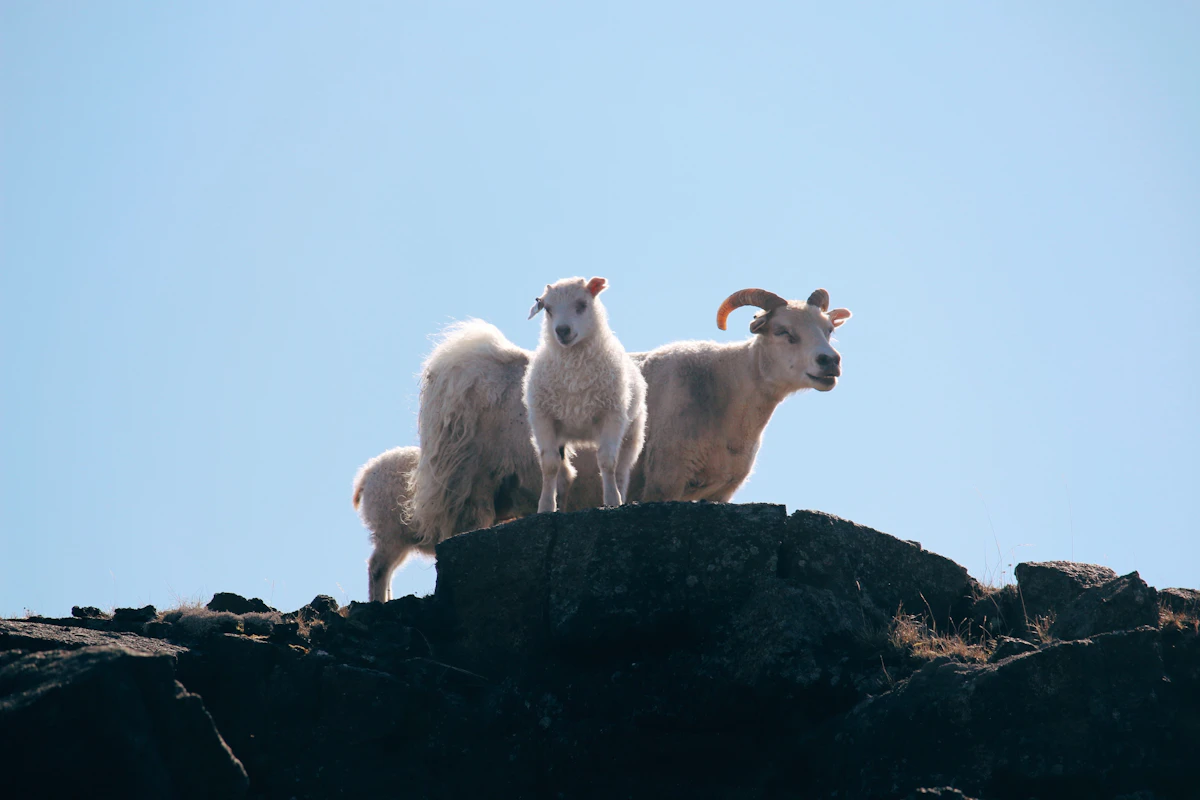
Alaska does not use preference points or bonus points for Dall sheep drawing permits. Drawing permits are awarded through a: Random Lottery That means an applicant who has been unsuccessful for 15 years doesn't receive additional point-based priority over a first-time applicant. For applicable drawing hunts, Alaska currently allows hunters to submit: Up to six applications per species across individual and party applications combined, subject to hunt-specific restrictions. Hunters can generally apply for: Multiple different Dall sheep drawing hunts or: The same hunt more than once provided they stay within the six-application limit and follow the current hunt-specific rules. For nonresidents, another rule is critical: A nonresident hunting Dall sheep must be accompanied by an Alaska-licensed guide or a qualifying Alaska resident relative within second degree of kindred. Some nonresident drawing hunts also require a guide-client contract when applying. For 2027 planning, research: Hunt Number + Residency + Permits Available + Historical Applications + Hunt Restrictions + Guide Requirements rather than looking for a nonexistent preference-point threshold.
Alaska Dall Sheep Draw Odds 2027: Permits & Strategy

Related

New Mexico Elk Draw Odds 2027: Units & Strategy

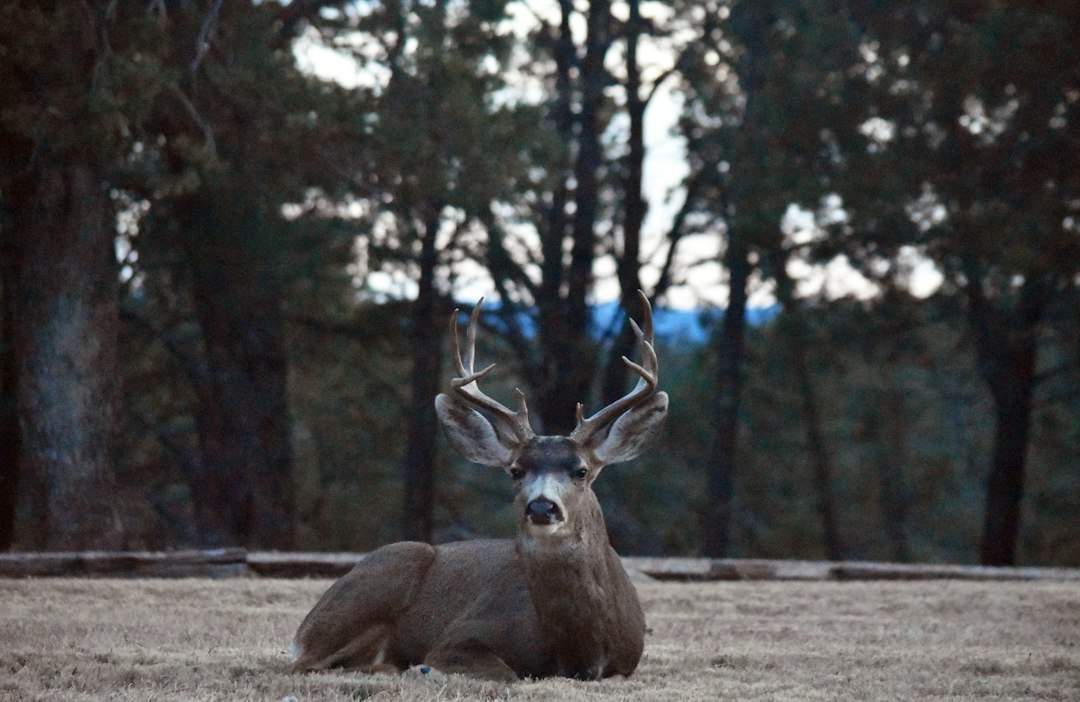
New Mexico is one of the most important Western states for hunters to understand because: New Mexico does not use preference points or bonus points for its public elk draw. You don't need to build points for years before having a chance at an elk tag. Instead, eligible applications are randomly assigned sequence numbers. When an application is processed, New Mexico attempts to award the applicant's: First Choice → Second Choice → Third Choice based on available licenses and the applicable quota pool. Under current law, New Mexico's draw attempts to allocate at least: 84% — New Mexico Residents 10% — Residents or Nonresidents Applying With a Registered New Mexico Outfitter 6% — Nonresidents Applying Without a Registered Outfitter That makes residency and outfitter status critical to understanding historical odds. For 2027 planning, research: Hunt Code + Residency/Draw Pool + Weapon + Season + Applicants + Licenses rather than simply searching for the "best New Mexico elk unit."
New Mexico Elk Draw Odds 2027: Units & Strategy

Next

California Guided Elk Hunts 2027: Tags, Draw & Costs

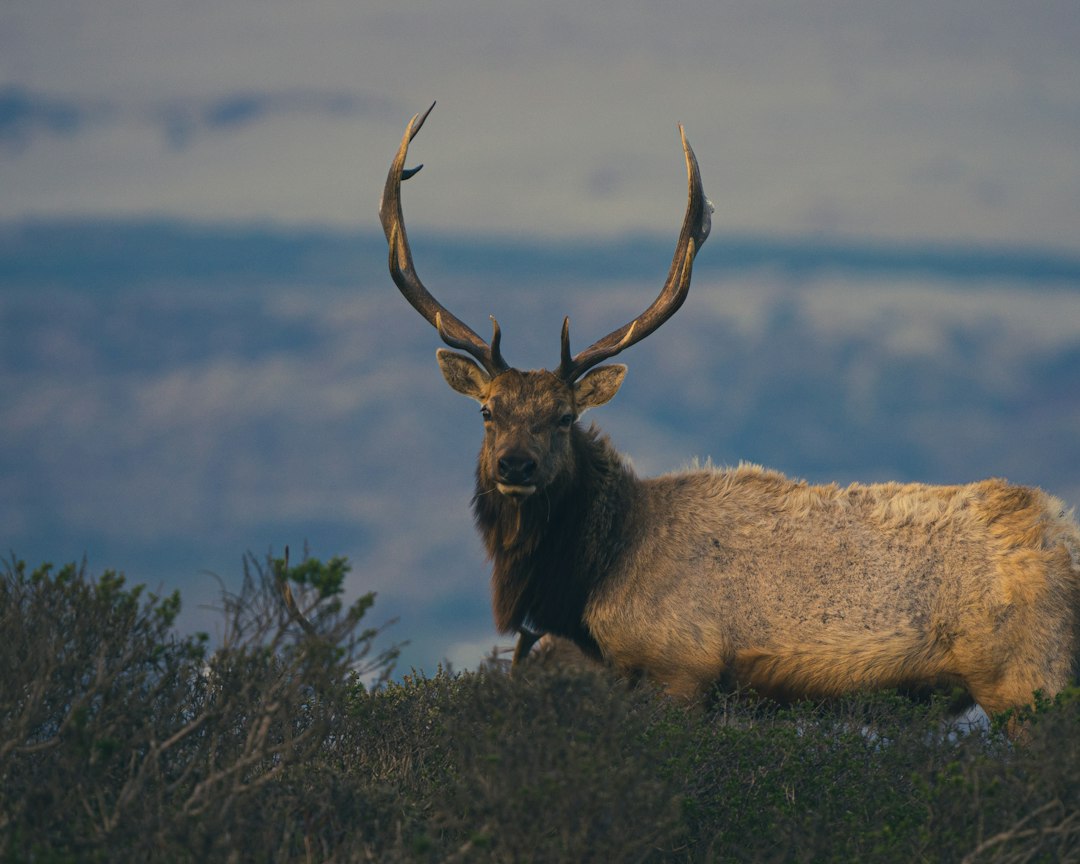
California offers guided hunting opportunities for Tule elk, Roosevelt elk and Rocky Mountain elk, but hunters need to understand the tag pathway before booking an outfitter. California does not have a broad general over-the-counter elk season. Depending on the hunt, your elk opportunity may come through: California's Big Game Drawing A Private Lands Management (PLM) property A SHARE Access Permit Another authorized special elk opportunity These pathways work differently. For the standard Big Game Drawing, California uses a modified preference-point system, and a guide doesn't automatically improve your drawing probability. For private-land opportunities, especially PLM properties, the tag structure can be substantially different. Before sending an outfitter a deposit, ask: "Exactly how will I legally obtain the elk tag for this hunt?" That should be the starting point for every California guided elk hunt. California Guided Elk Hunting in 2027
California Guided Elk Hunts 2027: Tags, Draw & Costs