Idaho's 2025 Harvest Numbers Are In: Here's What They Mean for Fall 2026
ElkMule DeerIdaho
3 min read·Apr 13, 2026
Idaho's 2025 Harvest Numbers Are In: Here's What They Mean for Fall 2026

Idaho Fish and Game just published their annual hunter harvest report, and the headline is clear: elk and mule deer harvests climbed for the second straight year, recovering from the 2023 low that followed a brutal winter. But harvest totals only tell part of the story. The real question is how these trends stack up against the environmental conditions shaping up for the 2026 season.

Elk Numbers Look Strong, But Elevation Will Matter

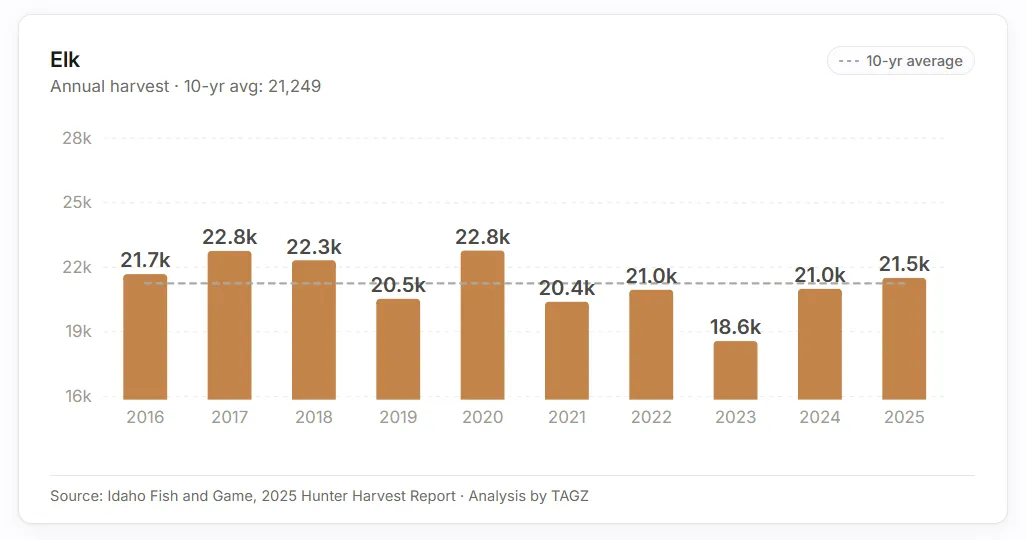
Hunters took 21,505 elk in 2025, up 2.4% from 2024 and nearly identical to the 10-year average. Success rates held steady at 23%, and six-point bull harvest reached a five-year high. All signals point to stable, healthy elk populations.

But context matters. The sharp drop in 2023 harvests wasn’t due to fewer elk, it was about access. That year’s dry summer drove elk higher, out of reach for most hunters. Fast-forward to 2026: Idaho just had its warmest winter on record, and April snowpack is near historic lows. If the summer turns hot and dry again, expect elk to push above 9,000 feet, leaving general-season hunters glassing empty timber at lower elevations.

On paper, your favorite unit’s draw odds might look great. But it pays to dig into terrain data: elevation bands, reliable water, and north-facing slopes will determine where elk actually hold during a drought year.
Mule Deer Rebound Is Real, But Recovery Is Fragile

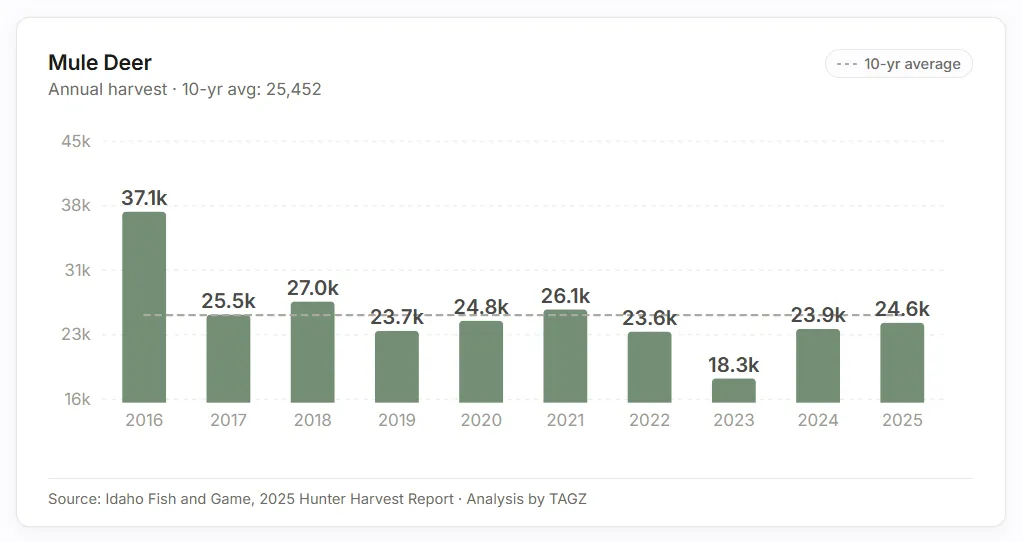
Mule deer harvest rose to 24,589, a 2.8% increase over 2024, with a 32% success rate. About 2,500 more hunters hit the field than last year. IDF&G reports more mature bucks showing up and four-point harvest numbers on the rise since the 2022–2023 nadir.

Still, the recovery is on a knife’s edge. More hunters during a rebound phase means more pressure on rebuilding herds. If drought conditions hurt fawn survival this summer, expect the state to tighten quotas or add restrictions in 2027. Keep an eye on Unit 73A’s archery/muzzleloader experiment, if it delivers strong buck numbers, similar management strategies could expand elsewhere.

One statistical note: the massive 2016 harvest (37,070) skews the 10-year average higher. Remove that outlier, and 2025’s harvest lands right on pace with a more realistic trendline.
White-Tailed Deer: EHD’s Impact and the 2026 Outlook

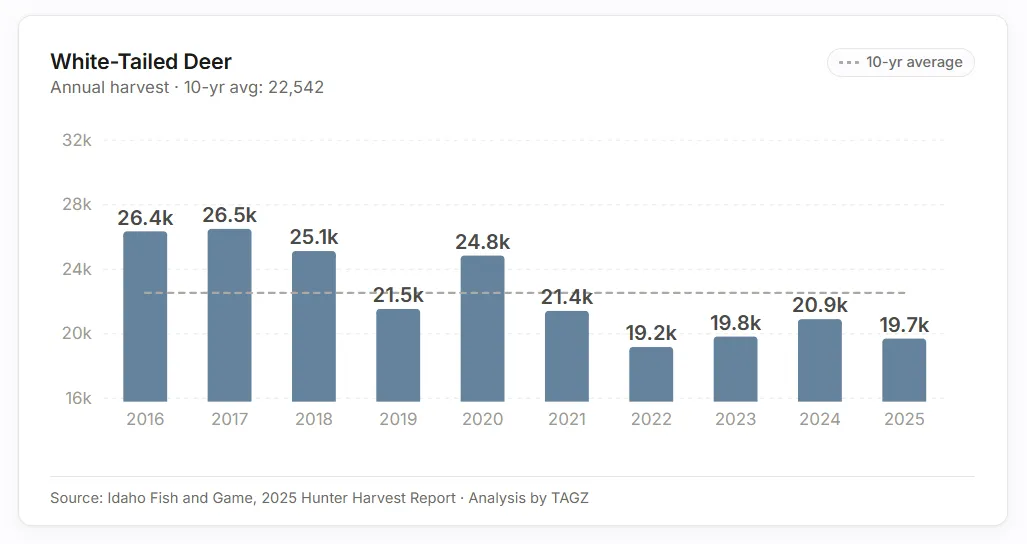
White-tailed deer harvest slipped to 19,702, down from 20,908 in 2024. IDF&G anticipated this drop after an EHD outbreak hammered the Clearwater and Panhandle regions in late July, similar to the 2021 event. The good news: populations were robust going in, so statewide harvests held steady and buck maturity remains solid (five-point bucks still over 20% of harvest).

The risk for 2026? EHD flares up in hot, dry summers with stagnant water — exactly what the forecast suggests. Back-to-back outbreak years are rare but possible. If you’re eyeing a whitetail hunt in Clearwater or the Panhandle, keep tabs on local conditions right through August.
CWD: The Slow-Moving Wildcard

CWD didn’t make headlines in the harvest report, but it’s creeping into the picture. Idaho expanded mandatory testing to seven GMUs in 2025, and detections now top 100 since 2021. While prevalence is still low, the geographic spread is growing. If detection rates climb, hunters could see reduced tags, shorter seasons, or new carcass transport rules. It’s a developing risk that’s worth tracking.
Draw odds
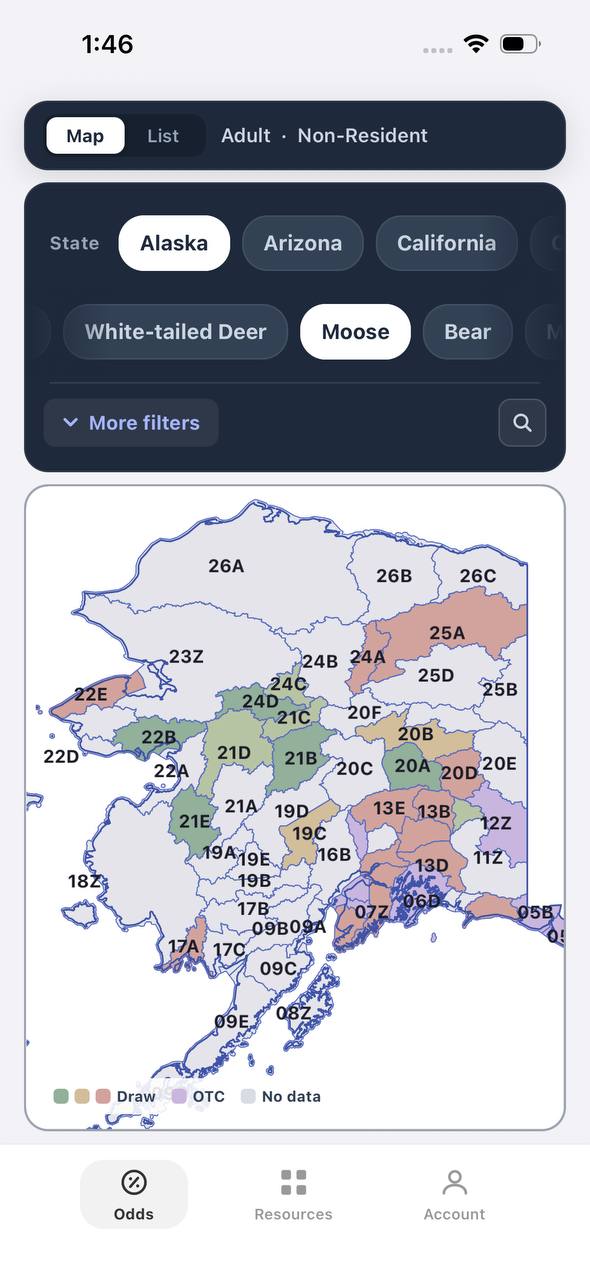
Alaska moose draw odds by unit, colored by draw, OTC, or no data
AdultNonresident

Alaska · Moose

Draw, OTC, and no-data units across the whole state.

Adult, Nonresident, Moose, no additional filters. Every unit is colored by its best matching draw odds; if nothing draws, it shows OTC; if neither, no data.

  • Alaska mixes draw and OTC moose hunts within the same region.
  • Green units are worth an application; purple units are OTC.
  • Filters stay applied when a unit is opened for hunt detail.
Draw odds
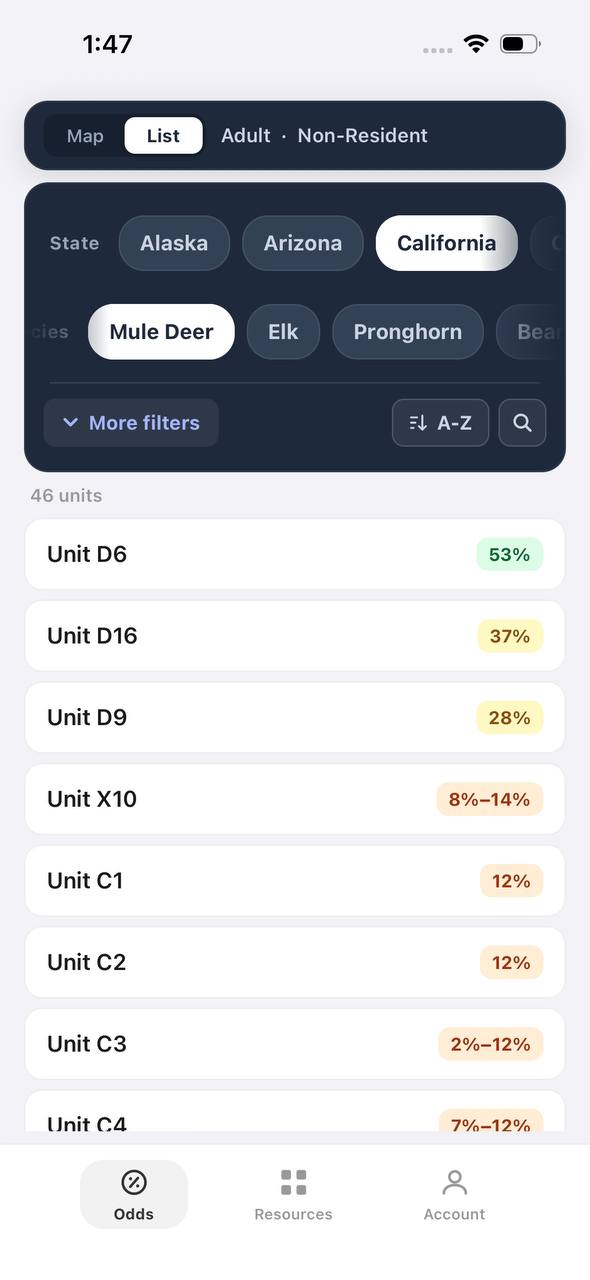
California mule deer draw odds ranked by unit in a list
AdultNonresident

California · Mule deer

Nonresident odds ranked unit by unit.

Adult, Nonresident, Mule deer, no weapon or season chip, so every matching hunt in a zone is combined into one badge and sorted by best projected odds.

  • D6 leads the list; a range like 8%–14% means more than one hunt code exists in that zone.
  • The list and the map read the same filtered hunt set.
  • 46 units are shown for this species and state alone.

Free to join

Download mobile app

  • Detailed draw odds
  • Point tracking
  • Deadline reminders
  • 19 states covered
Download on the App StoreGet it on Google Play
Unit detail
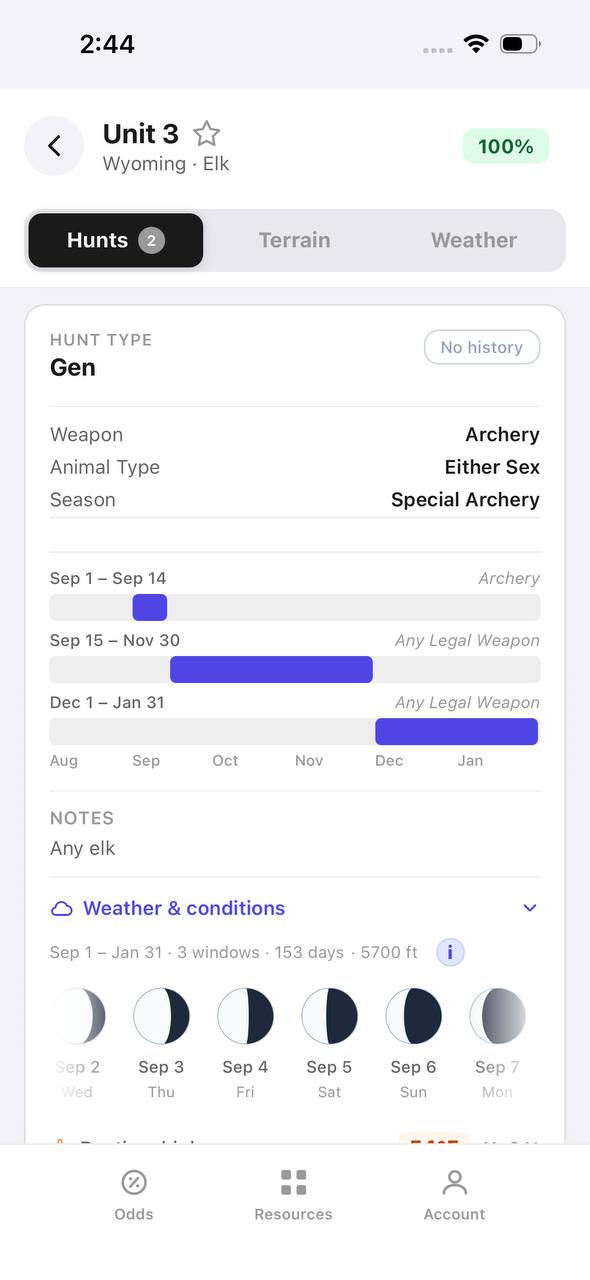
Wyoming elk unit detail, hunts tab, showing hunt windows on a timeline

Wyoming · Elk, Unit 3

Every hunt window inside one unit, laid out on a timeline.

Unit 3 has two hunt codes for elk. Each one shows its weapon, animal type, and season as a bar on a shared Aug–Jan timeline, plus a day-by-day moon phase strip.

  • Archery, then a long Any Legal Weapon window, then a late season — three opportunities in one unit.
  • The 100% badge at top means no real draw competition for the selected filters right now.
  • Weather & conditions expands below the hunt list without leaving the unit.
Terrain data
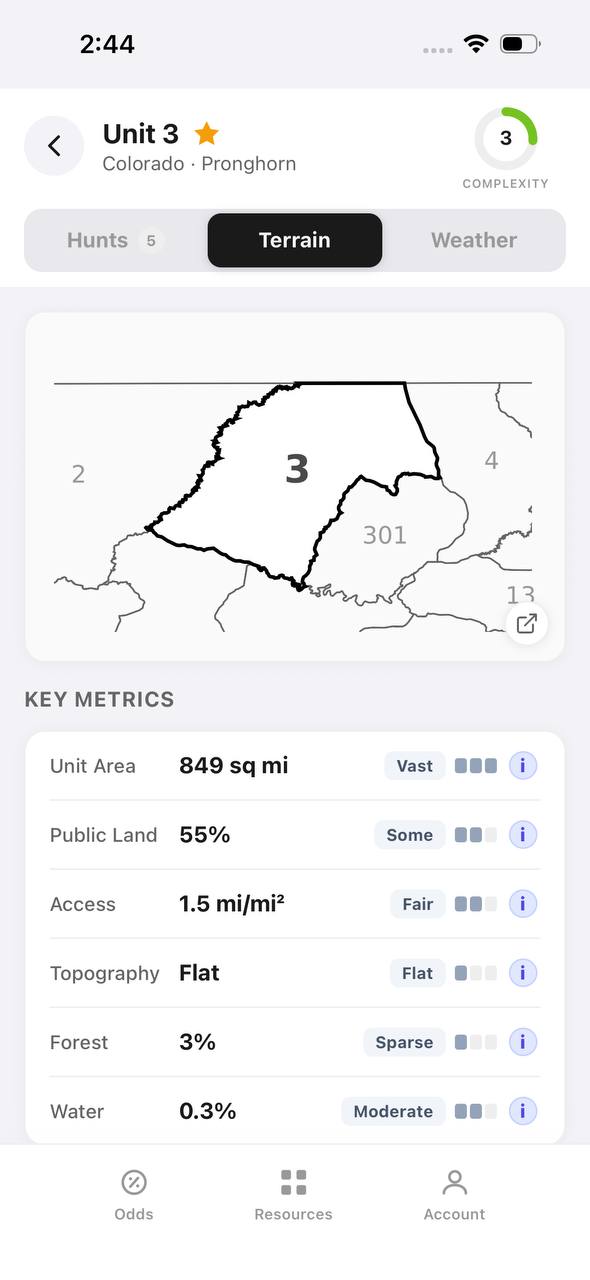
Colorado pronghorn unit detail, terrain tab, showing unit outline and key metrics

Colorado · Pronghorn, Unit 3

Unit boundaries and a complexity score at a glance.

The Terrain tab draws the unit outline against its neighbors and scores it for complexity, then breaks out area, public land, access, topography, forest, and water.

  • 849 sq mi, 55% public land, and flat topography make this a fairly approachable unit.
  • Each metric carries a short rating word — Vast, Some, Fair, Flat, Sparse, Moderate — with a tooltip.
  • The outline map shows adjacent units 2, 4, 13, and 301 for context.
State profiles
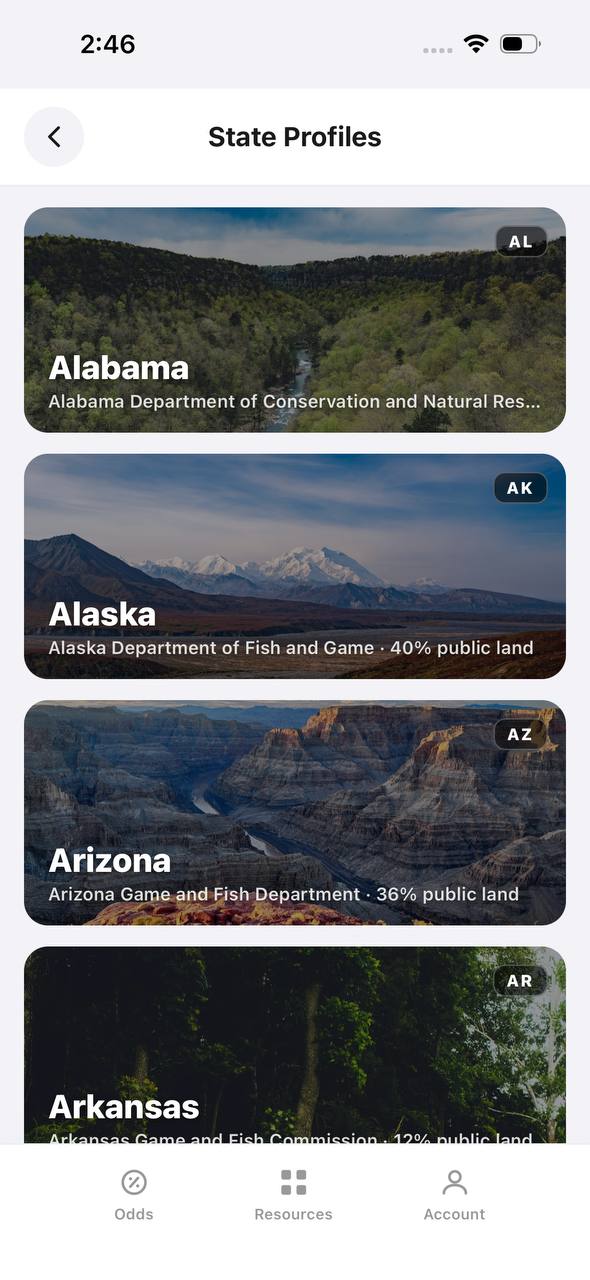
State Profiles screen listing states with wildlife agency and public land percentage

State Profiles

Each state's wildlife agency and public land share, at a glance.

State Profiles lists every covered state as a photo card naming its wildlife agency and, where available, its public land percentage.

  • Public land percentage shows right in the list, before opening the state.
  • Each card names the exact agency the regulations come from.
  • States without a public land figure yet, like Alabama here, are still listed.
Points wallet
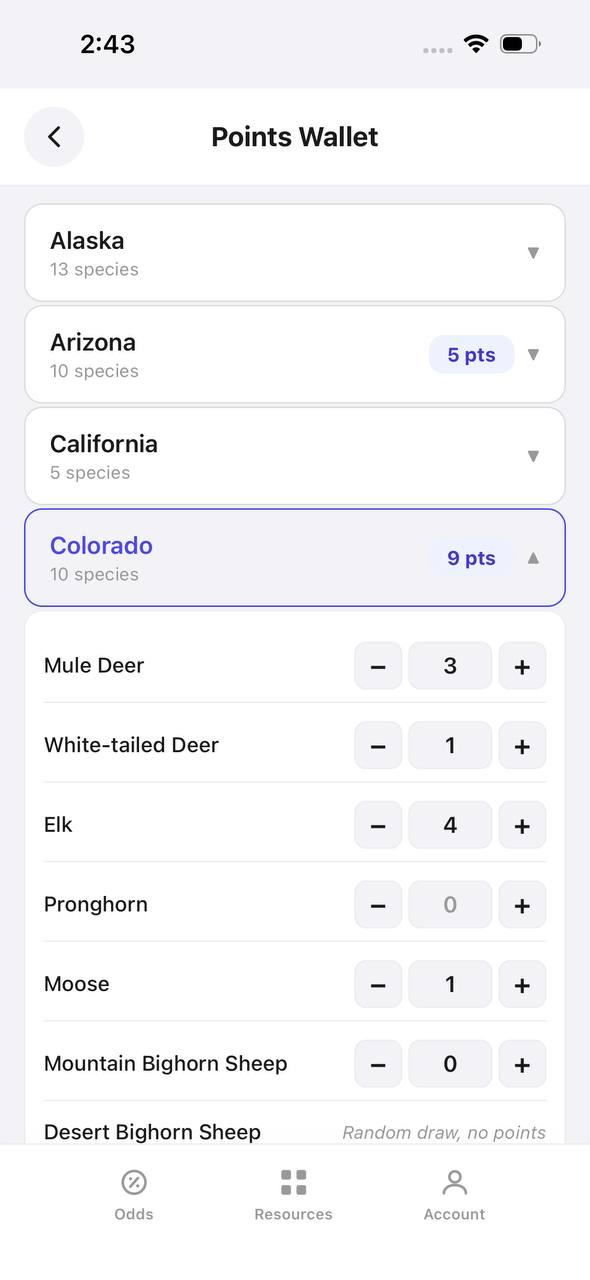
Points Wallet screen with Colorado expanded, showing a point stepper per species

Points Wallet · Colorado

Every state and species point balance in one wallet.

Points Wallet lists each state with a species count; expanding a state, like Colorado here, shows a stepper for every species so a balance can be entered or adjusted directly.

  • Colorado alone tracks points across 10 species independently.
  • Species with no points, like Pronghorn here, still show a zero to stay visible.
  • Desert Bighorn Sheep is flagged as a random draw with no points system.

Free to join

Download mobile app

  • Detailed draw odds
  • Point tracking
  • Deadline reminders
  • 19 states covered
Download on the App StoreGet it on Google Play
Draw odds
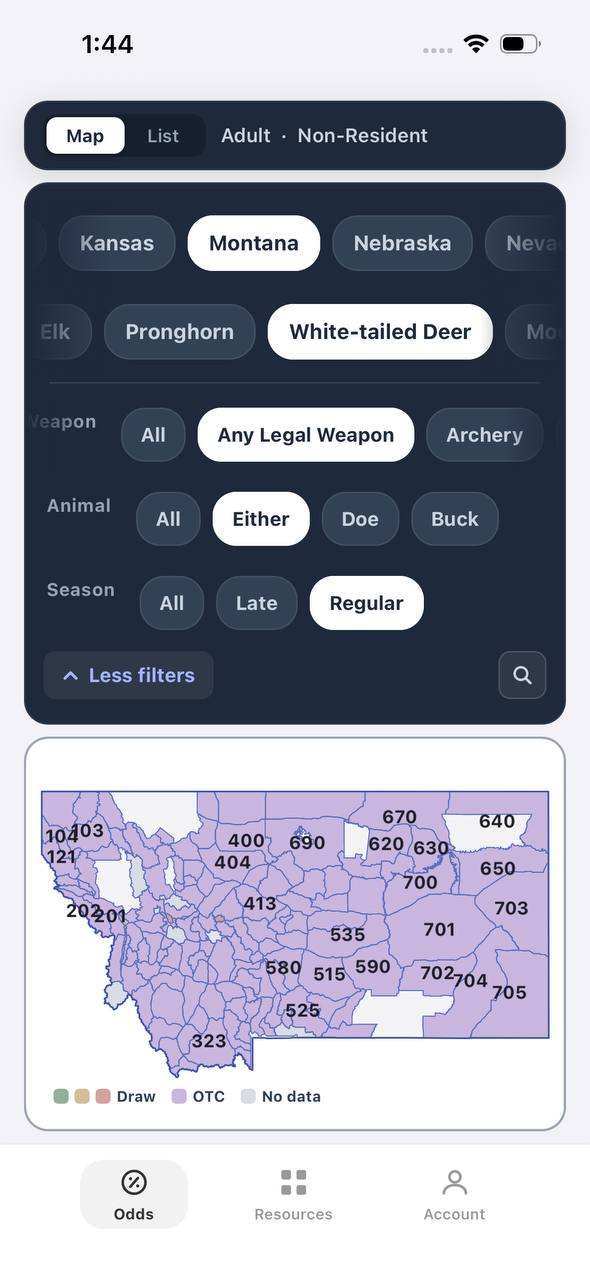
Montana white-tailed deer draw odds filtered to any legal weapon, either sex, regular season
AdultNonresidentAny Legal WeaponEitherRegular

Montana · White-tailed deer

Nearly the whole state is OTC for this filter combination.

Adult, Nonresident, White-tailed deer, filtered to Any Legal Weapon, Either, Regular. Under this combination almost every unit turns purple — over the counter.

  • Switching weapon, sex, or season changes the picture completely.
  • Purple means the tag can be bought directly, no draw.
  • This is the tag-and-go read of Montana whitetail, not the point-based one.
Terrain data
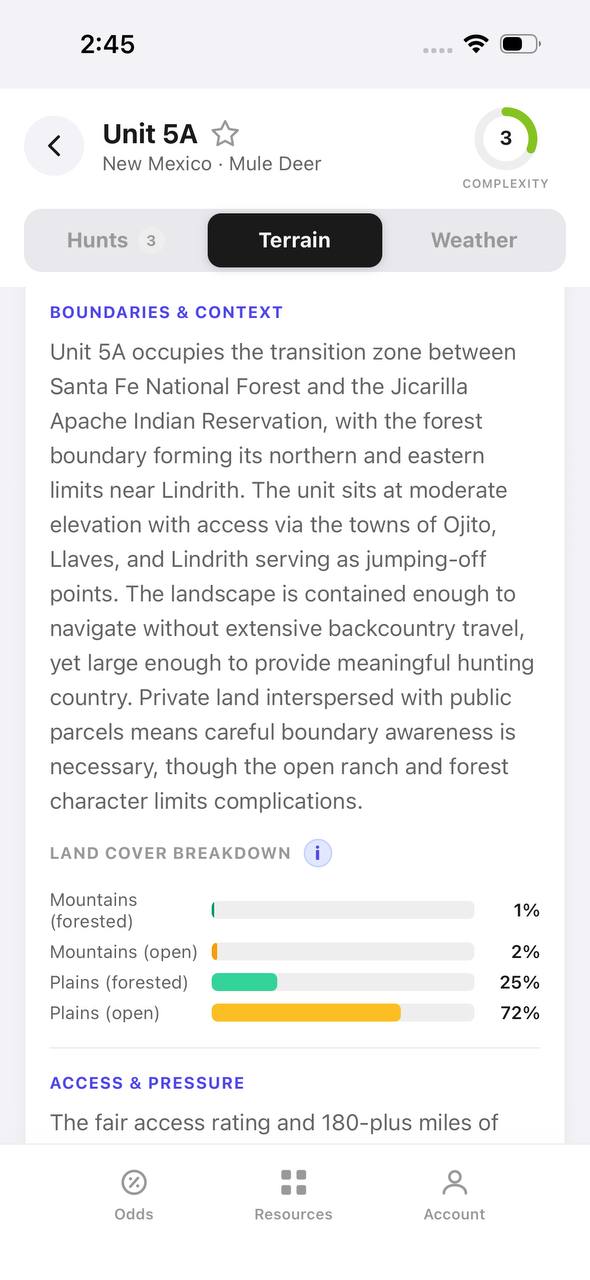
New Mexico mule deer unit 5A terrain tab with boundary description and land cover breakdown

New Mexico · Mule deer, Unit 5A

A written boundary description, not just a shape.

Unit 5A's terrain tab opens with a plain-language paragraph about surrounding land, access towns, and ownership mix, then a land cover breakdown by percentage.

  • 72% open plains and 25% forested plains describe the terrain at a glance.
  • The boundary text calls out the exact reservation and forest lines that define the unit.
  • Access & pressure continues below the fold with mileage detail.
Draw odds
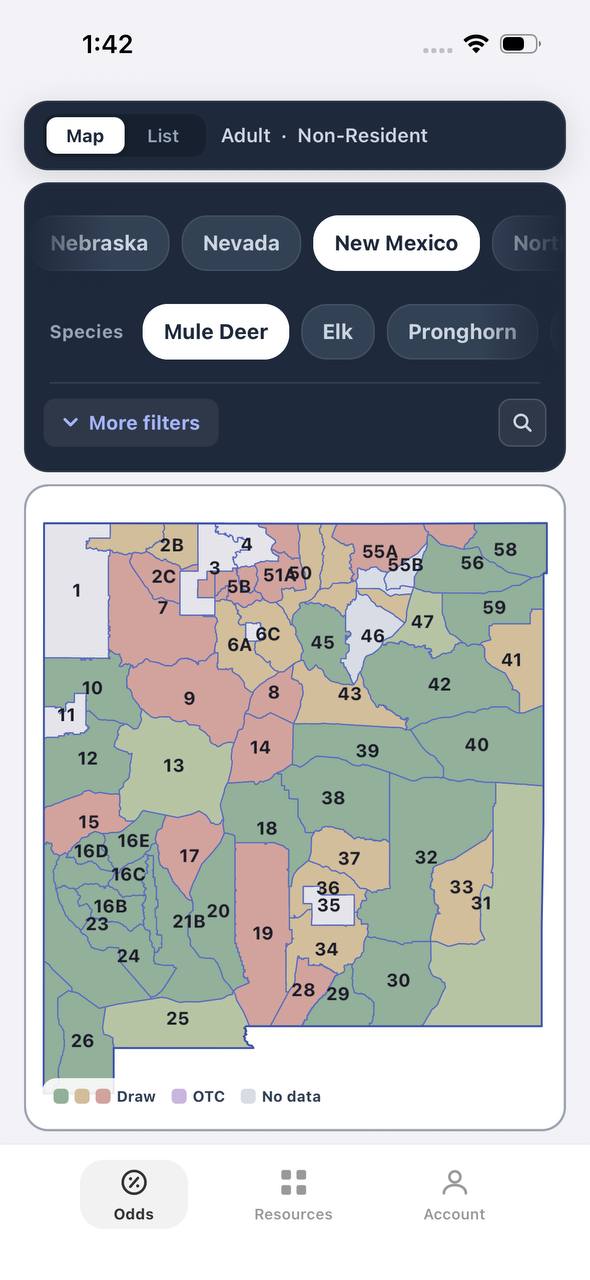
New Mexico mule deer draw odds by unit
AdultNonresident

New Mexico · Mule deer

Mule deer draw odds for every unit in the state.

Adult, Nonresident, Mule deer, all weapons and seasons. Each unit is colored by the same odds calculation used in the dashboard.

  • Green and tan together separate units worth applying to from units that are not.
  • Numbered units follow New Mexico's own game management unit boundaries.
  • Opening a unit shows the exact hunt behind the color.
Favorites
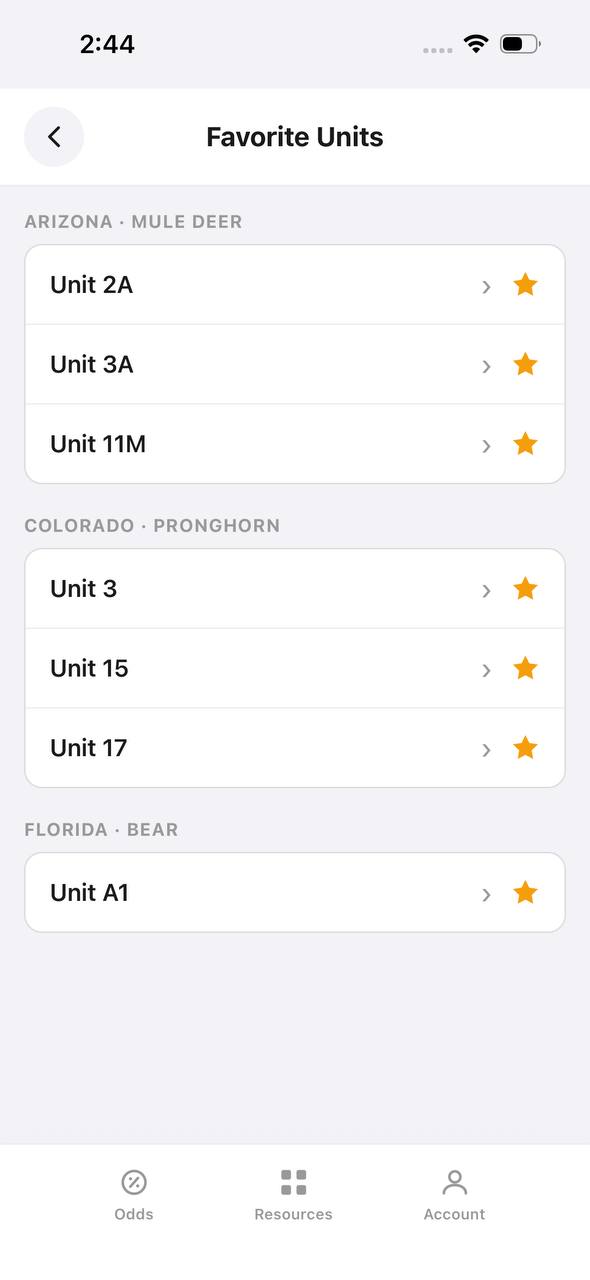
Favorite Units screen grouped by state and species

Favorite Units

Starred units from any state, grouped by species.

Favorite Units collects every starred unit across states and species into one list, grouped by state and species pair, so a saved unit is one tap away.

  • Arizona mule deer and Colorado pronghorn favorites sit side by side here.
  • Each row opens straight into that unit's detail view.
  • Unstarring from this screen removes it from the group instantly.
Deadlines
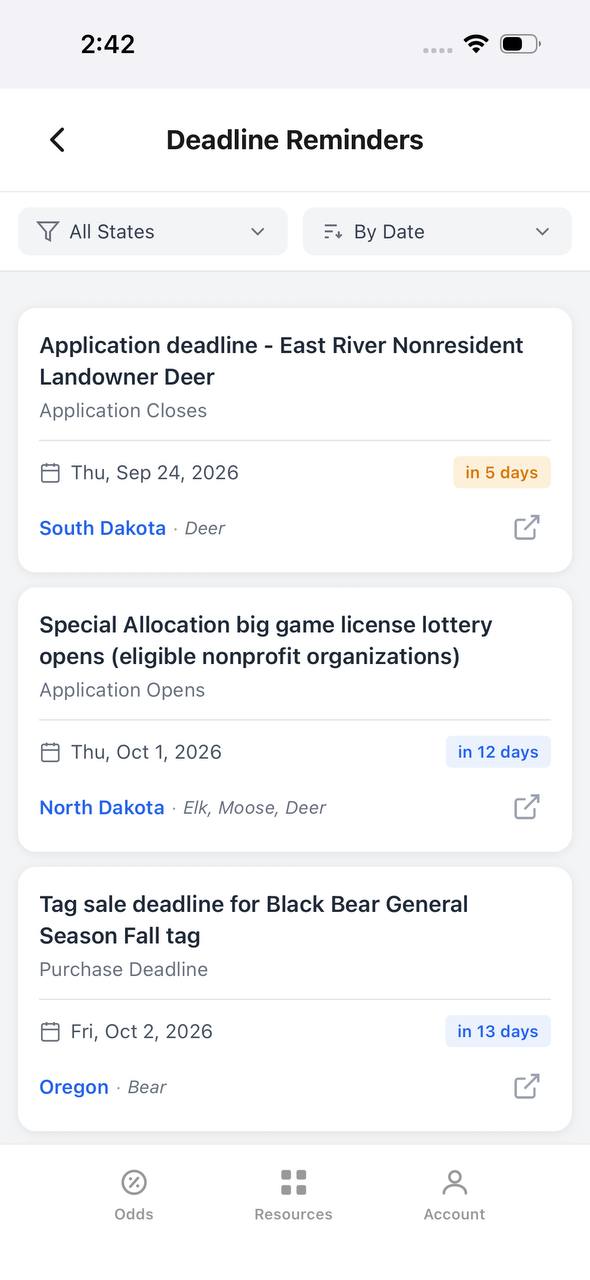
Deadline Reminders screen listing application and purchase deadlines by date

Deadline Reminders

Every application and purchase deadline, sorted by date.

Deadline Reminders filters by state and sorts by date, showing the deadline type, a countdown, and the state and species it applies to, with a link out to the source.

  • Countdown badges shift as a deadline gets close — "in 5 days" here, for example.
  • Application opens and closes are tracked as separate reminder types.
  • Each card links out to confirm the rule at the source.
Interactive map
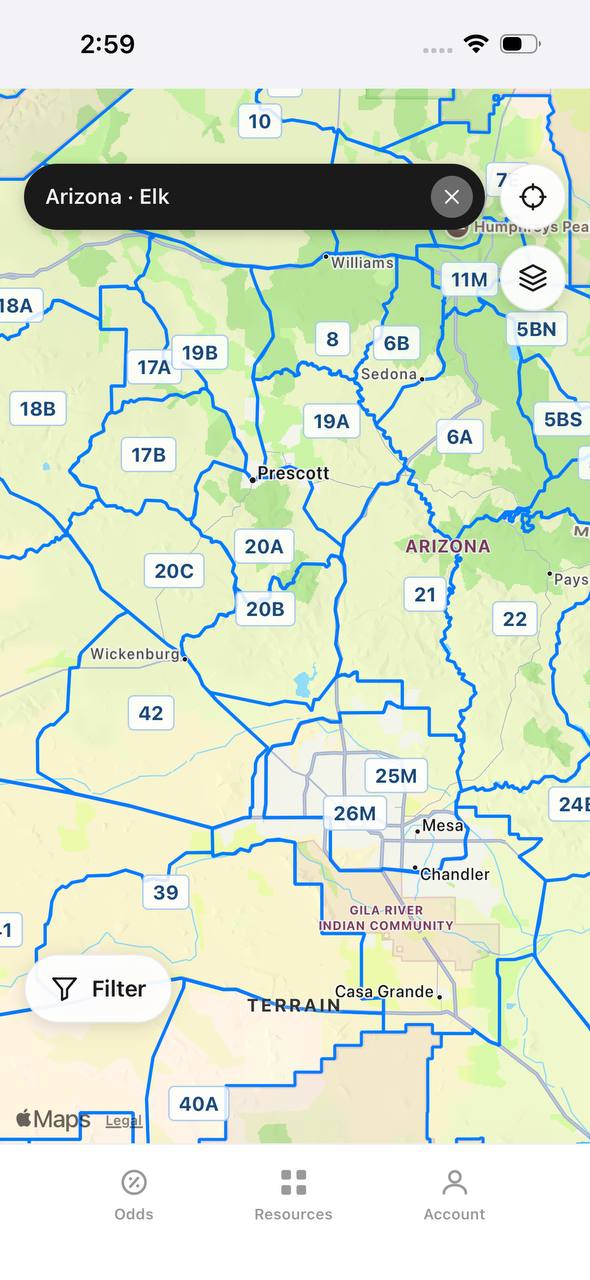
Arizona elk unit boundaries overlaid on an interactive street map

Arizona · Elk

Unit boundaries laid directly over a real map.

This view overlays Arizona elk unit boundaries and labels on top of a street map, with a search bar pinned to state and species and a layer toggle in the corner.

  • Real towns like Prescott and Sedona sit inside their unit boundaries for context.
  • A location button and layer switch float over the map, clear of the unit labels.
  • A Filter button at the bottom opens the same filters used elsewhere in the app.

Free to join

Download mobile app

  • Detailed draw odds
  • Point tracking
  • Deadline reminders
  • 19 states covered
Download on the App StoreGet it on Google Play
Insights
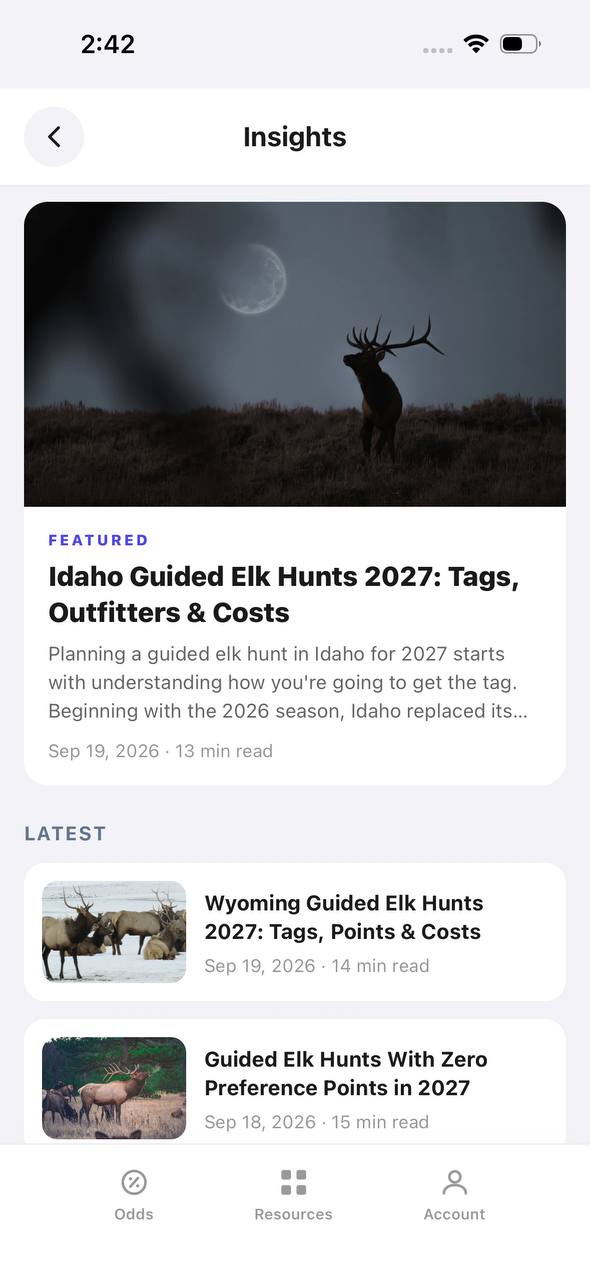
Insights screen with a featured article and a latest articles list

Insights

Hunting articles, built into the app itself.

Insights opens to a featured article with a hero image, then a Latest list of recent posts, each with a thumbnail, read time, and publish date.

  • The featured slot rotates to the newest deep-dive article.
  • Read time and publish date show on every card, not just the featured one.
  • This mirrors the blog content already published on the marketing site.
Download on the App StoreGet it on Google Play

Plan for the Year Ahead

The 2025 harvest data is reassuring: elk are stable, mule deer are climbing, and whitetails weathered EHD. But remember, harvest stats reflect where herds were — not where they’ll be if drought persists. For 2026, plan smarter: scout for water sources, study elevation and north-facing aspects, and monitor real-time conditions. Don’t count on last year’s honey hole if the landscape dries up and the animals move.


Source: Idaho Fish and Game Hunter Harvest Report, April 2026. All harvest figures, success rates, and wildlife management commentary are drawn from IDF&G's published data. Charts built by TAGZ using IDF&G data. Analysis and forward-looking commentary are our own.