Colorado Big Game Draw 2027: Application Deadlines, Preference Points & Strategy
Colorado's 2027 big game draw opens April 1 and runs through early April, with separate application windows for different species. Whether you're chasing your first Colorado elk tag or building points for a premium mule deer unit, understanding the draw system, point mechanics, and allocation rules will determine whether you hunt this fall or wait another year. Colorado Parks and Wildlife operates one of the West's largest and most accessible draw systems, but success requires knowing when to apply, how points affect your odds, and which species offer the best opportunities for your point total.
2027 Application Deadlines and Fees
Colorado's draw system divides big game species into separate application periods. For 2027, deer, elk, and pronghorn applications open April 1 and close at 8 PM Mountain Time on April 8. Bear applications follow the same April 1–8 window. Moose, mountain goat, and bighorn sheep operate on a longer timeline, with applications due by the first week of April but often with extended deadlines published in late winter.
Application fees for 2027 remain consistent with recent years. Residents pay $3 per species to apply, while nonresidents pay $10 per species for deer and elk, $9 for pronghorn, and $10 for bear. Preference point fees are separate: $10 per species for residents, $75 per species for nonresidents. If you draw a tag, you'll pay the license fee at that time. Resident elk licenses range from $49 to $359 depending on season and weapon type. Nonresident elk licenses start at $674 for cow tags and run up to $759 for bull tags. Mule deer and whitetail resident licenses cost $49 to $359, while nonresident deer licenses cost $419 to $474.
You can apply for up to four hunt codes per species as your first through fourth choices. If you don't draw any of your four choices, you can purchase a leftover tag later in the year if one becomes available for your preferred hunt code.
How Colorado Preference Points Work
Colorado uses a weighted preference point system, not a true bonus point system. Each preference point you hold gives you one additional entry in the draw. An applicant with zero points has one entry. An applicant with five points has six entries. More points mean better odds, but they don't guarantee anything—you're still in a random draw alongside everyone else, just with more tickets in the hat.
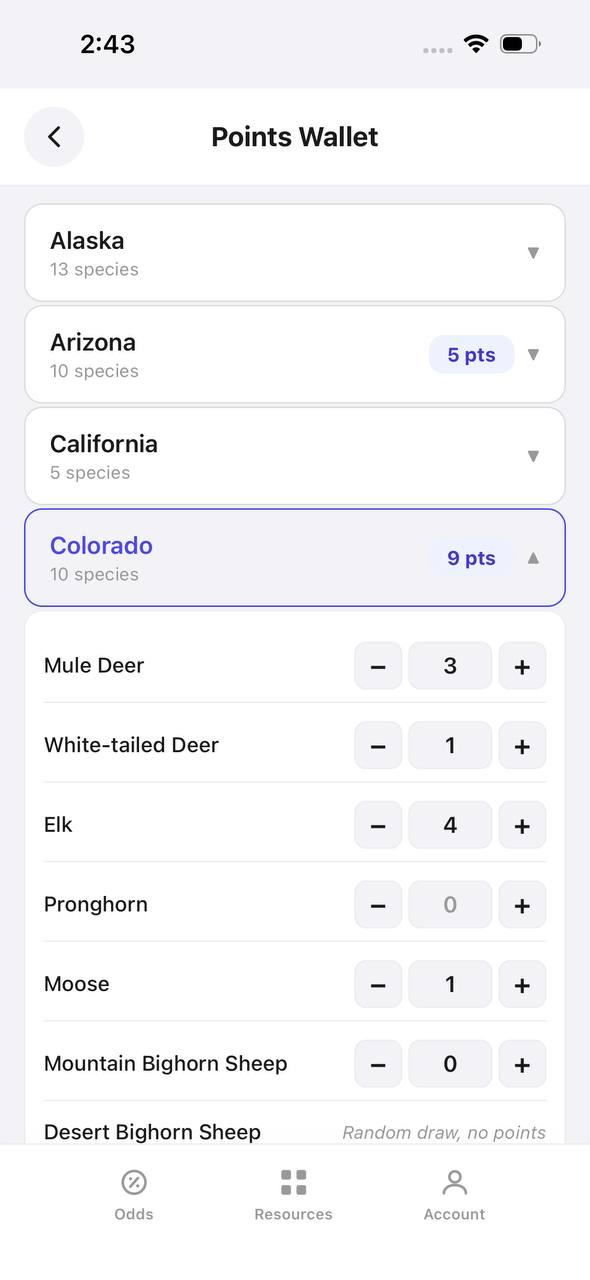
You earn one preference point per species per year if you apply and don't draw, or if you purchase a point without applying. Points are species-specific. Elk points don't help you draw deer, and deer points don't help you draw pronghorn. Points accumulate indefinitely until you draw a tag, at which point your points for that species reset to zero.
Colorado reserves tags for different point pools. For most limited deer and elk hunts, 80% of nonresident tags go to applicants with the most preference points in descending order (the preference point pool), while 20% of nonresident tags are drawn purely at random from all applicants regardless of points (the random pool). Resident allocations work similarly, with a 75%/25% split in some cases or 80%/20% in others depending on the species and hunt code. This random pool creates opportunity for first-time applicants—you can draw a premium tag with zero points if you get lucky in the 20% random draw.
Pronghorn uses a different structure. The first 80% of resident and nonresident pronghorn tags are allocated to the top point holders. The remaining 20% go through a weighted random draw where points still matter but aren't the sole factor. Bear allocations follow deer and elk rules with an 80/20 split between preference and random.
Resident vs. Nonresident Allocation
Colorado is one of the West's most generous states for nonresident opportunity, but residents still receive priority. For deer and elk, residents receive at least 65% of limited licenses, with up to 35% going to nonresidents. Some high-demand units have tighter nonresident caps, while others allocate closer to the 35% maximum.
Pronghorn allocations are stricter. Nonresidents receive no more than 20% of pronghorn licenses statewide, and some units allocate as little as 10% to nonresidents. Bear follows the deer and elk model with up to 35% nonresident allocation. Moose, bighorn sheep, and mountain goat are extremely limited, with most tags going to residents and only a handful available to nonresidents each year.
Resident point creep is slower than nonresident point creep because of these allocation differences. Nonresidents applying for premium units often need more years to accumulate competitive point totals, while residents can draw the same units with fewer points. If you're a nonresident targeting a unit that requires seven resident points, expect to need nine or ten nonresident points to match those odds.
What's New for 2027
As of early 2025, Colorado Parks and Wildlife has not published final 2027 regulation changes. However, recent trends and ongoing management priorities suggest a few areas to watch. Chronic wasting disease continues to drive season structure and harvest goals in parts of the state, particularly in mule deer units along the Front Range and in southwest Colorado. Some units may see expanded late seasons or additional either-sex opportunities to address CWD management goals.
Elk populations remain strong across much of the state, and Colorado continues to offer one of the nation's largest elk harvests. OTC elk units in the state saw minor boundary adjustments in 2026, and further fine-tuning may occur for 2027 depending on herd objectives and hunter distribution. Public-land crowding in popular OTC units pushes some hunters toward the draw system, increasing competition for limited-entry elk tags even as overall elk numbers remain healthy.
Pronghorn populations in eastern Colorado have stabilized after drought impacts in recent years, but some units continue to see quota adjustments based on fawn recruitment and habitat conditions. Expect similar tag numbers in 2027 compared to 2026 unless late-winter surveys show significant herd changes.
Colorado's preference point system itself remains stable. There have been discussions at the Parks and Wildlife Commission level about restructuring point systems or adjusting resident/nonresident allocations, but no major changes have been implemented. The current weighted point system and 80/20 preference/random split are expected to continue for 2027.
Free to join
Download mobile app
- Detailed draw odds
- Point tracking
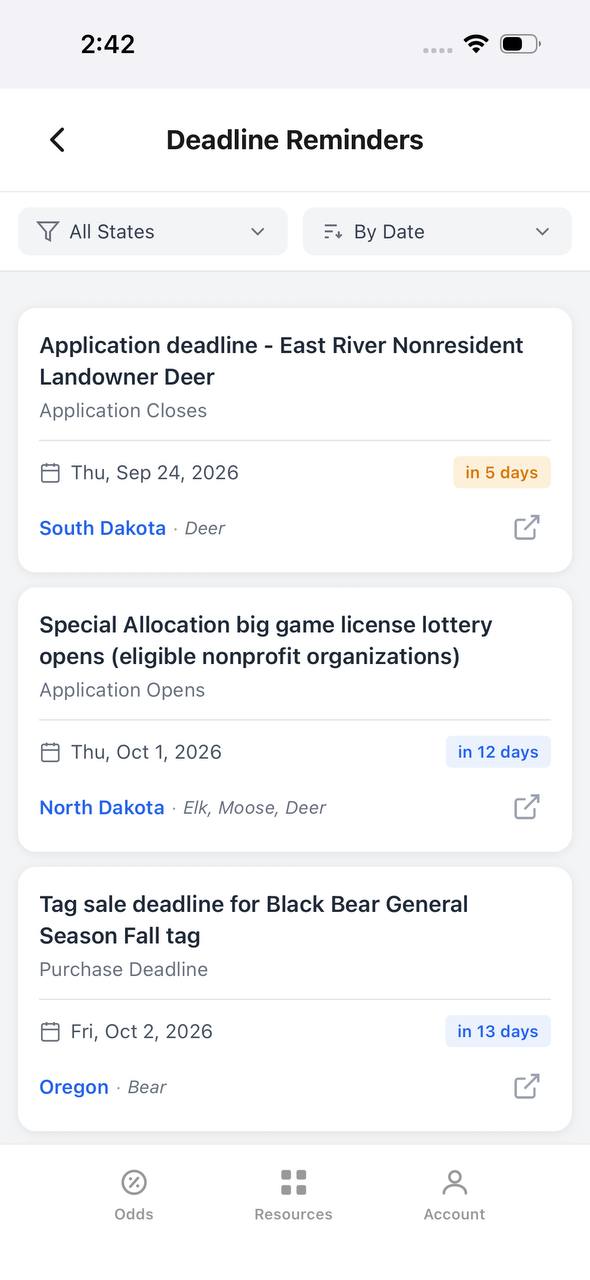
- Deadline reminders
- 19 states covered

Free to join
Download mobile app
- Detailed draw odds
- Point tracking
- Deadline reminders
- 19 states covered
Free to join
Download mobile app
- Detailed draw odds
- Point tracking
- Deadline reminders
- 19 states covered
Unit Selection Strategy by Species
Elk
Elk applicants face a choice between chasing premium limited-entry tags or hunting OTC units. Limited-entry rifle tags in units like 2, 10, and 201 offer the state's best trophy potential but require double-digit point totals for nonresidents and significant point investments for residents. Mid-tier units such as 61, 62, and 82 offer strong elk populations, better draw odds, and quality public-land hunting for applicants with three to seven points.
First-choice applicants should research reissue and leftover statistics. Some units draw out every year in the initial draw but return leftover tags because tag holders don't purchase their licenses. Units with consistent leftover availability may not be worth burning points on—you can often buy the tag in August without applying.
Archery elk tags in limited units offer better draw odds than rifle tags because fewer applicants compete for them. Archery success rates are lower, but public-land access is often better during September, and elk behavior during the rut gives bowhunters distinct advantages.
Mule Deer
Colorado mule deer units range from low-point opportunity hunts to true once-in-a-lifetime trophy units. Gunnison Basin units like 55 and 551 consistently produce mature bucks and require moderate point investments—often five to eight points for residents, eight to twelve for nonresidents. High-country rifle hunts in units 61, 62, and 76 offer good buck-to-doe ratios and reasonable draw odds for applicants with three to six points.
Late-season rifle hunts during fourth season offer hunters access to migration corridors and wintering areas where bucks concentrate. These hunts can be weather-dependent, but success rates often exceed early-season hunts. Units along the Uncompahgre Plateau and in the Flat Tops see particularly strong fourth-season hunting when snow pushes deer to lower elevations.
Whitetail opportunities exist in limited pockets along the eastern plains and in riparian corridors in western Colorado. Most whitetail hunting happens on private land, but some public-land units offer archery and rifle tags with low point requirements or even as leftover tags.
Pronghorn
Colorado pronghorn hunting centers on the eastern plains and a few high-desert units in the west. Top-tier units like 97, 123, and 134 require significant point investments for rifle tags—often ten or more points for nonresidents—but produce mature bucks with heavy horn mass and good success rates. Mid-tier units such as 138, 139, and 141 draw with three to six points and still offer solid public-land access and reasonable buck quality.
Archery pronghorn hunts draw with fewer points than rifle hunts, and early-season timing puts hunters in the field during late summer when bucks are visible and approachable. Spot-and-stalk tactics work well on BLM ground, and waterhole setups become productive during dry years. Private-land trespass programs such as Walk-In Access open additional opportunity in eastern Colorado pronghorn units.
Doe and fawn tags are available in many units as leftover licenses or through late-season hunts. These hunts rarely require points and offer an excellent introduction to pronghorn hunting.
Bear
Colorado bear hunting is underrated. The state has healthy black bear populations, and most units offer tags with minimal point investment. The majority of bear hunting happens during spring seasons when bears are focused on emerging vegetation and roadside feeding. Spot-and-stalk hunting along south-facing slopes and oak-brush draws produces consistent opportunities.
Units in the Gunnison area, around Aspen, and in the San Juan Mountains hold good bear populations and offer rifle, archery, and muzzleloader options. Most rifle bear hunts draw with zero to two points. Archery bear tags are often available as leftovers. Success rates are lower than for ungulates, but public-land access is excellent, and spring weather is generally favorable.
Fall bear seasons overlap with deer and elk, making combination hunts possible. Baiting is illegal in Colorado, so spot-and-stalk remains the primary tactic. Glassing burns, oakbrush, and berry patches during morning and evening hours is the most productive approach.
Group Applications and Party Hunting
Colorado allows group applications for up to five people. All group members must agree on the same four hunt code choices and must apply during the same application period. The group draws as a unit—everyone draws or no one draws. If the group draws, every member receives the same hunt code and season.
Group draw odds are based on the group member with the fewest preference points. If you have eight points and apply with a friend who has two points, your group will draw with two-point odds, not eight-point odds. This system discourages point-sharing but allows hunting partners to guarantee they'll hunt together when they finally draw.
Some applicants use group applications strategically by pairing a high-point applicant with a first-time applicant to maximize random-draw opportunities. Because 20% of tags go into the random pool, a zero-point group has the same chance as any other group in that pool. This strategy works best for hard-to-draw units where even high-point applicants face uncertain odds in the preference pool.
Group applications don't affect point accumulation. If your group doesn't draw, every member earns a preference point just as if they had applied individually.
Free to join
Download mobile app
- Detailed draw odds
- Point tracking
- Deadline reminders
- 19 states covered
Free to join
Download mobile app
- Detailed draw odds
- Point tracking
- Deadline reminders
- 19 states covered
Free to join
Download mobile app
- Detailed draw odds
- Point tracking
- Deadline reminders
- 19 states covered
Leftover Licenses and Reissue Lists
Colorado offers two opportunities to obtain tags after the initial draw. Leftover licenses become available in early August for any hunt codes that didn't fill during the draw. Reissue tags become available when tag holders return their licenses before the season. Both leftover and reissue tags are sold first-come, first-served with no preference given to point holders.
Leftover lists are published on the Colorado Parks and Wildlife website in early August, typically around the first or second week. Tags sell quickly for desirable units, especially elk and mule deer hunts. Checking the list at the moment it goes live gives you the best chance at prime units. Some units appear on the leftover list every year, indicating either low demand or poor hunting conditions.
Reissue lists update frequently—sometimes daily—as tag holders return licenses. Reissue tags can include units that never appear on the leftover list, creating unexpected opportunities. Hunters who monitor reissue lists carefully sometimes obtain tags for units that normally require several preference points.
Leftover and reissue strategies work particularly well for archery hunters and for applicants willing to hunt less-popular units or seasons. Fourth rifle deer, first rifle elk, and late pronghorn seasons often have leftover availability.
Building Points vs. Hunting Now
Deciding whether to burn points or keep building is one of the toughest decisions Colorado applicants face. Point creep—the annual increase in points required to draw competitive units—affects nearly every species. A unit that required six points five years ago may now require eight or nine. Waiting to build more points doesn't guarantee you'll eventually draw if point creep outpaces your point accumulation.
For nonresidents paying $75 per point per species annually, the cost of waiting adds up quickly. Ten years of elk point purchases costs $750 per species even if you never hunt. At some threshold, the cost of continuing to build points exceeds the value of hunting a slightly better unit.
A balanced strategy is to apply for a hunt code you'd be happy to draw while also considering the random pool. Applying for a unit that requires more points than you currently hold still gives you a chance in the 20% random draw, and if you don't draw, you gain a point for the following year. This approach keeps you hunting while building points for future premium tags.
Some applicants adopt a rotation strategy, burning points on a Colorado hunt one year and building points in other states during off years. This approach spreads costs across multiple states and prevents point totals from stagnating in any single state.
How to Apply for the 2027 Colorado Draw
Applications are submitted online through the Colorado Parks and Wildlife website. You'll need a CPW customer ID, which you can create during the application process if you don't already have one. Residents must provide proof of residency, typically a Colorado driver's license or state ID.
After logging in, select the species you want to apply for and enter up to four hunt codes in order of preference. The system shows you real-time point totals for each hunt code based on the previous year's draw, helping you evaluate your odds. You can apply for multiple species during the same application period by selecting each species separately and paying the associated application fees.
If you only want to purchase a preference point without applying for a tag, select the point-only option. Point-only purchases are cheaper than applying for a hunt code and guarantee you won't draw a tag, ensuring your points continue to accumulate. Hunters who aren't ready to hunt in the upcoming season but want to keep building points use this option.
After submitting your application, you'll receive a confirmation email. Draw results are typically published in late May or early June, depending on the species. You can check your draw status online by logging into your CPW account. If you draw, you'll have a limited window to purchase your license before it's forfeited and moved to the reissue list.
Free to join
Download mobile app
- Detailed draw odds
- Point tracking
- Deadline reminders
- 19 states covered
Free to join
Download mobile app
- Detailed draw odds
- Point tracking
- Deadline reminders
- 19 states covered
Free to join
Download mobile app
- Detailed draw odds
- Point tracking
- Deadline reminders
- 19 states covered
Draw Odds and Point Creep Research
Colorado Parks and Wildlife publishes detailed draw statistics for every hunt code, including the number of applicants, the number of tags issued, the point level of the last successful applicant, and the percentage of tags that went to the preference pool versus the random pool. These statistics are available on the CPW website as PDF downloads, typically organized by species and hunt code.
Analyzing draw odds requires understanding whether the statistics reflect resident or nonresident data. Resident and nonresident odds differ significantly because of allocation rules. A hunt code that shows three points as the minimum for residents may require six or seven points for nonresidents.
Point creep tracking shows how many points are required to draw a specific unit over time. If a unit required four points three years ago, five points two years ago, and six points last year, point creep is increasing by roughly one point per year. If you currently have four points, you'll likely need to wait at least three more years to draw, and possibly longer if creep accelerates.
Platforms like TAGZ analyze historical draw data and calculate odds projections based on your current point total and species preference. These tools save hours of manual research and help you identify units where you have realistic draw odds versus units where you're several years away from competitive point totals.
Internal Links to TAGZ Insights
For deeper strategies on specific Colorado species, check out our guides on Colorado OTC elk tactics and mule deer unit selection in Colorado. If you're comparing Western draw systems, our Wyoming vs. Colorado draw comparison breaks down which state offers better opportunities for your point level. For nonresidents managing limited budgets, our nonresident point-buying strategy guide explains when to invest in points and when to hunt instead. Finally, if leftover tags interest you, read our Colorado leftover license tactics to learn how to snag hard-to-draw tags after the initial draw.
FAQ — Colorado Big Game Draw 2027
When does the Colorado 2027 big game draw application period open?
Applications for deer, elk, pronghorn, and bear open April 1, 2027, and close at 8 PM Mountain Time on April 8, 2027. Moose, mountain goat, and bighorn sheep applications are also due in early April, with specific deadlines published by Colorado Parks and Wildlife in late winter.
How many preference points do I need to draw a Colorado elk tag?
It depends on the unit and whether you're a resident or nonresident. Premium rifle units require ten or more nonresident points, while mid-tier units draw with three to seven points. Some limited-entry archery and late-season rifle tags draw with zero to two points. The 20% random pool also allows zero-point applicants to draw any unit if they get lucky.
Can I apply for both deer and elk in the same year?
Yes. Colorado allows you to apply for multiple species during the same application period. You'll pay separate application fees for each species, but there's no restriction on applying for deer, elk, pronghorn, and bear all in the same year.
What happens to my preference points if I draw a tag?
Your preference points for that species reset to zero after you draw a tag. Points are species-specific, so drawing an elk tag won't affect your mule deer or pronghorn points. If you don't draw, you earn one additional preference point for the next year.
Do nonresidents have a realistic chance of drawing premium Colorado units?
Yes, but it takes time. Nonresidents can draw any unit if they accumulate enough points or get lucky in the 20% random pool. Point creep is slower for residents, so nonresidents generally need two to four more points than residents to draw the same unit. Building points over several years while hunting other states or OTC units is a common strategy.
Are leftover tags worth considering, or should I always apply in the draw?
Leftover tags offer excellent value if you're flexible on unit selection and season timing. Some units appear on the leftover list every year, meaning you can hunt them without burning points. Applying in the draw gives you more unit options and better odds at high-demand hunts, but leftover tags let you hunt immediately without waiting for draw results.
Was this article helpful?
Previous
Montana Nonresident Elk Draw Odds 2027: What Hunters Need to Know
Montana's nonresident elk draw operates through two systems: the Big Game Combination License lottery for general hunting access, and separate limited-entry permits for specific districts. Understanding both improves your odds of hunting elk in Montana.
Related
Arizona Nonresident Mule Deer Draw Odds 2027: What Out-of-State Hunters Need to Know
Arizona's bonus point system gives nonresidents realistic odds in quality mule deer units, but strategy matters. Here's how to navigate the 2027 draw and pick units that match your point total.
Next
Montana Preference Points Explained: How the Bonus Point System Works in 2027
Montana uses bonus points, not preference points, for most species. Understanding the weighted random draw system is essential for nonresident combination license and permit applications.