Species You Can Hunt
- Mule Deer
- Elk
- Pronghorn
- Moose
- California Bighorn Sheep
- Mountain Bighorn Sheep
- Desert Bighorn Sheep
- Mountain Goat
- Bear
- Mountain Lion
State Overview
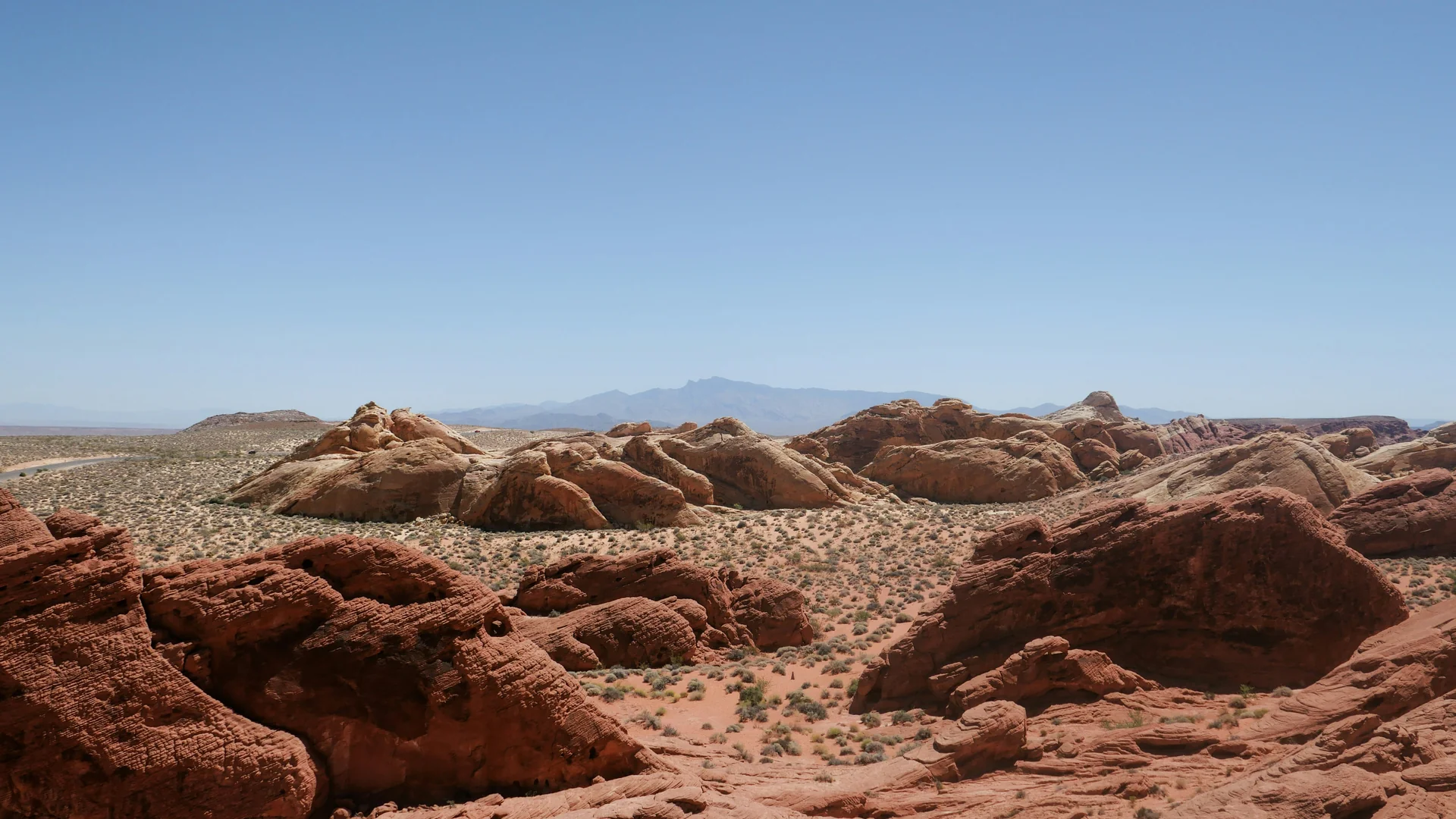
Nevada is classic Basin and Range: broad sagebrush valleys separated by isolated, rugged mountain ranges, arid and remote, with the great majority of the state managed as public BLM land.
Though tag numbers are low, quality is high—mule deer, elk, pronghorn, mountain goat, and especially desert, California, and Rocky Mountain bighorn sheep, which make Nevada a sheep hunter's mecca. Tags are awarded through a bonus-point draw, and drawing a premium hunt can take many years.
Licensing & Draw
How it works
Nevada runs its big-game tags through a random, computerized draw operated by the Nevada Department of Wildlife (NDOW). Unlike states with a preference-point queue, Nevada uses a bonus point system: your accumulated points give you more chances in the lottery, but never a guaranteed tag.
Most big-game species — deer, elk, pronghorn (antelope), bighorn sheep, mountain goat, moose, and black bear — are tag-draw only. Mountain lion is the exception and is sold over the counter year-round. Both residents and nonresidents can apply, though nonresident tag numbers are capped, so competition for nonresident tags is especially tight.
You must hold a valid Nevada hunting license to apply in the draw and to earn bonus points. A point is awarded when you hold a license and apply but come up empty in the draw for that species category.
Bonus points are tracked by species category (for example, antlered deer, antlerless deer, antlered elk), and you can only earn one point per category per year. Points reset to zero when you draw a tag in that category — or if you fail to apply for two consecutive years. If you want to build points without hunting a given year, you can buy a point through a point-only application (with a hunting license and a nonrefundable fee).
Applying & deadlines
Applications are submitted online through NDOW's draw system. On a single application you rank your hunt choices in order of preference — typically up to five choices — and the draw evaluates them from your first choice down.
Party applications are allowed: a group can apply together, and the party's bonus points are averaged (total points divided by the number of hunters, rounded to the nearest whole number) so the group is treated as a single unit in the draw.
For the 2026 season, the big-game application deadline was May 7 at 11:00 PM PST, with draw results released on or before May 23. Nevada's main big-game draw is a spring event with results in late May.
Dates shift slightly year to year, so always confirm the current deadlines and results date in the current Nevada Big Game Digest before you apply.
Draw mechanics
Here's the plain-English version of Nevada's bonus points: the system takes your point total, squares it, and adds one to decide how many random numbers you get. Zero points = one random number; ten points = 101 random numbers (10 squared, plus one). Every applicant's lowest random number becomes their draw number, and tags go to the lowest numbers first.
More points means more chances at a low number, which meaningfully improves your odds — but because it's still a lottery, even maximum-point applicants sometimes miss. Points increase probability; they never guarantee a tag. TAGZ calculates draw odds separately using historical NDOW data; that methodology is covered in its own section.
Fees at a glance
Licenses (2025 schedule): a resident adult hunting license runs about $38, and a resident combination hunting/fishing license about $75. Nonresidents generally buy the combination license at roughly $155. A small processing fee is added at purchase.
Tag fees are charged separately when you draw. Resident tag examples: deer about $30, antelope about $60, elk about $120. Nonresident tags cost considerably more — deer about $240, and premium species like bighorn sheep, elk, and mountain goat around $1,200 for nonresidents. These are approximate; see the current fee schedule for exact amounts.
How TAGZ Projects Odds in Nevada
Nevada's draw uses a bonus point system where your number of entries equals your bonus points squared plus one. Our projections are built on four years of official NDOW draw data (2022-2025), weighted to favor recent seasons: 2025 at 50%, 2024 at 25%, 2023 at 15%, and 2022 at 10%.
When we detect a steady decline in draw odds over three or more consecutive years, we project that trend forward rather than blending it with older, more favorable numbers. This gives a more realistic picture for hunts that are becoming increasingly competitive.
Nevada's official draw reports only list point levels where applicants actually existed, which leaves gaps across the full point range. We fill those gaps by extending known values to neighboring levels and estimating between data points, producing a smooth odds curve from zero points up to the highest observed level.
Nevada's draw results tend to be sharp: roughly 55% of hunt-point combinations historically show 0% odds and about 20% show 100%, reflecting the high-demand nature of many Nevada hunts. Projections cover ten species including elk, mule deer, pronghorn, moose, black bear, mountain goat, and three bighorn sheep subspecies.
Good to Know
Nonresident tags are limited by quota, so drawing a nonresident tag — especially for sheep, goat, or moose — can be very difficult even with many points. Bonus points are also not earned for depredation or management hunts, and they can't be transferred between people or species categories.
Applying costs money beyond the tag itself: expect a per-application game-tag charge and a processing fee on every application, and a small predator/wildlife management fee may apply at license purchase. Application fees are nonrefundable. And the key reminder — no number of bonus points guarantees a tag in Nevada's random draw. Check the fee schedule and digest for specifics.
Free to join
Access the full draw odds database for Nevada
View up to date season schedule and projected odds across all units.
Regulations
Hunting Regulation Brochures for Nevada
Official season brochures published by the state wildlife agency.

All Game Units
129 units — Unit details, topography, landcover, and access are open to everyone. Draw odds projections are available with a TAGZ account.