Species You Can Hunt
- White-tailed Deer
- Columbian Black-tailed Deer
- Mule Deer
- Elk
- Moose
- Mountain Bighorn Sheep
- Mountain Goat
- Bear
- Grizzly Bear
- Bison
- Caribou
- Wolf
- Muskox
State Overview
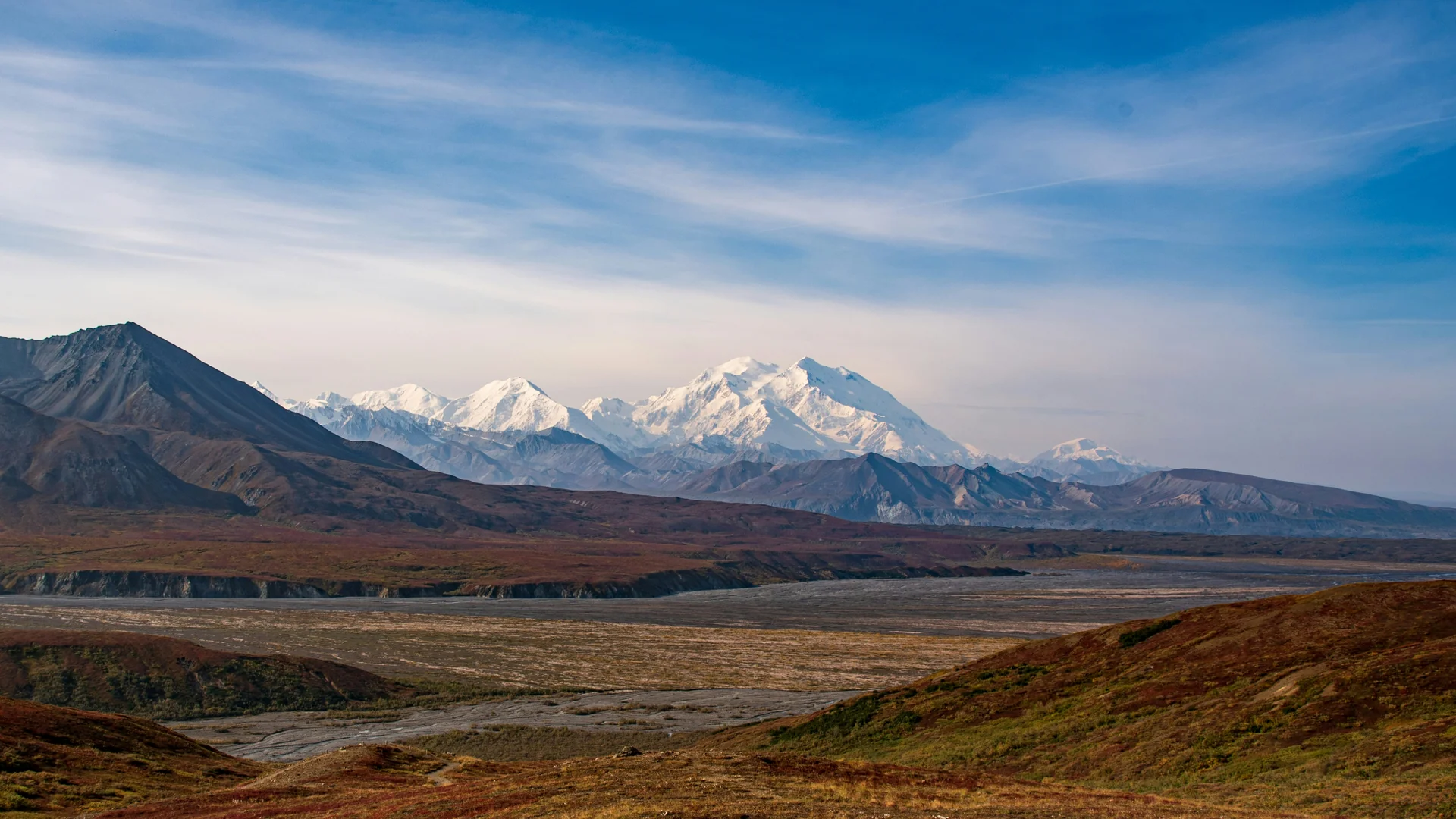
Alaska is immense and wild, ranging from the temperate rainforests and island archipelagos of the southeast panhandle to the Interior's boreal forest, the glaciated Alaska Range, and the Arctic tundra and Brooks Range in the far north. Public land is vast, but much of it is roadless and reached only by bush plane or boat.
Its big game lineup is unmatched—moose, several caribou herds, Dall sheep, mountain goat, brown/grizzly and black bear, Sitka black-tailed deer, muskox, and bison. Opportunity is world-class but often remote and logistically demanding; residents enjoy broad general-season access while nonresidents face guide requirements for species like sheep, goat, and brown bear.
Licensing & Draw
How it works
Alaska is run by the Alaska Department of Fish & Game (ADF&G) and works very differently from most Lower-48 states. A large share of hunting happens under general-season and registration hunts rather than a draw. General-season hunts (marked "HT" in the regulations) are the least restrictive and use free harvest tickets; registration hunts generally don't cap permits. Limited-entry opportunities run through Drawing permit hunts, plus subsistence-focused Tier I, Tier II, Community Subsistence Harvest, and Targeted hunts.
Resident vs. nonresident status matters at every step. Seasons are labeled open to residents (R), nonresidents (N), or both (B), and when game is scarce nonresidents are restricted or eliminated first. Many species also carry extra nonresident requirements, such as guide rules and higher fees (covered below).
A valid Alaska hunting license is the foundation. Residents 18-59 must hold one; residents 17 and under don't need a license, and residents 60+ can get a free permanent identification card. Nonresidents of any age need the appropriate license. Before applying for a Drawing permit you must already have (or have applied for) a hunting license, unless you're an Alaska resident under 18.
Big game "locking-tags" are numbered metal tags that lock onto the animal at the kill site and are separate from harvest tickets. Residents aren't required to have a locking-tag for most species (brown/grizzly bear in some areas and nonsubsistence muskox are exceptions). Nonresidents must buy the appropriate locking-tag for each big game species before hunting.
Importantly, Alaska does NOT use a preference-point or bonus-point system. Drawing permits are a pure random lottery every year, so applying more years in a row does not raise your odds.
Applying & deadlines
Drawing permit applications are submitted online at hunt.alaska.gov. Each hunt has a unique hunt number, and you apply using the numbers listed in the current Drawing Permit Hunt Supplement.
You may submit up to six applications per species (individual or party combined), no matter how many separate orders you place. You can apply for the same hunt multiple times or spread choices across hunts, as long as you don't exceed six per species; exceeding the limit rejects all of that species' applications. A few hunts have special limits (for example, certain Koyukuk Controlled Use Area moose and Kodiak brown bear hunts restrict guided nonresidents to one application). Party applications are allowed and count toward the six-per-species limit. No one may receive more than one Drawing permit per species per regulatory year.
For the 2026-2027 cycle, the online Drawing application period ran November 1 through December 15, 2025 (5 p.m. AKST), and results are announced on the third Friday of February. These windows are broadly consistent year to year, but always confirm against the current supplement/brochure for exact dates before you apply.
Note that some Alaska hunts span two calendar years (fall 2026 into spring 2027); winners may need a separate license and locking-tag for each calendar year they hunt.
Draw mechanics
Drawing permit hunts cap the number of hunters. Applicants pay a nonrefundable application fee, and permits are awarded by random lottery, with no points or seniority involved. The number of permits listed can be adjusted up or down based on the latest population surveys. TAGZ calculates and displays draw odds separately using ADF&G applicant and permit data; this overview intentionally doesn't reproduce odds math.
Fees at a glance
An annual resident hunting license is about $45; the nonresident all-game license is about $160 (nonresident-alien roughly $630). Drawing applications carry a small nonrefundable fee, the same for residents and nonresidents: about $5 per species for most species, and around $10 for bison and muskox.
Locking-tags are where nonresident costs climb. Residents pay nothing for most (brown/grizzly bear is about $25 where required), while nonresident locking-tags run much higher, for example roughly $800 for moose, $850 for Dall sheep, $1,000 for brown/grizzly bear, and up to about $2,200 for muskox. These are ballpark figures, see the current ADF&G fee schedule for exact amounts.
Good to Know
Guide requirements catch many visitors by surprise: a nonresident hunting brown/grizzly bear, Dall sheep, or mountain goat must be accompanied in the field by an Alaska-licensed guide or an eligible Alaska resident relative (19+, within second degree of kindred) who stays within 100 yards. Nonresident aliens must be guided for any big game.
The metal locking-tag must be attached at the kill site before you leave, and it can be used on a species of equal or lesser value if you hold the right harvest ticket or permit. Free harvest tickets are required for general-season caribou, deer, moose, and sheep statewide (and black bear in some units) and must be validated by notching immediately after a kill. Distinguish carefully between general/registration hunts (open, less pre-planning) and Drawing hunts (limited, apply in advance).
Free to join
Access the full draw odds database for Alaska
View up to date season schedule and projected odds across all units.
Regulations
Hunting Regulation Brochures for Alaska
Official season brochures published by the state wildlife agency.

All Game Units
73 units — Unit details, topography, landcover, and access are open to everyone. Draw odds projections are available with a TAGZ account.